Buffer Solutions (OCR A-Level Chemistry A): Revision Notes
📚Revision Notes
Buffer solutions
What is a buffer solution?
A buffer solution is a chemical system designed to resist changes in pH when small quantities of acid or base are added. These solutions are essential in many chemical and biological processes where maintaining a stable pH is critical.
Buffer solutions work through the presence of two key components working together:
- A weak acid (HA) - This component removes any added alkali
- Its conjugate base (A⁻) - This component removes any added acid
Note
These two substances act as chemical reservoirs, responding independently to neutralize added acids or bases by shifting the buffer's equilibrium system in the appropriate direction.
Important
Critical Limitation of Buffers
While buffers minimize pH changes, they don't keep pH completely constant. As acids and alkalis are added, the buffer components react and eventually become depleted. Once one component is fully consumed, the solution loses its buffering capacity and pH changes become much larger.
Preparing weak acid buffer solutions
There are two main methods for creating a buffer solution based on a weak acid and its conjugate base.
Preparation from a weak acid and its salt
This method involves mixing a solution of a weak acid (such as ethanoic acid, CH₃COOH) with a solution containing a salt of that acid (such as sodium ethanoate, CH₃COONa).
When ethanoic acid is added to water, it only partially dissociates because it's a weak acid. This means the concentration of ethanoate ions in the solution remains very small. The ethanoic acid provides the weak acid component of the buffer:
This equilibrium represents component 1 of the buffer system.
Note
Salts of weak acids are ionic compounds that completely dissociate when dissolved in water. This makes them a convenient source of the conjugate base.
When sodium ethanoate dissolves, dissociation into ions is complete, providing the conjugate base component of the buffer:
This represents component 2 of the buffer system.
Preparation by partial neutralisation of the weak acid
An alternative approach involves adding an aqueous alkali solution (such as NaOH(aq)) to an excess of the weak acid. The alkali partially neutralizes the weak acid, creating the conjugate base while leaving some unreacted weak acid in solution. The final mixture contains both the salt of the weak acid and unreacted weak acid - exactly what's needed for a buffer.
Two reservoirs working in equilibrium
Consider the ethanoic acid equilibrium system. In this equilibrium, the position lies well towards the left (the undissociated acid side). When ethanoate ions (CH₃COO⁻) are added to a solution of ethanoic acid (CH₃COOH), the equilibrium position shifts even further to the left. This further reduces the already small concentration of H⁺(aq) ions, creating a solution that contains predominantly two species: CH₃COOH and CH₃COO⁻.
Note
Independent Reservoir Action
These two substances function as independent reservoirs capable of removing added acid or alkali by shifting the buffer's equilibrium system either to the right or to the left as needed.
How buffer solutions control pH
The conjugate acid-base pair (HA and A⁻) in a buffer solution controls the pH through an equilibrium system. Understanding how this works requires applying Le Chatelier's principle to predict equilibrium shifts.
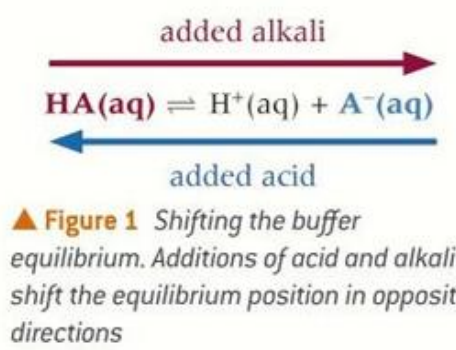
Conjugate base removes added acid
When an acid is added to the buffer, it increases the concentration of H⁺(aq) ions. Here's what happens:
- The concentration of [H⁺(aq)] initially increases
- The H⁺(aq) ions react with the conjugate base, A⁻(aq), which is present in the buffer
- This reaction causes the equilibrium position to shift to the left, removing most of the added H⁺(aq) ions
The equilibrium can be represented as:
Note
The leftward shift removes the majority of the added hydrogen ions, minimizing the pH change.
Weak acid removes added alkali
When an alkali is added to the buffer, it introduces OH⁻(aq) ions. The buffer responds through the following sequence:
- The concentration of [OH⁻(aq)] initially increases
- The small concentration of H⁺(aq) ions already present in the buffer reacts with the OH⁻(aq) ions:
- The weak acid HA then dissociates, shifting the equilibrium position to the right to restore most of the H⁺(aq) ions that were consumed
Important
Overall Buffering Mechanism
The overall effect is that the added alkali is neutralized with minimal change to the pH. The role of the weak acid (HA) and its conjugate base (A⁻) in controlling pH can be summarized as an equilibrium system that responds to oppose pH changes through Le Chatelier's principle.
Choosing buffer components and calculating pH
Selecting the appropriate weak acid for a buffer
Different weak acids produce buffer solutions that operate effectively over different pH ranges. The key question is: how do you determine which weak acid to use for a particular target pH?
A buffer works most effectively at removing either added acid or alkali when equal concentrations of the weak acid and its conjugate base are present. Under these conditions:
- The pH of the buffer solution equals the pKₐ value of the weak acid
- The operating pH range typically spans about two pH units, centered on the pH of the pKₐ value
Note
This means you can adjust the ratio of concentrations between the weak acid and its conjugate base to fine-tune the pH of the buffer solution within its operating range.
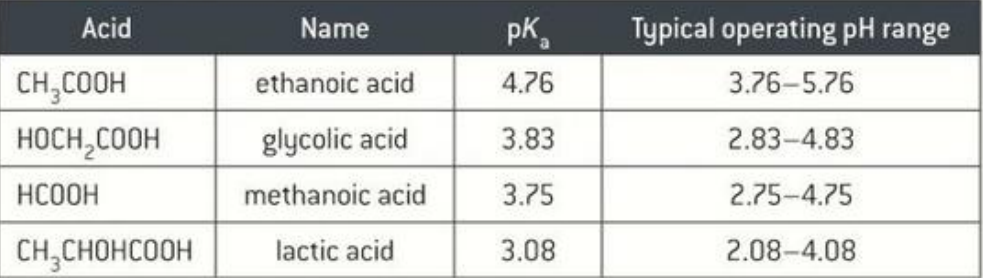
The table shows several common weak acids used in buffer preparations, along with their pKₐ values and typical operating pH ranges. For example, ethanoic acid with a pKₐ of 4.76 produces buffers that operate effectively in the pH range 3.76-5.76.
Calculating the pH of a buffer solution
The pH of a buffer solution depends on two factors:
- The pKₐ (or Kₐ) value of the weak acid
- The ratio of concentrations of the weak acid (HA) and its conjugate base (A⁻)
The equilibrium and Kₐ expression for a weak acid is:
Important
Key Difference from Weak Acid Calculations
When calculating the pH of a weak acid alone, you can approximate that [H⁺(aq)] = [A⁻(aq)]. However, for a buffer solution, this approximation is no longer valid because A⁻(aq) has been added as one of the buffer components.
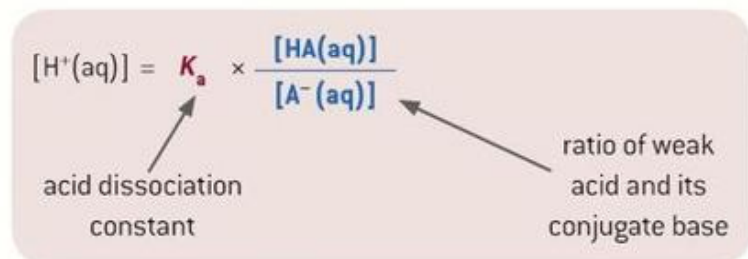
To determine the pH of a buffer solution, rearrange the Kₐ expression as shown:
This rearranged form shows that provided Kₐ and the concentrations of HA and A⁻ are known, you can calculate both [H⁺(aq)] and the pH.
Special case: equal concentrations
When the concentrations of HA and A⁻ are equal in the buffer:
- [HA(aq)] = [A⁻(aq)]
- Therefore:
- This means: Kₐ = [H⁺(aq)] and therefore pKₐ = pH
Note
Maximum Buffer Effectiveness
This is why buffers are most effective when the pH equals the pKₐ of the weak acid - the two components are present in equal concentrations, giving maximum capacity to neutralize both added acids and bases.
Worked example 1: Calculating buffer pH from concentrations
Example
Worked Example: Calculating Buffer pH from Concentrations
Question: Calculate the pH when a buffer solution contains 0.100 mol dm⁻³ CH₃COOH and 0.300 mol dm⁻³ CH₃COONa.
Given: Kₐ(CH₃COOH) = 1.74 × 10⁻⁵ mol dm⁻³
Step 1: Calculate [H⁺(aq)] from Kₐ, [HA(aq)], and [A⁻(aq)]
Step 2: Use your calculator to find the pH
Note
Study tip: If you are given pKₐ and the concentrations of HA and A⁻ are the same, the pH equals the pKₐ value - no calculation needed!
Worked example 2: Buffer prepared from weak acid and salt
Example
Worked Example: Buffer Prepared from Weak Acid and Salt
Question: 150 cm³ of 1.00 mol dm⁻³ HCOOH is mixed with 100 cm³ of 0.750 mol dm⁻³ HCOONa. Calculate the pH of the buffer solution formed.
Given: Kₐ(HCOOH) = 1.78 × 10⁻⁴ mol dm⁻³
Step 1: Calculate the amounts, in mol, of HCOOH and HCOO⁻ in the buffer solution
Step 2: Calculate the concentrations of HCOOH and HCOO⁻ in the buffer solution
Total volume of buffer solution = 250 cm³
Step 3: Calculate [H⁺(aq)] from Kₐ, [HA(aq)] and [A⁻(aq)]
Step 4: Use your calculator to find the pH
Note
Study tip: Remember the formula:
Worked example 3: Buffer prepared by partial neutralisation
Example
Worked Example: Buffer Prepared by Partial Neutralisation
Question: 100 cm³ of 0.750 mol dm⁻³ NaOH(aq) is added to 150 cm³ of 1.50 mol dm⁻³ HCOOH. Calculate the pH of the buffer solution formed.
Given: Kₐ(HCOOH) = 1.78 × 10⁻⁴ mol dm⁻³
Step 1: Calculate the amount, in mol, of HCOO⁻ in the buffer solution
The partial neutralisation reaction is:
Step 2: Calculate the amount, in mol, of HCOOH in the buffer solution
Step 3: Calculate concentrations and pH
These amounts are the same as obtained in Step 1 of the previous worked example. The remainder of the calculation follows identically to give a pH of 3.45.
Note
Key Insight
This demonstrates that both preparation methods (mixing acid with salt, or partial neutralisation) can produce the same buffer solution if the amounts are chosen appropriately.
Summary
Summary
Key Points to Remember:
- Buffer solutions resist pH changes by containing a weak acid (HA) and its conjugate base (A⁻) working as two independent reservoirs
- The weak acid removes added alkali by dissociating to replace H⁺ ions consumed in neutralization
- The conjugate base removes added acid by reacting with added H⁺ ions, shifting equilibrium to the left
- Buffers can be prepared either by mixing a weak acid with its salt, or by partially neutralizing a weak acid with an alkali
- The pH of a buffer depends on the pKₐ of the weak acid and the ratio [HA]/[A⁻], calculated using:
- Buffers work most effectively when [HA] = [A⁻], which means pH = pKₐ, with an operating range typically spanning about ±2 pH units from the pKₐ value