Iodine/Thiosulfate Redox Titrations (OCR A-Level Chemistry A): Revision Notes
📚Revision Notes
Iodine/Thiosulfate Redox Titrations
Introduction to iodine/thiosulfate titrations
Iodine/thiosulfate titrations are a powerful analytical technique used to determine the concentration of various oxidising agents. This method involves a two-stage process where thiosulfate ions () are used to reduce aqueous iodine ().
The fundamental principle relies on the following redox reactions:
Oxidation of thiosulfate:
Reduction of iodine:
Overall equation:
Note
This technique is particularly useful because directly titrating iodine would be very limiting on its own. However, by incorporating an additional step involving an oxidising agent, we can analyse many different substances indirectly. This makes it one of the most versatile analytical methods in chemistry.
Applications of iodine/thiosulfate titrations
This versatile analytical method can be used to determine the concentration of several important substances:
- Chlorate(I) content () in household bleach
- Copper(II) content () in copper(II) compounds
- Copper content in copper alloys such as brass and bronze
Note
The key requirement is that the oxidising agent must be capable of oxidising iodide ions () to iodine (). This principle allows the technique to be adapted for analyzing many different oxidising agents.
General procedure for iodine/thiosulfate titrations
Step 1: Preparing the sample
Begin by adding a standard solution of sodium thiosulfate () to a burette. This will be your titrant.
Step 2: Creating the iodine solution
Prepare a solution containing the oxidising agent you wish to analyse. Using a pipette, transfer a measured volume of this solution into a conical flask. Then add an excess of potassium iodide (KI).
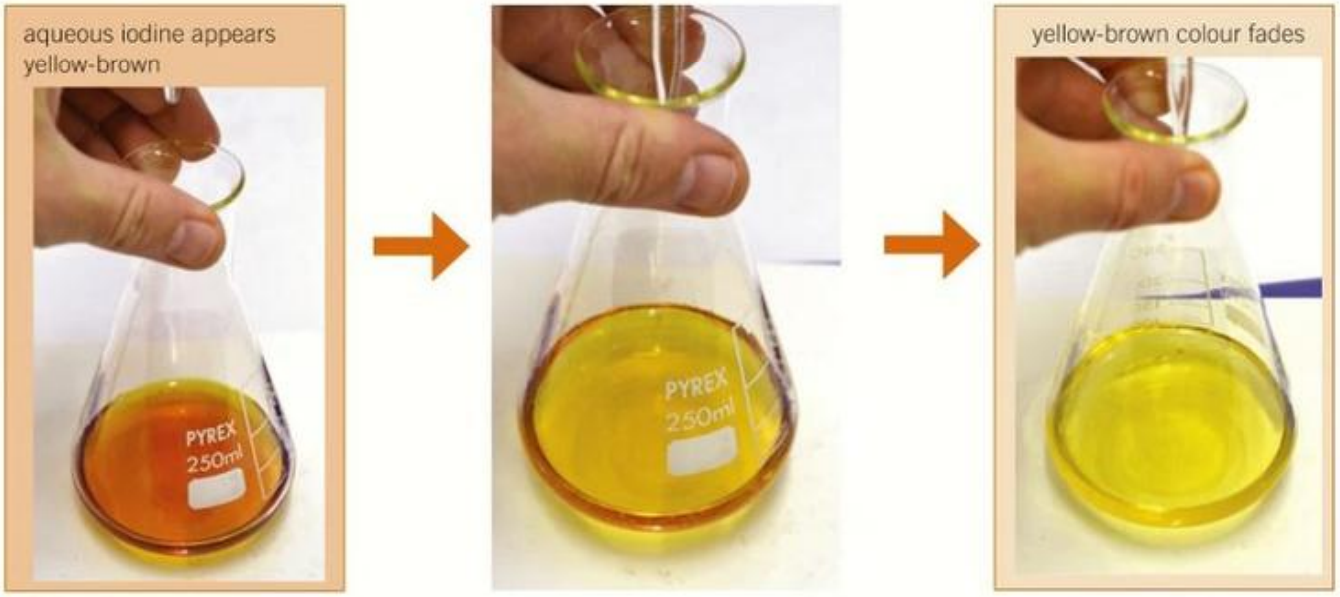
The oxidising agent reacts with the iodide ions to produce iodine, which gives the solution a distinctive yellow-brown colour.
Step 3: Initial titration
Begin titrating the solution with sodium thiosulfate from the burette. During this stage, the iodine is gradually reduced back to iodide ions (), and the brown colour begins to fade. Continue adding the thiosulfate solution until the mixture becomes a pale straw colour.
Note
This gradual colour change can make identifying the exact end point quite difficult, which is why we use a starch indicator in the next step. The pale straw colour indicates that most of the iodine has been reduced, but a small amount remains.
Step 4: Adding starch indicator
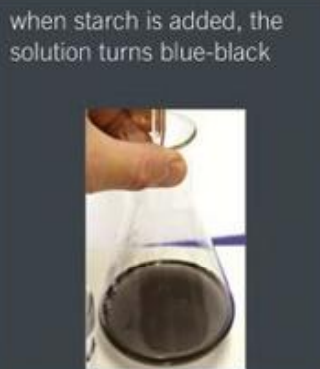
When the solution reaches a pale straw colour, add a small amount of starch indicator. The solution will immediately turn deep blue-black. This colour forms because starch creates a complex with iodine molecules.
Important
The starch indicator must only be added towards the end of the titration. If added too early, the starch-iodine complex may not fully break down, leading to an inaccurate end point. Always wait until the solution is pale straw colour before adding starch.
Step 5: Completing the titration
Continue adding sodium thiosulfate solution dropwise. The blue-black colour will gradually fade as more iodine is reduced. The end point is reached when the blue-black colour completely disappears, leaving a colourless solution. At this point, all the iodine has been reduced to iodide ions.
Step 6: Obtaining concordant results
Repeat the titration to obtain concordant (consistent) results, typically within 0.10 cm³ of each other. Calculate the mean titre for accurate analysis.
Analysis of household bleach
Background chemistry
Household bleach contains chlorate(I) ions (), commonly known as hypochlorite. The active ingredient is typically labelled as sodium chlorate(I) (NaClO) or sodium hypochlorite on product labels, showing the percentage content.
In this analysis, we calculate the concentration of ions in bleach, usually expressed in mol dm⁻³.
Chemical reactions involved
First reaction - producing iodine:
The chlorate(I) ions from the bleach react with iodide ions () and hydrogen ions () to form iodine:
Second reaction - titrating the iodine:
The iodine produced is then titrated with sodium thiosulfate solution:
Important
Key mole ratio:
From these equations, we can determine that:
- 1 mol produces 1 mol
- 1 mol reacts with 2 mol
Therefore: 1 mol ClO⁻ is equivalent to 2 mol S₂O₃²⁻
This 1:2 ratio is critical for all bleach calculations.
Practical procedure
-
Using a pipette, add 10.0 cm³ of bleach to a 250 cm³ volumetric flask and add water to prepare 250.0 cm³ of solution. This dilutes the bleach to a workable concentration.
-
Using a pipette, measure 25.0 cm³ of this diluted solution into a conical flask. Then add 10 cm³ of 1 mol dm⁻³ potassium iodide (KI) followed by sufficient 1 mol dm⁻³ hydrochloric acid (HCl) to acidify the solution. The HCl provides the ions needed for the reaction.
-
Using a burette, titrate this solution with a standard 0.0500 mol dm⁻³ solution of sodium thiosulfate ().
-
Repeat the titration to obtain concordant results.
-
Analyse your results to determine the concentration of chlorate(I) ions in the bleach.
Example
Worked Example: Calculating the concentration of ClO⁻ in bleach
Let's assume a mean titre of 24.20 cm³ of sodium thiosulfate was required.
Step 1: Calculate the amount of S₂O₃²⁻ that reacted
Using the formula:
Step 2: Determine the amounts of I₂ and ClO⁻ that reacted
Using the mole ratio: 1 mol is equivalent to 2 mol
Step 3: Determine the amount of ClO⁻ in the 250.0 cm³ solution
The 25.0 cm³ used in the titration contained mol
Therefore, the 250.0 cm³ solution contains:
Step 4: Determine the concentration of ClO⁻ in the bleach
The 250.0 cm³ solution was prepared using 10 cm³ of bleach, so:
10 cm³ bleach contains mol ions
1 dm³ bleach contains: mol NaClO
Therefore, the concentration of ions in the bleach is:
Analysis of copper in alloys
Background chemistry
Iodine/thiosulfate titrations can also be used to determine the copper content in copper(II) salts or copper alloys. For copper(II) salts, the compound is simply dissolved in water to produce ions. For insoluble copper(II) compounds, they can be reacted with acid to form soluble ions.
For copper alloys such as brass or bronze, the alloy is first reacted and dissolved in concentrated nitric acid. The resulting solution is then neutralised to form ions in solution.
Chemical reactions involved
First reaction - producing iodine:
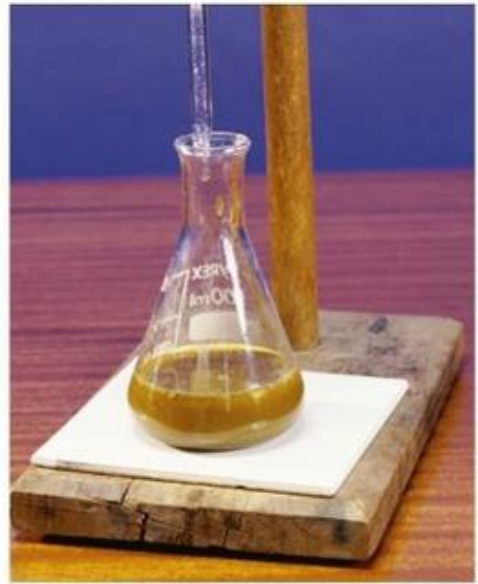
When excess potassium iodide (KI) is added, the ions react with iodide ions to form a white precipitate of copper(I) iodide (CuI) and release iodine. The mixture appears brown in colour:
Note
Oxidation states:
- Reduction: Cu²⁺ (+2) → CuI (+1)
- Oxidation: I⁻ (-1) → I₂ (0)
This is a redox reaction where copper is reduced and iodide is oxidised simultaneously.
Second reaction - titrating the iodine:
The iodine in the brown mixture is then titrated with a standard solution of sodium thiosulfate:
Important
Key mole ratio:
From the equation, 2 mol produces 1 mol iodine, which reacts with 2 mol
Therefore: 1 mol Cu²⁺ is equivalent to 1 mol S₂O₃²⁻
This is a simpler 1:1 ratio compared to the bleach analysis, making calculations more straightforward.
Example
Worked Example: Analysis of brass
Brass is an alloy of copper and zinc used in many ornaments and brass musical instruments. We can use an iodine/thiosulfate titration to find the percentage composition of copper and zinc in brass.

Given information:
- A 0.500 g sample of brass is reacted with concentrated nitric acid to form a solution containing and ions
- The solution is neutralised
- Excess KI is added, causing ions to react with ions, forming
- The iodine is titrated with 0.200 mol dm⁻³ sodium thiosulfate
- 25.20 cm³ of thiosulfate solution is required to reach the end point
Step 1: Calculate the amount of S₂O₃²⁻ that reacted
Step 2: Determine the amounts of I₂ and Cu²⁺ that reacted
Using the 1:1 mole ratio: 1 mol is equivalent to 1 mol
Step 3: Work out the percentages of Cu and Zn
Mass of Cu²⁺ in the sample:
Mass of Zn in the sample:
Percentage composition of Cu:
Percentage composition of Zn:
Therefore, the brass sample is approximately 64% copper and 36% zinc by mass.
Key exam tips
Important
Understanding mole ratios:
The most critical aspect of these calculations is identifying the correct mole ratio between the analyte and thiosulfate. Remember:
- For : 1 mol ≡ 2 mol
- For : 1 mol ≡ 1 mol
Using mean titres:
Always use the mean titre value from concordant results and the concentration of the standard sodium thiosulfate solution in your calculations.
Scaling up calculations:
When a sample is diluted (as in the bleach example), remember to scale up your answer to find the amount in the original solution.
Note
Common mistakes to avoid:
- Adding starch indicator too early in the titration
- Forgetting to account for dilution factors
- Using incorrect mole ratios
- Not using concordant results
Being aware of these common pitfalls will help you avoid errors in both practical work and calculations.
Summary
Key Points to Remember:
-
Iodine/thiosulfate titrations involve oxidising iodide ions () to iodine () using an oxidising agent, then titrating the iodine with sodium thiosulfate ()
-
Starch indicator is added only when the solution becomes pale straw colour (near the end point) to give a blue-black colour, which disappears at the end point
-
For bleach analysis: The mole ratio is 1 mol ClO⁻ ≡ 2 mol S₂O₃²⁻, so divide the moles of thiosulfate by 2
-
For copper analysis: The mole ratio is 1 mol Cu²⁺ ≡ 1 mol S₂O₃²⁻, giving a simpler 1:1 relationship
-
This technique can determine the concentration of any oxidising agent capable of oxidising to , making it highly versatile for different analytical applications