Stereoisomerism in Complex Ions (OCR A-Level Chemistry A): Revision Notes
📚Revision Notes
Stereoisomerism in Complex Ions
Introduction to stereoisomerism
Stereoisomers are compounds that contain the same atoms bonded together in the same sequence, but these atoms are arranged differently in three-dimensional space. Complex ions can display two main types of stereoisomerism:
- Cis-trans isomerism (also called geometric isomerism)
- Optical isomerism
The type of stereoisomerism that a complex ion can exhibit depends on:
- The coordination number of the central metal ion
- The geometry of the complex (square planar or octahedral)
- The types of ligands present (monodentate or bidentate)
- The number of different ligands attached
Important
Understanding stereoisomerism in complex ions is essential because different isomers can have dramatically different properties, including different colours, reactivities, and biological activities. In medicine, the difference between a cis and trans isomer can mean the difference between an effective drug and an inactive compound.
Cis-trans isomerism in complex ions
Key differences from organic chemistry
You may have encountered cis-trans isomerism in organic chemistry, where it occurs around carbon-carbon double bonds (). The double bond prevents rotation, which locks groups into different positions.
In complex ions, cis-trans isomerism works differently:
- No double bonds are involved
- The rigid geometry of the complex prevents ligands from moving
- The shape of the complex holds ligands in fixed orientations around the central metal ion
Cis-trans isomerism occurs in both square planar and octahedral complex ions.
Cis-trans isomerism in square planar complexes
Requirements and basic principles
For cis-trans isomerism to occur in square planar complexes, the complex must have:
- A coordination number of 4
- At least two pairs of identical ligands
- Square planar geometry (ligands arranged in a flat square around the metal)
In square planar geometry, ligands are positioned at the corners of a square in the same plane. Each ligand is separated from its neighbours by bond angles of .
Note
The key difference between isomers:
- Cis isomer: The two identical ligands are positioned next to each other (adjacent), with a bond angle of 90° between them
- Trans isomer: The two identical ligands are positioned opposite each other (across the metal), with a bond angle of 180° between them
Memory aid: Cis = Close (identical ligands are close together) and Trans = Traverse (identical ligands traverse across from each other)
Example: Dichlorodiamminepalladium(II)
The complex is formed from:
- A ion (central metal)
- Two ligands (ammonia)
- Two ligands (chloride ions)
This complex exists as two distinct isomers:
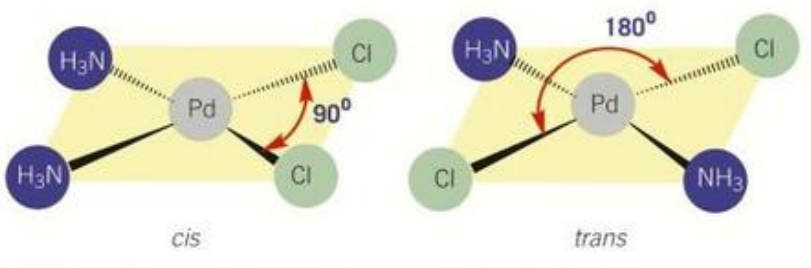
In the diagram above:
- Cis isomer (left): Both ammonia ligands are adjacent, both chloride ligands are adjacent, with 90° angles between identical ligands
- Trans isomer (right): Ammonia ligands are opposite each other, chloride ligands are opposite each other, with 180° angles between identical ligands
Drawing cis-trans isomers in three dimensions
When drawing these isomers, it's important to represent them in three dimensions to clearly show the spatial arrangement. The standard convention uses:
- Solid wedge bonds: Ligands coming out of the page towards you
- Dashed wedge bonds: Ligands going behind the page away from you
- Normal lines: Ligands in the plane of the page
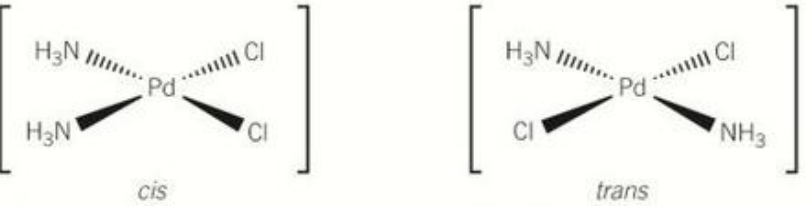
Note
This 3D representation makes it clearer how the ligands are positioned relative to each other in space. Always use proper wedge-and-dash notation in exams to show three-dimensional structures clearly.
Cis-trans isomerism in octahedral complexes
Octahedral complexes with monodentate ligands
Octahedral complexes have a coordination number of 6, with six ligands arranged around the central metal ion. The geometry resembles two square-based pyramids joined at their bases.
Important
For cis-trans isomerism to occur in octahedral complexes with monodentate ligands, you need:
- Four ligands of one type
- Two ligands of another type
This specific ratio is essential for cis-trans isomerism in octahedral geometries with monodentate ligands.
Example: Tetraamminedichlorocobalt(III) ion
The complex contains:
- A ion (central metal)
- Four ligands
- Two ligands
This complex exists as two isomers with different colours:
- Cis isomer: Violet coloured
- Trans isomer: Green coloured
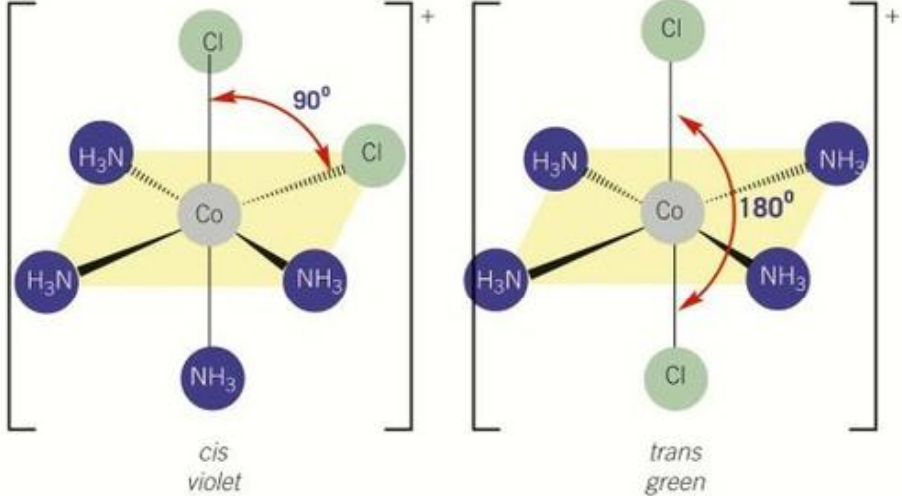
In the octahedral arrangement:
- Cis isomer: The two chloride ligands are adjacent to each other with a bond angle of 90° between their coordinate bonds
- Trans isomer: The two chloride ligands are at opposite corners of the octahedron with a bond angle of 180° between their coordinate bonds
Note
These isomers were famously identified by Alfred Werner, a chemist working in Zurich, who successfully explained why two different forms of this compound existed. This work was crucial in establishing the theory of coordination chemistry.
Three-dimensional representation of octahedral isomers
Drawing octahedral complexes in three dimensions requires careful use of wedge-and-dash notation:
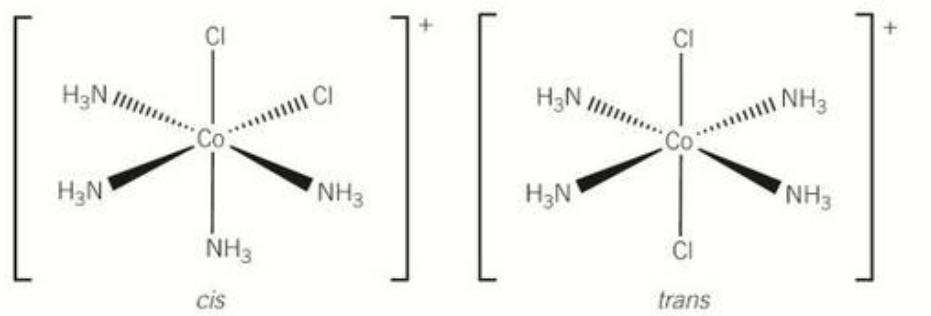
The 3D diagrams clearly show how the chloride ligands are positioned:
- In the cis isomer: both chlorides are apart
- In the trans isomer: the chlorides are apart (directly opposite)
Important
When drawing these structures in exams, remember that the bond to the metal ion comes from the atom in the ligand that has the lone pair. For , this is the nitrogen atom. For , the entire ion acts as the ligand.
Octahedral complexes with bidentate ligands
Bidentate ligands are ligands that can form two coordinate bonds to the central metal ion. This means one bidentate ligand occupies two of the coordination sites in the complex.
Structure of ethylenediamine
A common bidentate ligand is ethylenediamine (also called 1,2-diaminoethane), with the formula :
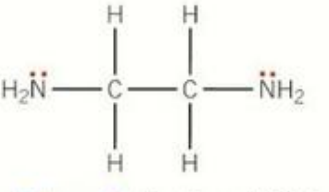
Ethylenediamine has:
- A two-carbon chain
- An group at each end
- Two nitrogen atoms, each with a lone pair of electrons
- The ability to form two coordinate bonds to a metal ion
Note
Because ethylenediamine is used so frequently in coordination chemistry, it is often abbreviated as en. Therefore, you might see a complex like written more simply as .
Memory aid: Optical needs "teeth" - optical isomerism requires bidentate ligands (bi = two "teeth")
Example: Dichlorobis(ethylenediamine)cobalt(III) ion
The complex contains:
- A ion
- Two ethylenediamine ligands (occupying four coordination sites)
- Two ligands (occupying two coordination sites)
This complex can exist as both cis and trans isomers:
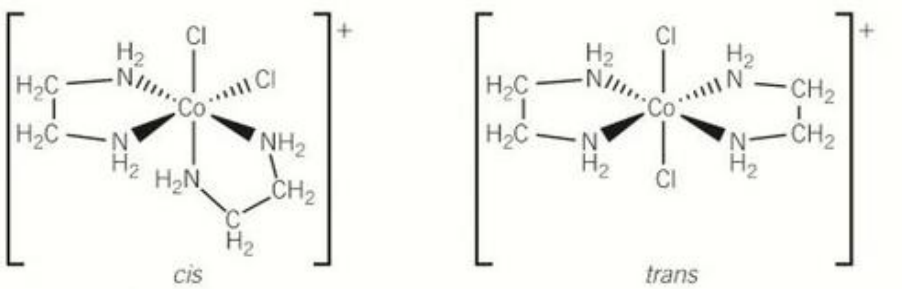
The difference between the isomers:
- Cis isomer: Both chloride ligands are adjacent ( apart)
- Trans isomer: Both chloride ligands are opposite each other ( apart)
The ethylenediamine ligands "wrap around" the metal ion, occupying two coordination sites each.
Optical isomerism in octahedral complexes
What is optical isomerism?
Optical isomerism is a special type of stereoisomerism that produces enantiomers - molecules that are non-superimposable mirror images of each other. Think of your left and right hands: they are mirror images, but you cannot place one exactly on top of the other to make them match perfectly.
Requirements for optical isomerism
Important
Optical isomerism in complex ions only occurs in octahedral complexes that contain:
- Two or more bidentate ligands
This is a crucial requirement - you cannot get optical isomerism with only monodentate ligands.
Memory aid: 2+ for optical - Need at least 2 bidentate ligands for optical isomerism
Why trans isomers don't show optical isomerism
An important point to remember: trans isomers cannot form optical isomers. The mirror image of a trans isomer is exactly the same as the original - it can be superimposed. Only cis isomers with bidentate ligands can exist as optical isomers.
Example: Complexes with two bidentate ligands
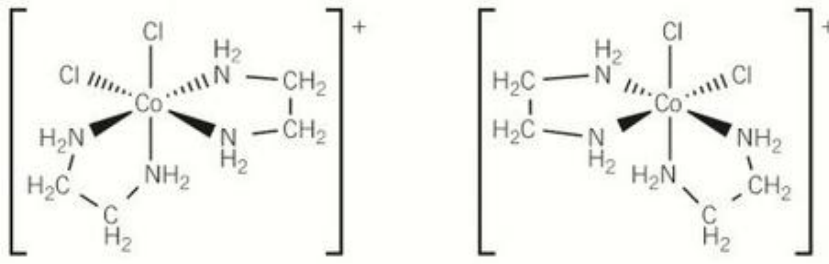
The cis form of (which we looked at earlier for cis-trans isomerism) also exists as two optical isomers:
Example
Understanding Optical Isomers:
These two structures are mirror images of each other, and they cannot be superimposed - no matter how you rotate one structure, you cannot make it look identical to the other. This is because the bidentate ligands create a chiral (non-superimposable) arrangement around the metal centre.
The trans isomer of this same complex does not show optical isomerism because its mirror image is superimposable.
Example: Complexes with three bidentate ligands
Optical isomerism can also occur in octahedral complexes containing three bidentate ligands. For example, exists as two optical isomers:
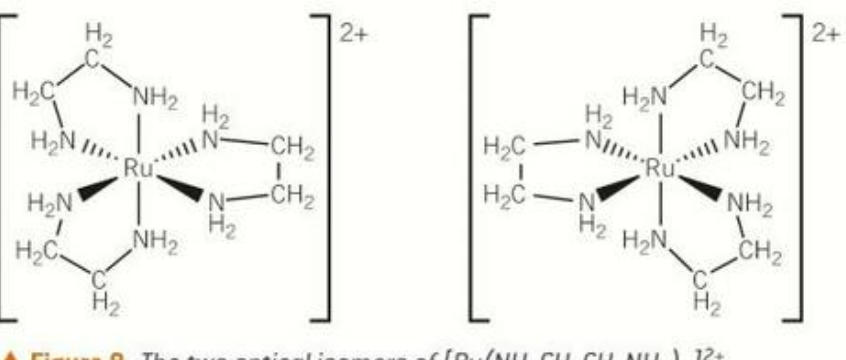
In this complex:
- The ruthenium(II) ion is at the centre
- Three ethylenediamine ligands wrap around the metal
- The overall charge is 2+
- The two forms are non-superimposable mirror images
Note
This type of optical isomerism is important in many areas of chemistry, including biochemistry and pharmaceutical chemistry, where different enantiomers of a molecule can have very different biological activities. This is particularly crucial in drug design.
The role of cis-trans isomerism in medicine
Discovery of cisplatin
The medical importance of cis-trans isomerism in complex ions was discovered accidentally. Scientists were researching the effects of electric fields on bacteria using platinum electrodes. When they applied an electrical current to a colony of E. coli bacteria, they noticed the bacteria failed to divide but continued to grow.
Initially, they thought the electric current was preventing cell division. However, further investigation revealed that a platinum compound was being formed at the electrode. This compound was cis-platin (cisplatin).
Structure of cisplatin
Cisplatin has the formula and has a square planar geometry:
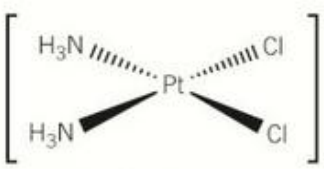
The structure shows:
- A platinum(II) metal centre
- Two ammonia ligands
- Two chloride ligands
- The cis configuration (both ammonia ligands adjacent, both chloride ligands adjacent)
How does cisplatin work?
Cisplatin is effective as an anticancer drug because:
- It enters cancer cells
- It binds to DNA strands, forming cross-links between DNA bases
- This binding prevents the DNA from replicating
- The cell's own repair mechanisms detect the damage
- Unable to repair the damage, the cell undergoes apoptosis (programmed cell death)
Important
The cis geometry is crucial - the trans isomer is not effective as an anticancer drug because it cannot form the correct type of cross-links with DNA. This is a perfect example of how stereoisomerism can have profound effects on biological activity.
Clinical use and limitations
After extensive clinical trials, cisplatin was proven to be effective at attacking tumours. In many cases, tumours treated with cisplatin shrank significantly in size.
Unfortunately, cisplatin has significant side effects:
- Kidney damage
- Nausea
- Other unpleasant effects
Despite these side effects, cisplatin is still used extensively in cancer treatment today. Researchers continue to search for other platinum-based drugs that can inhibit tumour growth with fewer side effects.
Oxaliplatin
Another platinum-based anticancer drug is oxaliplatin, which is used for the treatment of colorectal cancer:
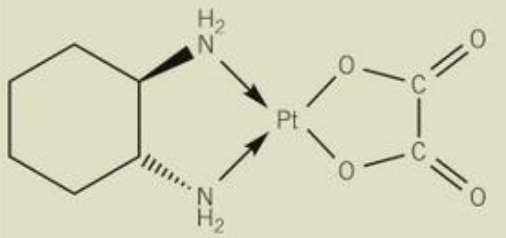
Oxaliplatin contains:
- A platinum(II) centre
- A cyclohexane ring with two amino groups attached (a bidentate ligand)
- An oxalato ligand (also bidentate)
The coordination number of platinum in oxaliplatin is 4, and the geometry is square planar. The presence of different ligands compared to cisplatin gives oxaliplatin different properties and effectiveness against different types of cancer.
Exam tips and common mistakes
Note
Drawing 3D structures:
- Always use wedge-and-dash notation for 3D structures
- Make sure wedges and dashes are clear and distinct
- Show the correct bond angles ( for cis, for trans)
Identifying isomers:
- Check the coordination number and geometry first
- Count the types and numbers of ligands
- Remember: square planar and octahedral can show cis-trans isomerism
- Only octahedral complexes with 2+ bidentate ligands show optical isomerism
Important
Common mistakes to avoid:
- Confusing cis-trans isomerism in complex ions with E/Z isomerism in organic chemistry
- Thinking optical isomerism can occur in square planar complexes (it cannot)
- Forgetting that trans isomers cannot form optical isomers
- Not clearly showing 3D structure in diagrams
- Incorrectly showing which atom forms the coordinate bond to the metal
Note
Naming conventions:
- Use systematic names: cis-[complex formula] or trans-[complex formula]
- Show charges clearly on complex ions
- Remember ligand names: ammine (), chloro (), etc.
Remember!
Summary
Key Points to Remember:
-
Stereoisomers have the same structural formula but different spatial arrangements of atoms
-
Cis-trans isomerism occurs in square planar complexes (with 2 pairs of identical ligands) and octahedral complexes (with specific ligand arrangements)
-
In cis isomers, identical ligands are adjacent ( apart in square planar; apart in octahedral)
-
In trans isomers, identical ligands are opposite ( apart)
-
Optical isomerism only occurs in octahedral complexes containing two or more bidentate ligands, producing non-superimposable mirror images called enantiomers
-
Bidentate ligands (like ethylenediamine) form two coordinate bonds to the metal centre and are essential for optical isomerism
-
Trans isomers cannot show optical isomerism - only cis forms with bidentate ligands can
-
Cisplatin () is a cis isomer used as an anticancer drug that works by binding to DNA and preventing cell replication
-
The geometry matters - the cis form of cisplatin is medically active, but the trans form is not effective as an anticancer drug
Memory aids:
- Cis = Close, Trans = Traverse
- 90-180 rule: Cis = , Trans =
- Optical needs "teeth": Optical isomerism requires bidentate ligands
- 2+ for optical: Need at least 2 bidentate ligands for optical isomerism