Aristotle's view of the soul (OCR A-Level Religious Studies): Revision Notes
📚Revision Notes
Aristotle's view of the soul
Aristotle observed that despite drastic physical change, people still remain the same 'person' throughout their lives. Aristotle concluded that there must be a constant that is immutable (unchanging), the soul.
Pondering over questions such as: what is the fundamental difference between a physical body and a living one, Aristotle mused that they had different capabilities. From this he postulates that the soul is the thing that gives people the required capabilities to achieve their telos.
Aristotle held that all things in the world are on a journey of motus from potentiality to actuality.
This journey is facilitated through movement between the four causes.
For living, animate things, the soul acts as the efficient cause. It is the agent of change that allows matter, the material cause, to move towards achieving telos and being actualized.
The example of the axe
He states that if an axe were to have a soul its soul would be the thing that gave it the capability to chop-this is because being able to cut things is what makes an axe an axe.
A toy axe is not a real axe because it does not have the capability to chop. The toy axe has a different telos therefore necessarily would have a different soul since it would require different capabilities to reach this telos e.g. the capability to bring joy to children.
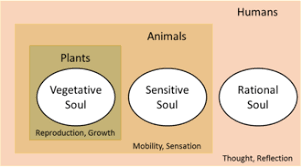
Aristotle identified that all living things have a telos, but that their telos is different depending on what those things are. Subsequently, he presented three different variations of the soul.
Plants: Vegetative soul – the telos of plants is to reproduce therefore the efficient cause which allows the material of the plant to move towards this telos must provide the plant with the capacity to get nourishment for themselves & ensure reproduction of species
Animals: Perceptive souls – the telos of animals is also to reproduce. However, the capabilities provided by the efficient cause in the vegetative soul would not provide animals with the adequate ability to do this. Therefore the perceptive soul includes all of the capabilities of the vegetative soul in addition to the capability to have sense experience and to distinguish pleasure and pain
Humans: Intellectual soul – Aristotle held that the telos of human life was to achieve eudemonia – to flourish. Just like with the perceptive soul, the human soul also holds the capabilities of the vegetative and perceptive soul but, for humans to reach eudemonia they will need to live according to the principles of virtue ethics. As such, their soul gives them the capability to reason and make moral decisions.

The analogy of the wax stamp.
Here he highlights that the soul and the body are intertwined and cannot be separated, just like once the wax has been imprinted with the stamp, it is not possible to remove it.
This view makes Aristotle a monist meaning that he believe the soul and the body to be inextricably linked.
For this reason, it is difficult for Aristotle to argue that the soul can survive after bodily death although in his later works, he does begin to question the possibility of an afterlife, he is unclear on how this would work and what the role of the soul would be.