Organisational structures (AQA GCSE Business): Revision Notes
📚Revision Notes
Organisational structures
Introduction
As businesses expand and employ more people, they need to establish clear internal structures that define how employees, managers, departments, and locations relate to each other. The structure chosen will depend on factors like the type of business, its size, and specific characteristics.
Note
Key considerations when choosing organisational structures include:
- Cost management
- Maintaining control
- Ensuring effective communication throughout the organisation
Organisation charts and hierarchy
The most straightforward way to visualise how a business is organised is through an organisation chart. This diagram displays the management hierarchy from top to bottom, clearly showing reporting relationships and authority levels within the company.
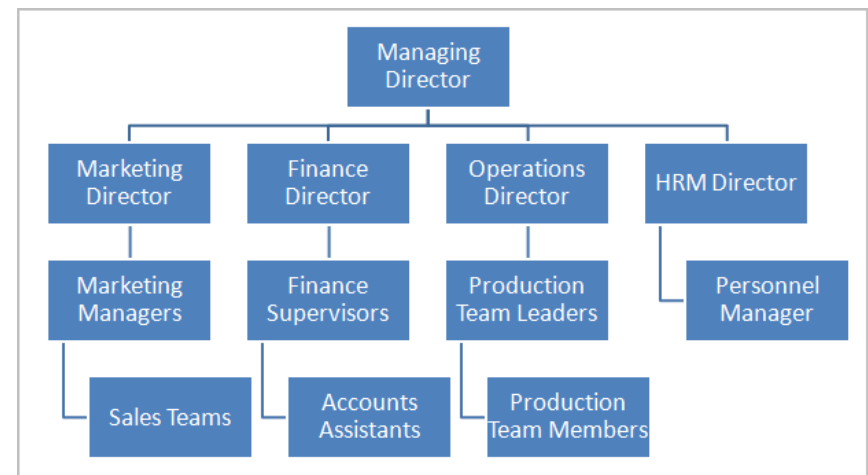
This chart demonstrates how businesses are arranged in hierarchical levels with clearly defined roles and reporting lines. The Managing Director sits at the top of the structure, with four directors reporting directly to them. Each department then has its own management layers, with the Marketing Director overseeing marketing managers who in turn supervise sales teams.
Key roles within business structures
Different positions exist within business hierarchies, each with specific responsibilities:
- Directors lead major functional areas within large companies, such as Finance or Marketing. They form part of the Board of Directors and report to the most senior director, typically the Managing Director.
- Managers and senior managers take responsibility for significant portions of business operations and directly supervise multiple employees. They ensure their departments meet objectives and coordinate activities.
- Team leaders and supervisors work within larger teams, often having more experience than other team members. They help ensure teams operate effectively while maintaining some management responsibilities.
- Operational staff keep the business running day-to-day, working alongside managers and other personnel to complete required tasks and deliver services.
- Support staff assist across various areas of the organisation, providing specialist knowledge or skills. Examples include IT support, cleaning, catering, and administrative personnel.
Span of control
The span of control refers to the number of employees for whom a manager is directly responsible. This concept is crucial for understanding how management structures work in practice.
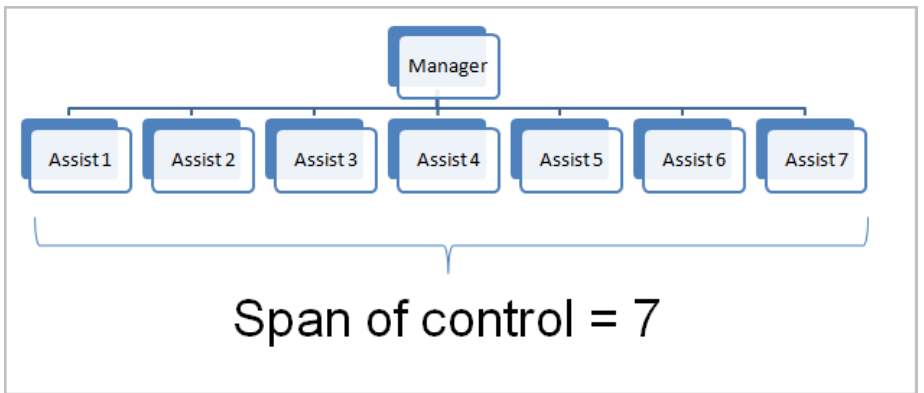
A span of control of 7 is considered quite wide, meaning one manager directly supervises seven people.
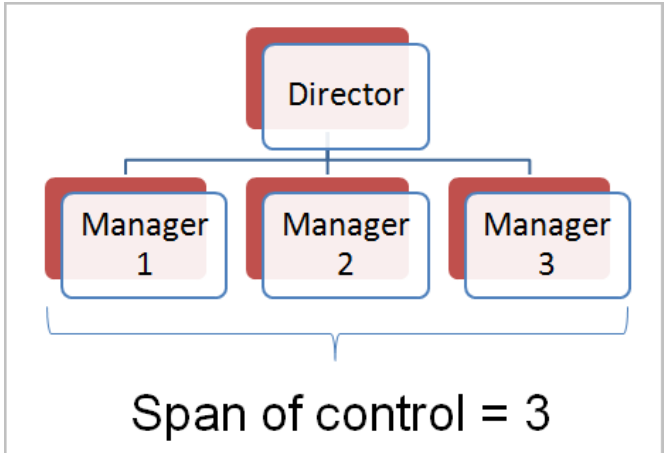
In contrast, a span of control of 3 is considered narrow, with the director managing only three people directly.
Note
The ideal span of control depends on several factors:
- The manager's experience and personality
- The type of business and whether close supervision is required
- The skills and attitudes of employees being supervised
Comparing narrow and wide spans of control
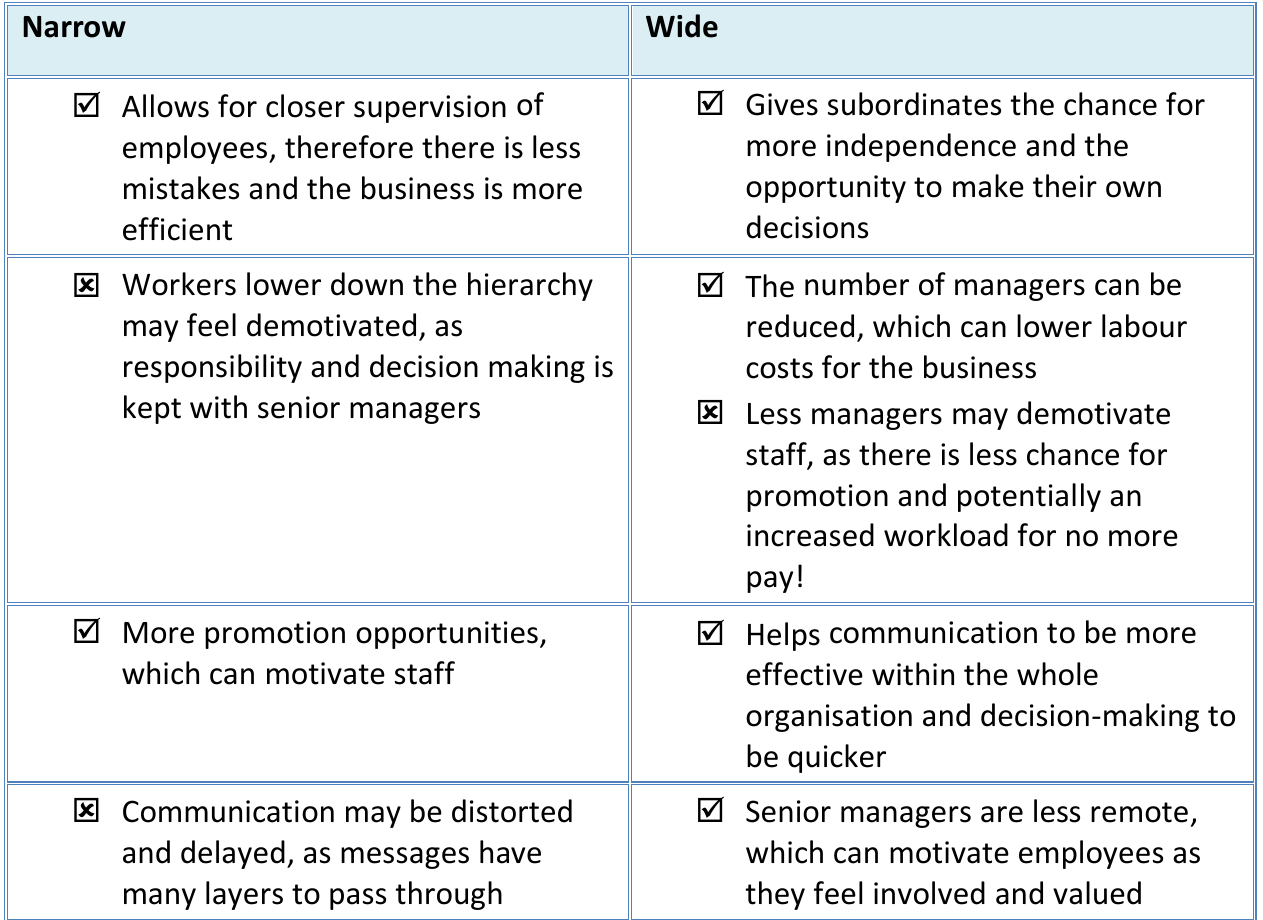
Narrow spans of control allow for closer supervision, leading to fewer mistakes and greater efficiency. They also create more promotion opportunities, which can motivate staff. However, workers lower in the hierarchy may feel demotivated as responsibility and decision-making remain with senior managers. Communication can also become distorted as messages pass through many layers.
Wide spans of control give employees more independence and decision-making opportunities. They reduce the number of managers needed, potentially lowering labour costs. Communication becomes more effective throughout the organisation, and senior managers feel less remote from their teams. However, fewer managers may demotivate some staff due to reduced promotion opportunities and potentially increased workloads without additional pay.
Chains of command
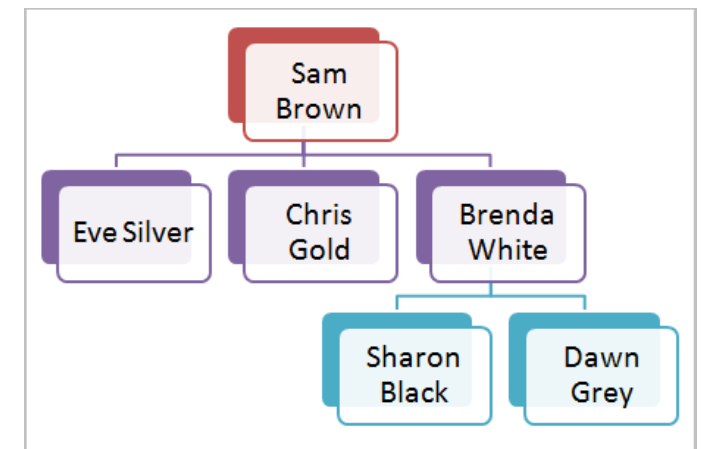
The chain of command shows the lines of authority within a business, indicating who reports to whom and how communication flows through the organisation.
Example
Worked Example: Understanding Chain of Command
In this example, Sam oversees Eve, Chris, and Brenda. Moving down the chain, Brenda is responsible for Sharon and Dawn.
Communication flow:
- Sam would communicate with his three direct reports (Eve, Chris, Brenda)
- Brenda would pass relevant messages to her team as their line manager
- For specific issues, Sharon and Dawn could communicate directly with Sam since he's ultimately responsible for everyone
- Normal day-to-day communication would go through Brenda
Important
The relationship between span of control and chain of command is crucial: businesses with wide spans of control typically have short chains of command, while those with narrow spans tend to have longer chains. This affects management control and communication effectiveness.
Types of organisational structures
Businesses can choose between different structural approaches, each with distinct characteristics:
Flat structures have few layers, short chains of command, and wide spans of control. This creates a more horizontal organisation where decision-making is distributed across fewer levels.
Tall structures feature many layers, long chains of command, and narrow spans of control. This creates a more vertical organisation with multiple management levels.
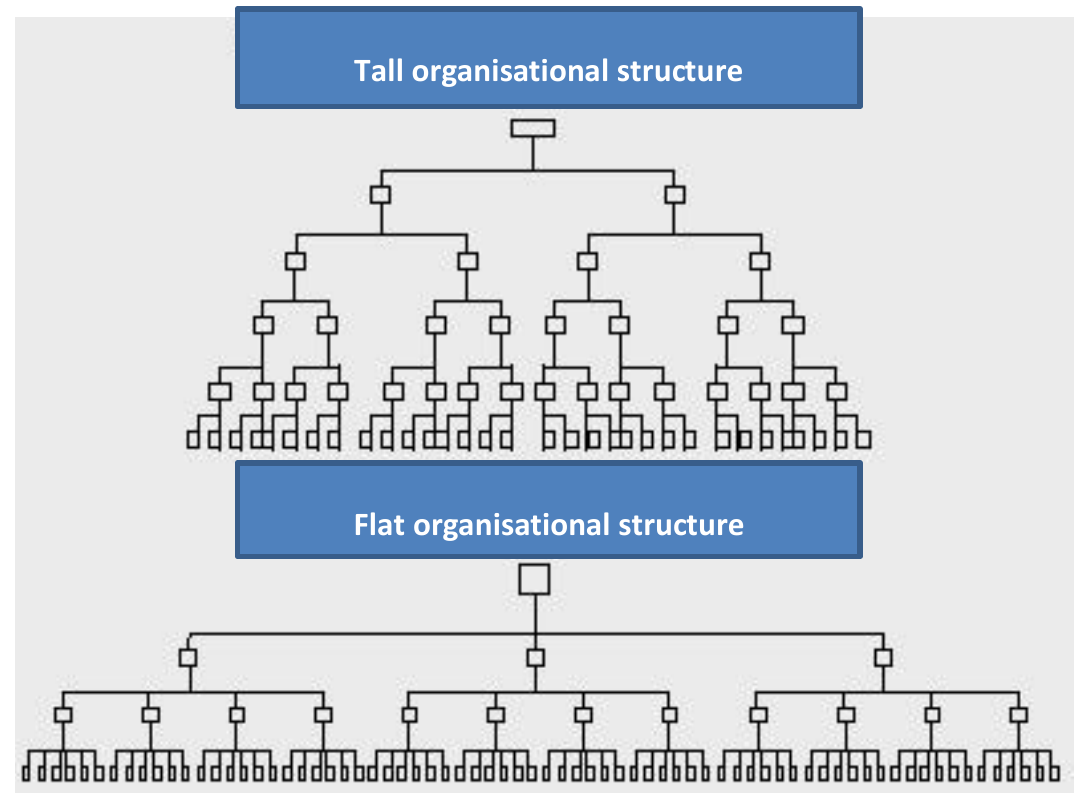
The tall structure shown has six layers with narrow spans of control, while the flat structure has only four layers with wider spans. The choice depends on the business's nature and operational requirements.
As businesses grow, they often become more difficult to control, coordinate, and organise. Sometimes this necessitates adding management layers to the hierarchy. Conversely, if a business is reducing in size or cutting costs, it might remove a management layer through delayering.
Important
Delayering Considerations: While delayering can improve communication, it also reduces promotion opportunities and may require remaining staff to take on additional responsibilities, potentially increasing costs through additional training needs.
Delegation
Delegation occurs when a manager or senior employee gives some of their workload to a less senior employee. This process moves down the chain of command, with the subordinate receiving authority to complete the delegated task.
Important
Key principle: However, responsibility for the work remains with the manager who delegated it.
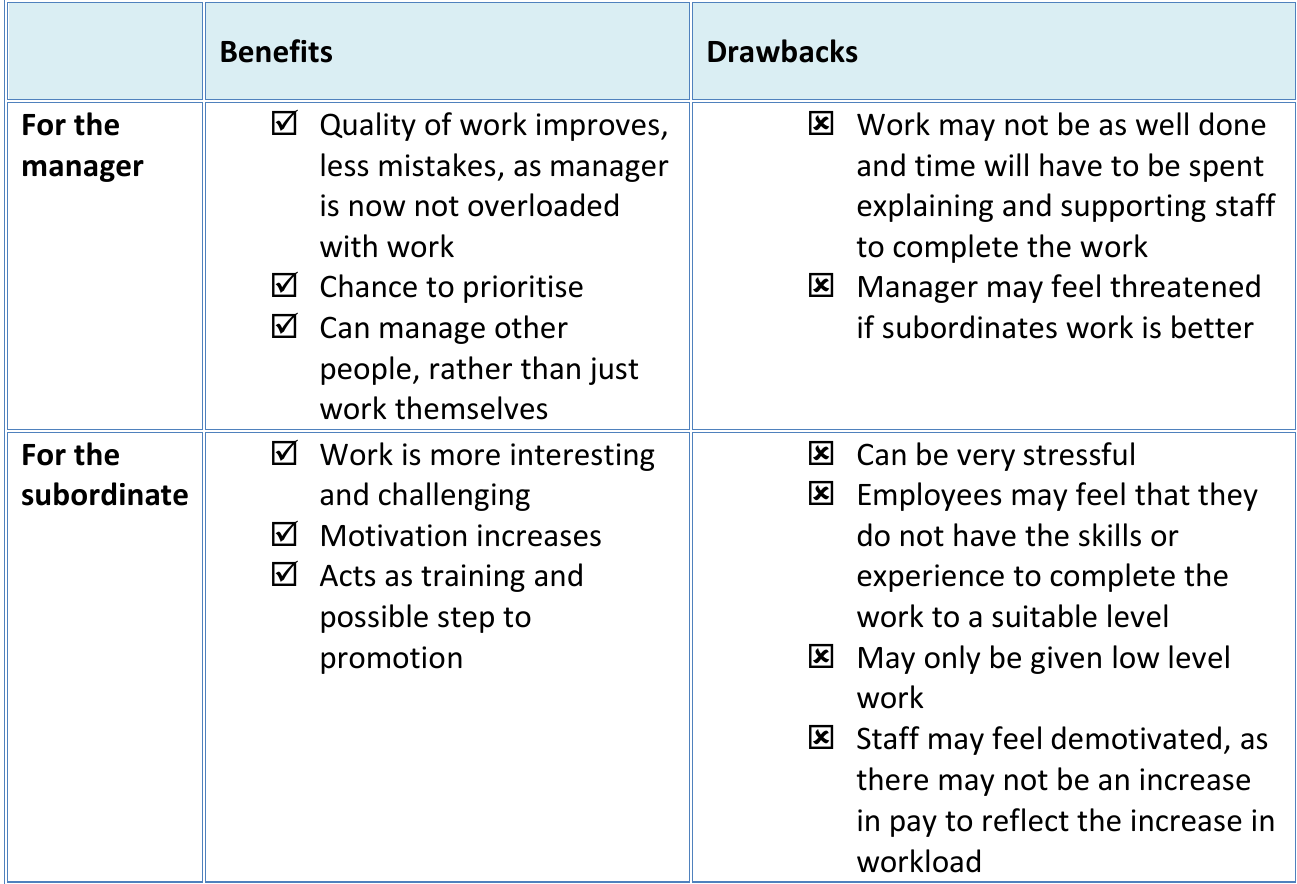
Benefits for managers include improved work quality due to reduced overload, better opportunities to prioritise important tasks, and the ability to focus on managing people rather than just completing tasks. However, managers may worry about work quality, need to invest time in training staff, and potentially feel threatened if subordinates perform exceptionally well.
Benefits for subordinates include more interesting and challenging work, increased motivation, and training opportunities that could lead to promotion. The drawbacks include potential stress from new responsibilities, possible feelings of inadequacy regarding skills and experience, being assigned only routine tasks, and potential demotivation from increased workload without corresponding pay increases.
Summary
Key Points to Remember:
- Organisational structures show relationships between employees, managers, and departments, with the choice depending on business type and characteristics
- Span of control measures how many people report directly to a manager - narrow spans allow closer supervision while wide spans give more employee independence
- Chain of command shows authority lines and communication flows, with longer chains in tall structures and shorter chains in flat structures
- Flat structures have few layers and wide spans, while tall structures have many layers and narrow spans
- Delegation passes authority down the hierarchy but responsibility stays with the delegating manager, offering benefits and challenges for both parties