Centralisation and decentralisation (AQA GCSE Business): Revision Notes
📚Revision Notes
Centralisation and decentralisation
Understanding the key decision in organisational structure
When businesses grow and develop, they face a crucial choice about where decision-making power should be located within their organisation. This decision centres around whether authority should remain concentrated at the top with senior management (centralisation) or be distributed throughout different levels and locations (decentralisation).
Most large businesses today use a combination of both approaches, particularly when they operate across multiple locations or have diverse product ranges. The key challenge lies in determining how much independence different business units should have when making important decisions that could impact the entire organisation.
Note
The choice between centralisation and decentralisation is not an either/or decision. Most successful businesses find the right balance by centralising some decisions while decentralising others, depending on the specific context and potential impact.
Centralised structures
In a centralised structure, decision-making authority remains firmly concentrated at the top of the organisational hierarchy with senior management. This approach ensures that all major choices are made by those at headquarters level.
A prime example of centralised structure can be found in fast-food businesses. These companies deliberately maintain tight control over their thousands of outlets worldwide. The primary motivation is to guarantee consistency in customer experience and product quality across every single location, regardless of where customers visit.
Benefits and drawbacks of centralisation
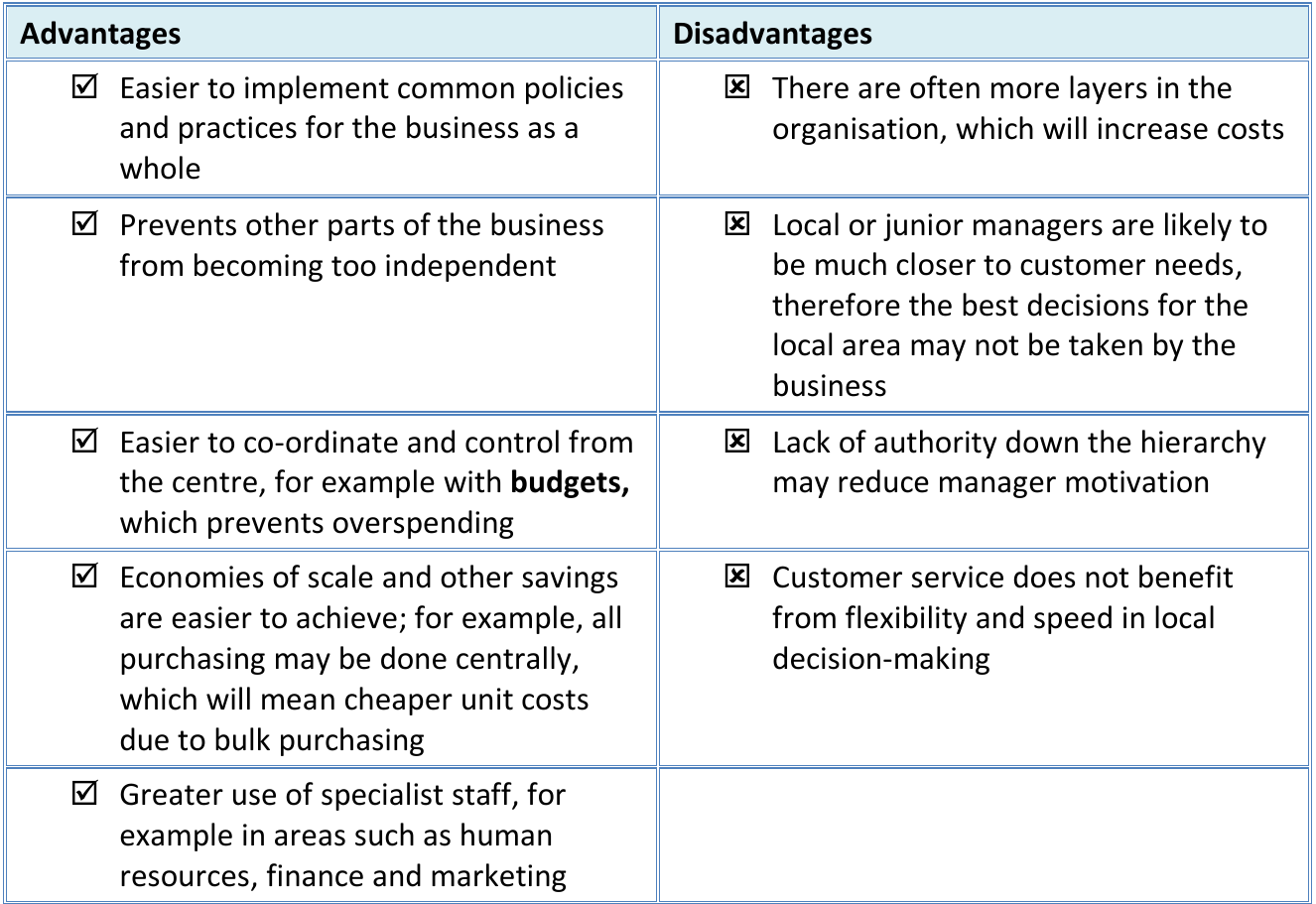
 Centralised structures offer several compelling advantages that make them attractive to many businesses. Understanding both the benefits and limitations helps explain why some organisations choose this approach.
Note
Key Benefits of Centralisation:
Centralised structures make it much simpler to implement uniform policies and practices across the entire business, ensuring everyone follows the same standards. This approach also prevents different parts of the organisation from becoming too independent, which could lead to inconsistencies or conflicting approaches.
From a financial perspective, centralisation enables better coordination and control from headquarters, particularly when managing budgets and preventing overspending. It also allows businesses to achieve economies of scale more easily, such as when all purchasing decisions are made centrally, resulting in cheaper unit costs through bulk buying. Additionally, specialist staff in areas like human resources, finance, and marketing can be utilised more effectively across the entire organisation.
Important
Challenges of Centralisation:
However, centralisation also presents notable challenges. The structure often creates additional layers within the organisation, which inevitably increases operational costs. Perhaps more concerning is that local or junior managers, who are closest to customer needs, may not have the authority to make the best decisions for their specific areas. This lack of authority can significantly reduce manager motivation and means that customer service may suffer from inflexibility and slower local decision-making.
Decentralised structures
Decentralised structures distribute decision-making authority more broadly throughout the organisation, involving junior managers and individual business units in important choices. This approach recognises that those closer to customers and local markets often have valuable insights that can improve business performance.
Excellent examples of decentralised structures include major supermarket chains, where individual store managers have the authority to make specific decisions about their particular location, such as staffing levels and local promotions. However, larger strategic decisions about store layout typically remain with head office. Hotel chains also favour decentralised approaches, empowering local hotel managers to make immediate decisions to address customer problems or complaints effectively.
Benefits and drawbacks of decentralisation
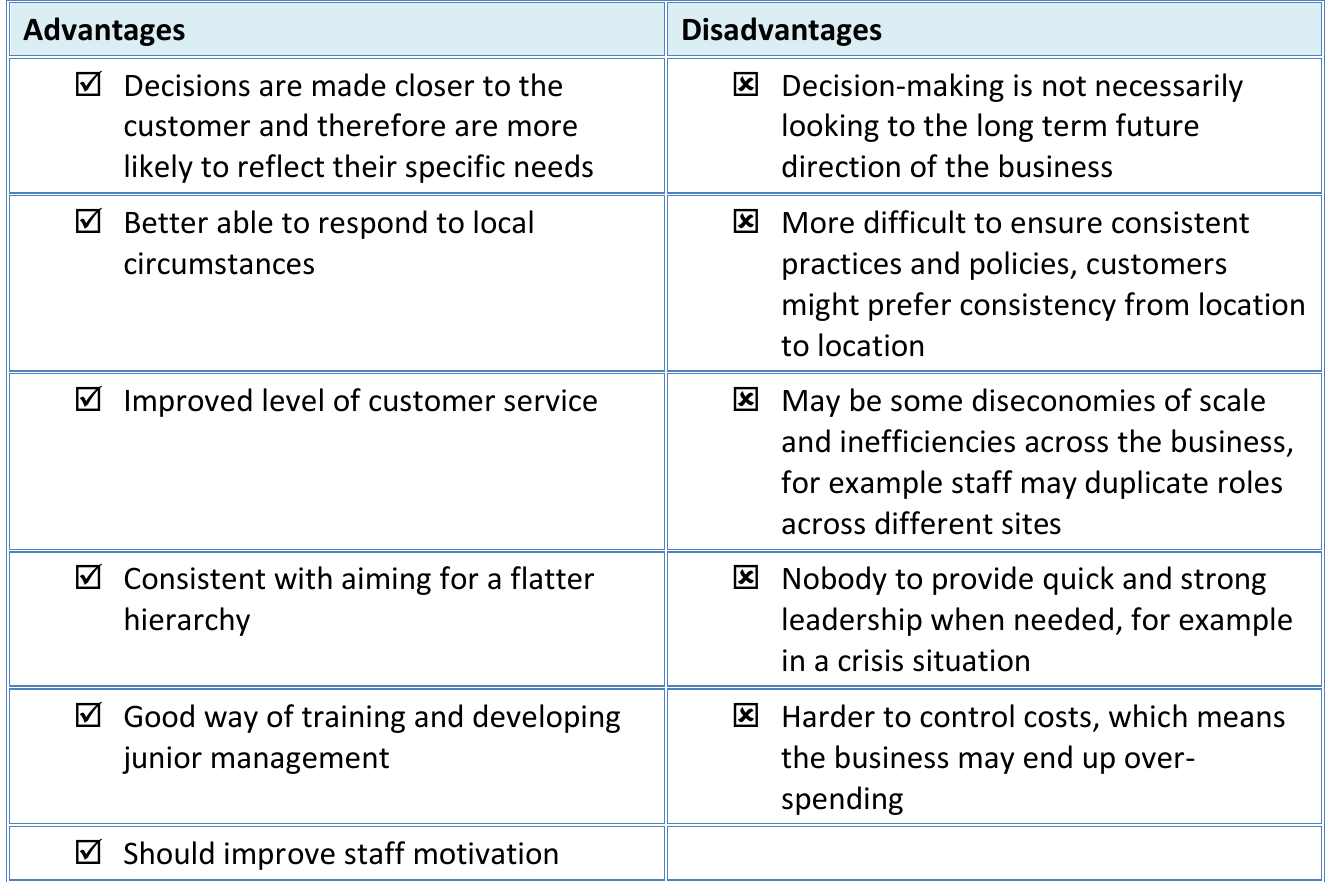 Decentralised structures bring their own set of advantages and challenges that organisations must carefully consider when deciding on their structural approach.
Note
Key Benefits of Decentralisation:
Decentralised structures bring numerous advantages to businesses. Decisions are made much closer to customers, meaning they're more likely to reflect specific local needs and circumstances. This proximity enables businesses to respond more effectively to local market conditions and provides an improved level of customer service overall.
From an organisational perspective, decentralisation aligns well with the goal of creating flatter hierarchies, which many modern businesses prefer. It also serves as an excellent method for training and developing junior management, giving them real responsibility and decision-making experience. This increased responsibility typically leads to improved staff motivation throughout the organisation.
Important
Challenges of Decentralisation:
Nevertheless, decentralisation also presents significant challenges. Decision-making may not always consider the long-term strategic direction of the business, as local managers might focus on short-term gains. It becomes much more difficult to ensure consistent practices and policies across different locations, and customers might actually prefer uniformity from location to location.
Operationally, decentralisation can lead to diseconomies of scale and inefficiencies, particularly when staff roles are duplicated across different sites. During crisis situations, there may be nobody available to provide the quick, strong leadership that's needed. Finally, cost control becomes more challenging, increasing the risk that the business will end up overspending.
Summary
Key Points to Remember:
- Centralisation keeps decision-making power with senior management at headquarters, ensuring consistency but potentially reducing local responsiveness
- Decentralisation spreads decision-making throughout the organisation, improving local responsiveness but potentially reducing consistency
- Most large businesses use a combination of both approaches, depending on the type of decision and its potential impact
- The key trade-off is between maintaining control and consistency versus enabling flexibility and local responsiveness
- Real-world examples show that fast-food chains favour centralisation for consistency, while supermarkets and hotels prefer decentralisation for customer service