Commercial processes (AQA GCSE Design and Technology): Revision Notes
📚Revision Notes
Commercial processes
Commercial processes are manufacturing methods used to shape and form metals in industry. Understanding these processes is essential for working with metal-based materials, as they determine the quality, cost, and suitability of the final product.
Note
The choice of commercial process directly impacts production costs, product quality, and manufacturing timeline. Different processes are suited to different types of products and production volumes.
Milling
Milling is a machining process that uses rotating cutting tools to remove material from a workpiece. The process involves a milling machine equipped with multi-toothed rotating cutters that spin at high speeds to cut away unwanted metal.
During milling, the workpiece is securely fixed to a machine table that can move in three different directions (axes). As the cutting tool rotates, the table moves the workpiece left and right, forwards and backwards, and up and down. This precise movement ensures that metal is removed only from the desired areas.
Note
The depth of the cut can be controlled by adjusting the vertical position of the machine table using a rotating handle. This level of control allows for precise material removal and accurate final dimensions.
Computer numerical control (CNC) vs manual milling
Modern milling machines can be operated manually by a skilled machinist or controlled automatically using computer numerical control (CNC) technology. CNC milling machines offer several significant advantages over manually operated conventional machines:
- Higher accuracy: CNC machines can achieve much more precise measurements and repeated cuts
- Consistent quality: Every part produced will be identical, reducing variation between products
- Continuous operation: CNC machines can run 24 hours a day, 7 days a week without breaks
- Improved safety: Operators don't need to be as close to the cutting tools during operation
- Faster production: Automated processes can often work quicker than manual operation
- Repeatable processes: Once programmed, the same operation can be performed multiple times with identical results
Important
CNC technology represents a fundamental shift in manufacturing capability. The ability to maintain consistent quality and operate continuously makes CNC milling essential for modern mass production requirements.
Casting
Casting is a manufacturing process where metal is heated until it becomes molten (liquid), then poured into a specially shaped mould. Once the molten metal cools and solidifies, it takes on the shape of the mould cavity. This process allows manufacturers to create complex shapes that would be difficult or expensive to machine.
Note
There are two main types of casting processes you need to understand: die casting and sand casting. Each method has specific applications based on the size, quantity, and quality requirements of the final product.
Die casting
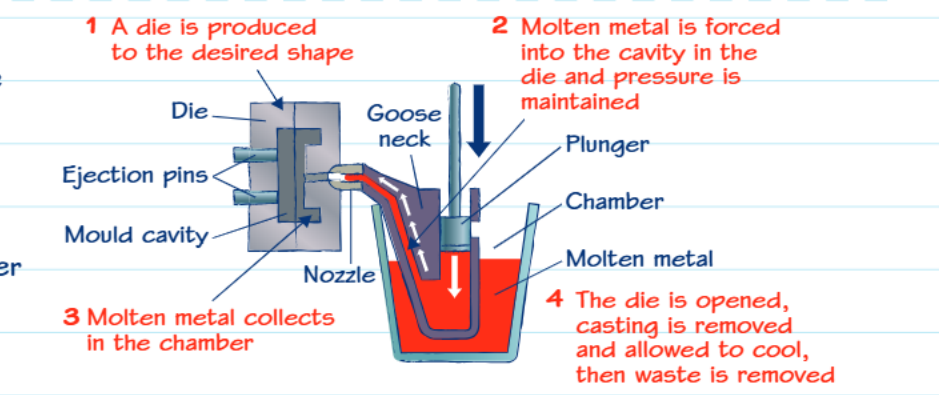
Die casting is typically used for manufacturing smaller metal products and components. This process involves forcing molten metal into a precision-made steel mould (called a die) under high pressure.
Example
Die Casting Process Steps:
Step 1: Die preparation A steel die is manufactured to the exact shape required for the final product
Step 2: Metal injection Molten metal is forced into the die cavity under maintained pressure using a plunger system
Step 3: Metal collection The molten metal collects in a chamber before being pushed through a goose neck and nozzle
Step 4: Part removal Once cooled, the die opens and ejection pins push the finished casting out, while any waste material is removed
Die casting is preferred for smaller products because it offers excellent repeatability and produces a high-quality surface finish. The same die can be used thousands of times, making it cost-effective for large production runs.
Sand casting
Sand casting is used for manufacturing larger metal objects such as vices, clamps, and engine blocks. Unlike die casting, sand casting typically produces items with a lower quality surface finish, but it's more suitable for bigger components.
Example
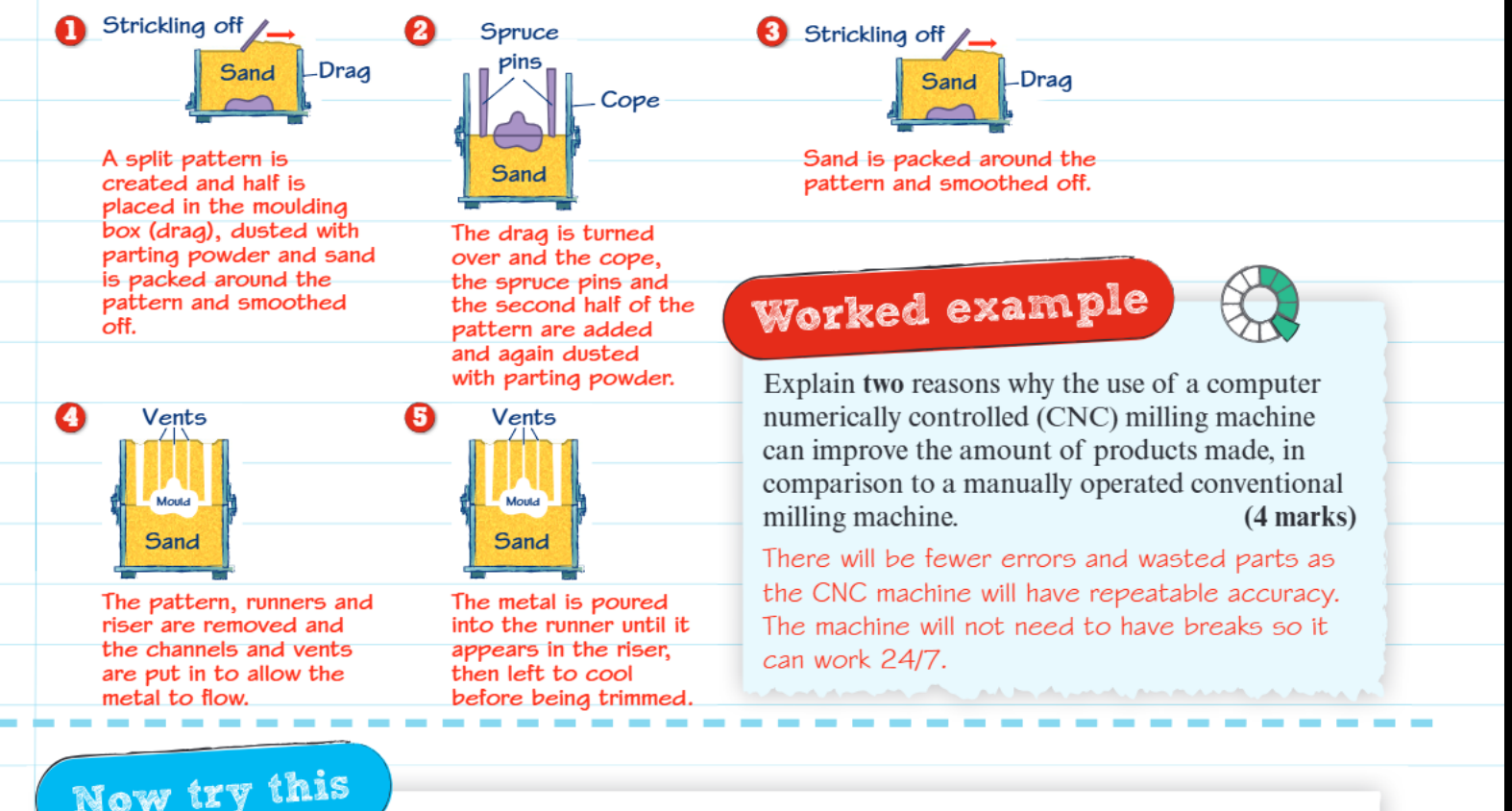
Sand Casting Process Steps:
Step 1: Pattern creation A split pattern is made and the first half is placed in the moulding box (drag), then sand is packed around it and smoothed off (strickled)
Step 2: Mould assembly The drag is turned over, the cope (top half) is positioned, and spruce pins are inserted along with the second half of the pattern
Step 3: Pattern removal Sand is packed around the pattern and smoothed off, then the pattern and spruce pins are removed, leaving cavities
Step 4: Preparation for pouring Channels and vents are cut to allow the molten metal to flow into the mould and air to escape
Step 5: Metal pouring Molten metal is poured into the runner system until it appears in the riser, then left to cool before the casting is removed and trimmed
Important
Sand casting moulds must be remade for each individual casting, which makes this process more suitable for smaller production quantities. However, it's ideal for creating large, complex shapes that would be impractical with other methods.
Key differences between casting methods
Die casting and sand casting each have their own advantages and applications:
Die casting is best for:
- High volume production runs
- Smaller, detailed components
- Parts requiring excellent surface finish
- Items needing consistent dimensions
Sand casting is best for:
- Large, heavy components
- Low volume or one-off production
- Complex internal cavities
- Situations where tooling costs need to be minimised
Summary
Key Points to Remember:
- Milling uses rotating cutters to remove material from metal workpieces, with CNC machines offering superior accuracy and consistency compared to manual operation
- Die casting forces molten metal into steel moulds under pressure, ideal for high-volume production of smaller parts with excellent finish quality
- Sand casting pours molten metal into sand moulds, perfect for larger objects but requiring new moulds for each casting
- CNC technology provides 24/7 operation, repeatable accuracy, and improved safety compared to manual machining
- Choose casting method based on part size, production volume, quality requirements, and cost considerations