Sources and origins (AQA GCSE Design and Technology): Revision Notes
📚Revision Notes
Sources and origins of metals
Understanding metals and their classification
Metals can be grouped into different categories based on their properties and composition. The main classification distinguishes between ferrous metals (which contain iron) and non-ferrous metals (which don't contain iron). These materials are elementary substances that form crystalline structures when they solidify.
When metals are combined together, they create alloys. These are mixtures containing two or more metallic elements that typically offer enhanced properties and improved characteristics compared to pure metals.
Note
Alloys are particularly important in industry because they often have superior properties to pure metals - for example, steel (an iron alloy) is much stronger than pure iron, and bronze (a copper-tin alloy) is more durable than pure copper.
Where metals come from
Metals don't exist freely in nature in their pure form. Instead, they are found naturally within ores, which are solid rock formations containing the metal compounds. The process of obtaining usable metals involves extracting and purifying them from these ore sources.
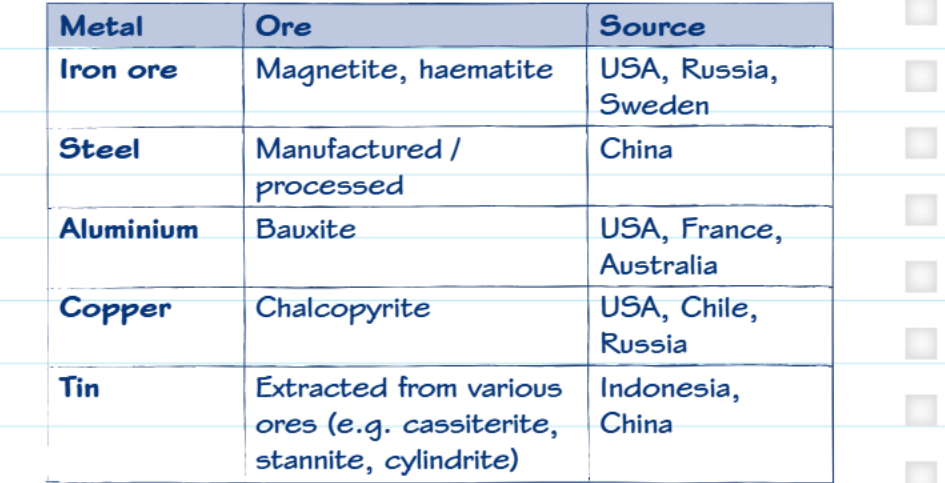 The table shows the main sources of important metals used in industry. For example, iron ore comes from magnetite and hematite ores found primarily in the USA, Russia, and Sweden. Aluminium is extracted from bauxite ore, with major deposits in the USA, France, and Australia.
Methods of metal extraction
The technique used to extract metals from their ores depends on how chemically reactive the metal is. There are two primary approaches: carbon reduction and electrolysis.
Important
Key Principle: The more reactive a metal is, the stronger its bond with oxygen, and the more energy is needed to break that bond and extract the pure metal.
Carbon reduction process
Less reactive metals like zinc, iron, and tin can be extracted using a blast furnace and carbon reduction. This method works because carbon is more reactive than these metals, so it can remove oxygen from their compounds.
Example
Worked Example: Iron Extraction Process
The iron extraction process demonstrates this well:
- Iron ore gets fed into the furnace along with coke (carbon source), limestone, and oxygen-rich air
- The mixture is heated to approximately 2000°C
- At this temperature, chemical reactions occur that convert iron oxides into liquid iron
- The molten iron settles at the bottom of the furnace where it can be collected
- Limestone helps eliminate acidic impurities during the process
- This entire process is known as a reduction reaction
Electrolysis process
More reactive metals, particularly aluminium, require electrolysis for extraction because they hold onto oxygen more strongly than carbon can remove it.
Aluminium extraction happens in two main stages:
Stage 1 - Preparing the aluminium ore The bauxite ore undergoes purification using a hot caustic soda solution. This dissolves the aluminium oxide, creating a white solid material. After washing and drying, this becomes a white powder ready for the next stage.
Stage 2 - Extracting pure aluminum The aluminium oxide powder gets dissolved in molten cryolite to create a liquid mixture. This liquid goes into an electrolysis tank equipped with carbon electrodes - a negative cathode and positive anode. When electricity passes through, the aluminium gets attracted to the negative electrode and collects at the tank's bottom, where it can be extracted as pure metal.
Note
Cryolite plays a crucial role in this process as it's a mineral containing aluminium and sodium fluoride, which helps dissolve the aluminium oxide effectively and reduces the temperature needed for electrolysis.
Summary
Key Points to Remember:
- Metals are naturally found in ores, not in pure form, and must be extracted and refined
- Less reactive metals (iron, zinc, tin) use carbon reduction in blast furnaces at very high temperatures
- More reactive metals (aluminium) require electrolysis because carbon reduction isn't strong enough
- The choice of extraction method depends entirely on the metal's reactivity level
- Major metal sources are distributed globally, with different countries specialising in different ores