Using and working with metals (AQA GCSE Design and Technology): Revision Notes
📚Revision Notes
Using and working with metals
When manufacturers select materials for their products, they must carefully evaluate how well each material will meet all the required needs. The characteristics of metals can be modified through various processes like alloying, hardening, and tempering to better suit specific applications.
Properties that influence design decisions
The selection of metals for any product depends on multiple interconnected factors that manufacturers must balance. These properties work together to determine whether a metal is suitable for a particular application.
Note
Understanding how different properties interact is crucial for successful material selection. A metal that excels in one area may be deficient in another, requiring designers to make thoughtful compromises based on the specific application requirements.
Physical properties
These fundamental characteristics include the density and weight of the metal, which affects how heavy the final product will be. Fusibility refers to how easily the metal can be melted and shaped, while electrical and thermal conductivity determine how well the metal can conduct electricity or heat.
Mechanical properties
The strength of a metal includes both its ability to resist tension (pulling forces) and compression (pushing forces). Hardness measures how well it resists scratching or denting, while toughness indicates its ability to absorb energy before breaking. Malleability describes how easily it can be hammered into sheets, and ductility refers to how well it can be drawn into wires. Elasticity shows whether it returns to its original shape after bending, while plasticity indicates its ability to be permanently deformed.
Important
The mechanical properties of metals are often the most critical factors in determining suitability for structural applications. A material may look perfect but fail catastrophically if its mechanical properties don't match the intended use.
Aesthetic considerations
The visual appeal of the metal plays a crucial role in consumer products. This includes how the metal will look to customers, the colours and textures that can be achieved, and the overall form or shape possibilities.
Functional requirements
Designers must consider what the final product needs to accomplish and who will be using it. This includes thinking about measurable performance factors that determine how well the product will work in real-world conditions.
Cultural and social factors
Modern manufacturing must account for diverse user needs, including considerations for people with disabilities, different religious groups, age ranges, and various consumer society trends. The target market and potential obsolescence also influence material choices.
Environmental and ethical factors
Sustainability has become increasingly important, including waste management strategies, energy demands during production, and recycling possibilities. Ethical sourcing of raw materials and fair trade organisations also influence material selection decisions.
Economic considerations
The cost of raw materials and their conversion into finished products significantly impacts material choice. Manufacturers must balance the budget available against the target price for the intended market.
Production scale factors
The methods used for processing metals, joining techniques, and overall manufacturing capabilities all affect which materials are practical for a given production run.
Enhancing metals through structural modifications
Metals can be strengthened and improved by changing their physical structure rather than their chemical composition. One of the most effective methods is bending or folding the metal to create a more rigid structure.
 When thin metal sheets are used in their flat form, they tend to be quite flexible and may not provide adequate structural support. However, by folding or bending these sheets, manufacturers can dramatically increase their rigidity and strength.
Important
Key Structural Principle: Flat metal sheets lack structural rigidity, but folding or bending the sheet transforms it into a much more rigid form. This technique allows manufacturers to use less material while achieving greater strength.
Example
Practical Application: Aluminium Chair Legs
Consider aluminium chair legs that use thin-walled tube structures:
- Flat sheet: Flexible and weak under load
- Folded into tube: Much stronger than solid flat pieces of the same weight
- Result: Better strength-to-weight ratio with less material usage
This principle is commonly used in furniture design, where the structural transformation provides both material efficiency and improved performance.
Practical applications and examples
Kitchen utensils made from stainless steel
 Stainless steel has become the preferred material for kitchen utensils due to several important properties. Its functionality makes it easy to clean, which is essential for cooking applications where hygiene is critical. The aesthetic appeal of stainless steel includes its shiny surface that looks professional and attractive while being resistant to scratching.
Example
Material Selection: Stainless Steel Kitchen Utensils
Key Properties that make stainless steel ideal:
- Hygiene: Easy to clean and sanitise
- Aesthetics: Professional, shiny appearance
- Durability: Scratch and corrosion resistant
- Manufacturing: Can be easily pressed into complex shapes
- Maintenance: No additional coatings required
- Strength: Withstands regular kitchen use
Additional advantages include scale of production benefits - the steel can be easily pressed and formed into complex shapes during manufacturing. The material also has excellent finishing properties since it doesn't require additional coatings or treatments, being naturally corrosion-resistant.
Engineering tools made from cast iron
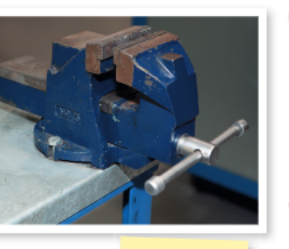 Cast iron serves as an excellent material for heavy-duty engineering tools like vises because of its specific combination of properties. The material choice reflects careful consideration of functional requirements - the tool needs to hold workpieces securely under significant force without breaking or deforming.
Example
Material Selection: Cast Iron Engineering Vises
Why cast iron is ideal for vises:
- Compressive strength: High resistance to clamping forces
- Stability: Heavy weight provides stable work platform
- Manufacturing: Can be cast into complex, precise shapes
- Durability: Handles repeated heavy-duty use
- Cost-effectiveness: Economical for specialised tool production
Cast iron's mechanical properties include high compressive strength, making it ideal for applications where heavy clamping forces are required. Its density and weight actually become advantages in this application, as the mass helps provide stability during use.
Summary
Key Points to Remember:
-
Material selection involves balancing multiple factors - physical, mechanical, aesthetic, functional, cultural, environmental, and economic properties all influence design decisions
-
Metals can be enhanced structurally - bending and folding thin metal sheets creates much stronger, more rigid structures without adding weight
-
Different applications require different properties - kitchen utensils need hygiene and corrosion resistance, while engineering tools need strength and stability
-
Cost and production methods matter - the scale of production, joining methods, and manufacturing capabilities all affect which materials are practical to use
-
Real-world examples demonstrate principles - stainless steel utensils and cast iron vises show how material properties match application requirements