Dialysis machines & kidney transplants (Edexcel GCSE Biology): Revision Notes
📚Revision Notes
Dialysis machines & kidney transplants
Treatments for Kidney Failure
Note
Kidney failure occurs when the kidneys can no longer function properly to philtre waste products, such as urea, from the blood. This leads to a dangerous buildup of toxins in the body. There are two main treatments for kidney failure: kidney dialysis and kidney transplants (organ donation). Additionally, urea production in the body plays a key role in this process, and its removal is crucial for maintaining health.
Kidney Dialysis:
Note
Dialysis is a medical procedure that philtres the blood of patients whose kidneys have stopped functioning properly.
How it works:
- A dialysis machine acts as an artificial kidney by removing waste products, such as urea, from the blood.
- The patient's blood flows into the machine, which contains a partially permeable membrane. This allows urea, excess salts, and waste to pass out of the blood while keeping essential substances like glucose and some ions.
- Dialysis fluid on the other side of the membrane ensures that waste products move out of the blood by diffusion.
- The cleaned blood is then returned to the patient's body.
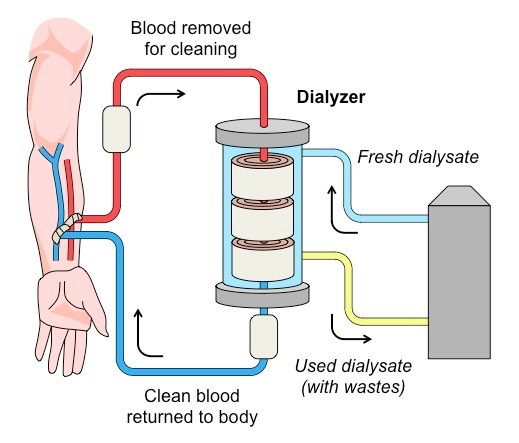
Frequency: Patients typically need dialysis sessions several times a week, with each session lasting several hours.
Limitations:
- Dialysis can be time-consuming and restrictive, requiring regular sessions.
- It does not cure kidney failure, and patients may need dialysis for the rest of their lives unless they receive a kidney transplant.
- Long-term dialysis can lead to complications like infection or damage to the blood vessels used for treatment.
Kidney Transplant (Organ Donation):
Note
A kidney transplant involves surgically replacing a failed kidney with a healthy kidney from a donor.
How it works:
-
The donated kidney is typically from a living relative or from a deceased donor.
-
The new kidney is connected to the patient's blood vessels and urinary system, allowing it to take over the function of filtering the blood.
-
After a successful transplant, the patient no longer needs dialysis. Advantages:
-
It provides a long-term solution and allows the patient to return to a more normal lifestyle without the need for regular dialysis. Challenges:
-
The patient must take immunosuppressive drugs for life to prevent their body from rejecting the new kidney.
-
There is always a risk of rejection, even with immunosuppressive drugs.
-
There may be a shortage of donor kidneys, leading to long waiting times for a transplant.
Comparison of Dialysis and Kidney Transplant:
| Treatment | Kidney Dialysis | Kidney Transplant |
|---|---|---|
| Frequency | Several times a week (ongoing) | One-time surgery, lifelong monitoring required |
| Invasiveness | Non-surgical, but involves regular access to the blood | Surgical procedure |
| Advantages | Does not require surgery, immediate access for most | Long-term solution, no need for regular dialysis |
| Limitations | Time-consuming, short-term solution, can lead to complications | Risk of rejection, need for immunosuppressants, donor shortage |