The Battle of Agincourt, 1415 (Edexcel GCSE History): Revision Notes
📚Revision Notes
The Battle of Agincourt, 1415
Background and context
The Battle of Agincourt took place in 1415 during the Hundred Years' War between England and France. This famous confrontation occurred when Henry V's English army was making its way to the port of Calais after a long and exhausting military campaign across France. The English forces were weakened by disease and fatigue from their extended march when they were intercepted by a much larger French army.
Note
The Hundred Years' War (1337-1453) was actually a series of conflicts between England and France over territorial claims and succession rights. Agincourt was one of the most decisive English victories during this prolonged period of warfare.
The battle demonstrates several crucial aspects of mediaeval warfare, including military strategy, the effectiveness of different weapons, leadership qualities, and the impact of social attitudes on battlefield decisions.
The opposing forces
The English army consisted of approximately 8,000 troops, significantly outnumbered by the French force of around 15,000 soldiers. However, the composition of these armies was quite different. The English force included a substantial number of skilled longbowmen, while the French army was dominated by heavily armoured knights and cavalry, reflecting the traditional approach to mediaeval warfare.
Example
Army Composition Breakdown
English Forces (≈8,000):
- Skilled longbowmen: ~6,000
- Men-at-arms and knights: ~2,000
French Forces (≈15,000):
- Heavy cavalry and knights: ~10,000
- Infantry and crossbowmen: ~5,000
This shows the English relied heavily on missile troops, while the French emphasised traditional heavy cavalry.
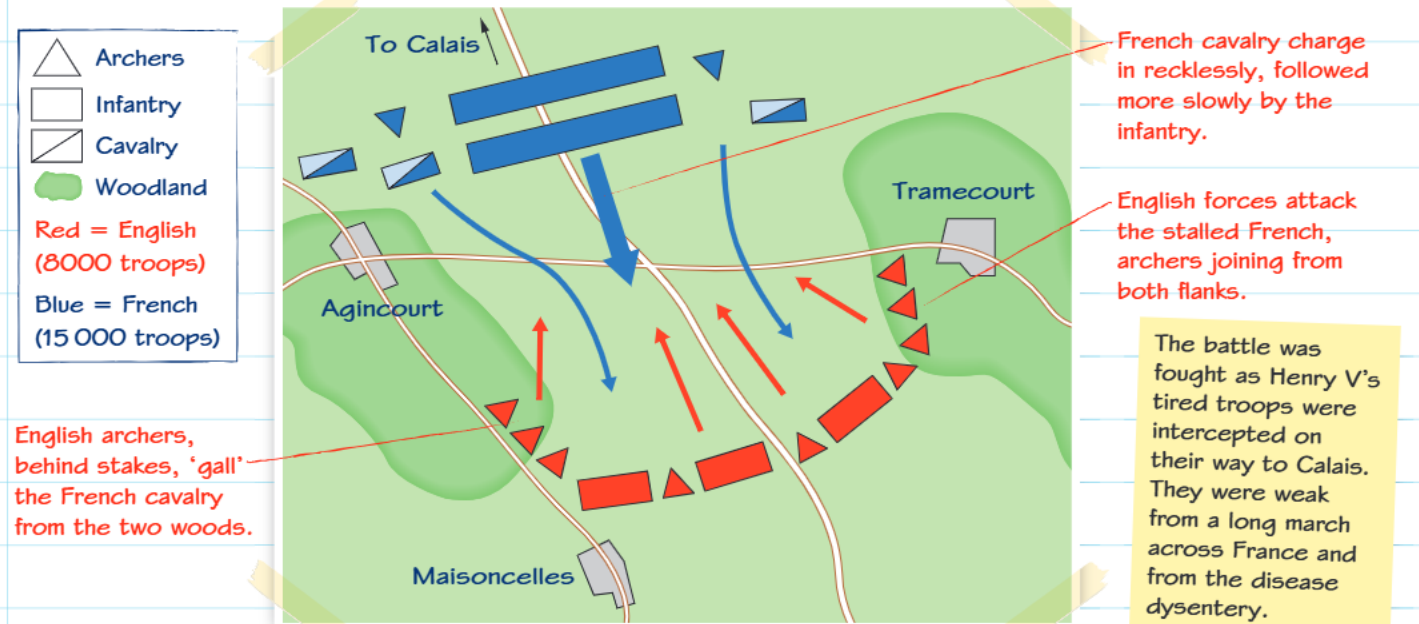
Henry V's tactical positioning
Henry V demonstrated excellent strategic thinking in his choice of battlefield position. He positioned his army at the narrowest point of the available terrain, which served multiple tactical purposes. This narrow positioning meant the French forces would be funnelled into a tighter space, preventing them from taking full advantage of their numerical superiority and making it much harder for them to overwhelm the English lines.
The battlefield terrain worked in England's favour in several ways. The heavy, wet clay soil made movement difficult, particularly for heavily armoured cavalry trying to charge across the field. Additionally, the flanks of the English position were protected by woodland areas, which prevented the French from attacking from the sides and allowed English archers to position themselves safely within the tree cover.
Note
Tactical Advantages of Henry's Position:
- Narrow field limited French numerical advantage
- Muddy terrain hindered heavy cavalry charges
- Woodland flanks provided natural protection
- Defensive stakes created additional barriers
To further strengthen his defensive position, Henry V ordered long, sharpened stakes to be planted in the ground and angled towards the approaching French forces. These stakes were specifically designed to stop charging cavalry and horses, creating a formidable barrier that would break up any coordinated attack.
The role of English archers
The English longbowmen played a decisive role in the battle's outcome. These skilled archers could fire up to 100,000 arrows per minute collectively, creating a devastating barrage that could penetrate armour and kill or wound both horses and riders. Some English archers took advantage of the woodland protection to fire at French forces while remaining relatively safe from retaliation.
The archers' effectiveness was enhanced by their positioning and the tactical situation. As the French cavalry became trapped and disorganised in the muddy terrain, the archers could target them more easily. When the battle moved to close combat, many archers joined the fighting with swords and daggers, supporting the English infantry.
Important
Why English Longbows Were So Effective: The English longbow had a range of up to 300 yards and could penetrate most armour of the period. When thousands of archers fired simultaneously, they created a "storm of arrows" that was nearly impossible to survive. The key was not just the weapon, but the tactical coordination and positioning that made mass archery so devastating.
The French approach and chivalric code
The French forces were heavily influenced by their adherence to chivalric ideals, which ultimately contributed to their defeat. French knights followed a strict code of behaviour that emphasised honourable combat between equals - knight against knight in individual duels. This chivalric mindset made them view attacks by archers as dishonourable and unchivalrous.
This attitude led to reckless decision-making on the battlefield. Outraged by what they saw as unfair tactics, French knights reacted emotionally rather than strategically. Instead of adapting their approach to counter the English tactics effectively, they charged forwards recklessly, playing directly into Henry V's defensive strategy.
Important
How Chivalric Ideals Led to Defeat: The French knights' commitment to "honourable" individual combat made them unable to adapt to new battlefield realities. They saw coordinated missile attacks as cowardly and refused to use similar tactics themselves. This rigid thinking cost them the battle and thousands of lives.
Key phases of the battle
The battle unfolded in several distinct phases, each demonstrating different aspects of mediaeval military tactics:
Example
The Five Phases of Agincourt
Phase 1 - The French cavalry charge: French knights launched a direct assault on the English positions, but their charge became disorganised as they struggled through the heavy mud and encountered the defensive stakes. Many horses were killed or injured, leaving knights vulnerable on foot.
Phase 2 - English archer dominance: As the French cavalry became bogged down and trapped, English archers maintained their devastating fire, picking off targets that could no longer manoeuvre effectively.
Phase 3 - Infantry engagement: With the French cavalry neutralised, English knights fought on foot, forming a solid centre that could withstand the remaining French attacks while being supported by archers from the flanks.
Phase 4 - English flanking attacks: English forces attacked the stalled French from both sides, taking advantage of their enemy's disorganisation and the confusion caused by the muddy battlefield conditions.
Phase 5 - French retreat: Exhausted and having suffered massive casualties, the remaining French forces were finally forced to retreat, leaving the field to the victorious English army.
Henry V's leadership decisions
Henry V's performance during the campaign and battle showed both strengths and weaknesses as a military leader:
Effective decisions:
- He chose an excellent defensive position that maximised his army's advantages
- He fought alongside his soldiers, boosting morale and demonstrating personal courage
- He made his cavalry fight on foot, creating a stronger, more stable centre for his battle line
- He used his archers strategically to provoke the French into attacking across unfavourable terrain
Poor decisions:
- His extended march across France had significantly weakened his army through disease and exhaustion
- He allowed his force to become trapped and was forced to fight when retreat might have been wiser
Note
Leadership Lesson: Even great military leaders make mistakes. Henry V's strategic brilliance at Agincourt partially compensated for his earlier tactical errors during the campaign. The key was his ability to maximise his advantages when forced into battle.
Significance and consequences
The Battle of Agincourt became one of the most famous English victories of the mediaeval period, demonstrating that superior tactics, effective use of terrain, and disciplined troops could overcome numerical disadvantage. The battle highlighted the changing nature of mediaeval warfare, showing how traditional heavy cavalry could be defeated by well-positioned infantry and missile troops.
The victory also enhanced Henry V's reputation as a military leader and strengthened English claims in France, though it did not end the Hundred Years' War. The battle became a source of English national pride and was later immortalised in literature and popular culture.
Note
Long-term Impact: While Agincourt was a spectacular tactical victory, it didn't end the war. The French eventually adapted their tactics and drove the English out of most of their French territories by 1453. However, the battle's psychological impact and its demonstration of new military realities influenced European warfare for generations.
Timeline of events
- 1415: Henry V launches campaign in France
- October 1415: English army begins march to Calais
- 25 October 1415: Battle of Agincourt fought
- After the battle: English forces continue to Calais and return to England
Remember!
Summary
Key Points to Remember:
- Superior tactics beat superior numbers: Despite being outnumbered almost 2:1, the English won through better positioning and strategy
- Terrain matters: The muddy battlefield and narrow position neutralised French numerical advantage
- Technology and tactics work together: English longbows were most effective when combined with defensive stakes and good positioning
- Leadership decisions are crucial: Henry V's choice of battlefield position was the key factor in English victory
- Social attitudes affect military performance: French chivalric ideals led to poor tactical decisions and reckless attacks