The Three Circulation Cells (Leaving Cert Geography): Revision Notes
📚Revision Notes
The three circulation cells
Introduction to atmospheric circulation
Earth's atmospheric circulation in each hemisphere is organised into three distinct circulation patterns called cells. These cells work together to redistribute heat energy from the equator towards the poles, creating the global wind patterns that drive our weather systems.
Note
Understanding these circulation cells is fundamental to comprehending global weather patterns, climate zones, and why certain regions experience specific types of weather conditions throughout the year.
The three circulation cells are:
- Hadley cell - operates in tropical regions
- Ferrel cell - operates in temperate regions
- Polar cell - operates in polar regions
Each cell creates specific pressure patterns and wind systems that influence climate and weather across different latitudes.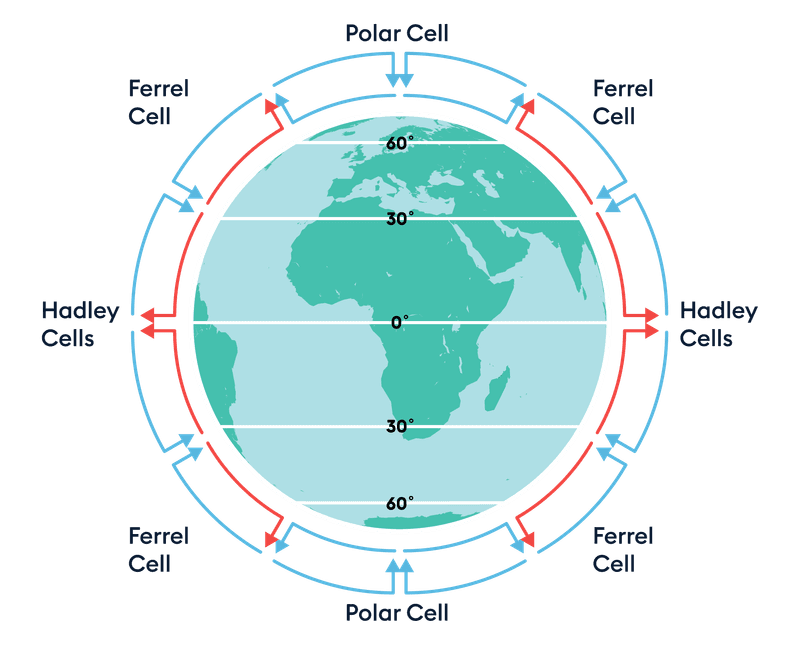
Hadley cell
Location and operation
The Hadley cell functions between the equator and 30° latitude in both the northern and southern hemispheres. This circulation pattern begins when intense solar heating at the equator causes warm air to rise rapidly, creating an area of low pressure at the surface.
Important
The Hadley cell is the most powerful and consistent of the three circulation cells because it is driven directly by the strong temperature contrast between the hot equator and cooler regions at 30° latitude.
Air movement and pressure patterns
As the heated air rises at the equator, it cools and spreads poleward through the upper atmosphere. At approximately 30° latitude, this cooled air descends back to Earth's surface, forming regions of high pressure. This descending air creates the dry conditions that explain why many of the world's major deserts are located around 30° latitude.
Example
Real-world Application: Desert Locations
The descending air at 30° latitude creates some of the world's major deserts:
- Northern Hemisphere: Sahara Desert (North Africa), Sonoran Desert (USA/Mexico)
- Southern Hemisphere: Kalahari Desert (Southern Africa), Great Victoria Desert (Australia)
These deserts exist because the descending air is dry and creates high-pressure conditions that suppress cloud formation.
Trade winds
The surface air flows back towards the equator from these high-pressure areas at 30° latitude, creating the trade winds. These consistent wind patterns were historically crucial for maritime navigation and continue to be fundamental in shaping global weather patterns. The trade winds converge at the equator in a zone called the Intertropical Convergence Zone (ITCZ).
Polar cell
Location and characteristics
The Polar cell operates from 60° latitude to the poles in both hemispheres. This circulation pattern involves cold, dense air that descends at the poles, creating high-pressure areas at the surface.
Air circulation pattern
Cold air sinks at the poles due to its density, then flows towards lower latitudes along the surface. At around 60° latitude, this air meets warmer air from lower latitudes and rises, creating a low-pressure area. The rising air then flows back towards the poles in the upper atmosphere, completing the circulation.
Note
The Polar cell is the weakest of the three circulation cells because the temperature differences that drive it are less extreme than those in the Hadley cell, and it covers a smaller area.
Polar easterlies
The surface winds in the Polar cell are known as polar easterlies, which blow from east to west. These winds play a significant role in shaping the harsh climates of both the Arctic and Antarctic regions.
Ferrel cell
Location and complexity
The Ferrel cell exists between 30° and 60° latitude and is the most complex and unpredictable of the three circulation cells. Unlike the Hadley and Polar cells, which are driven primarily by temperature differences, the Ferrel cell is largely influenced by the neighbouring cells.
Important
The Ferrel cell is often called an "indirect cell" because it doesn't operate independently like the other two cells. Instead, it acts like a gear wheel between the Hadley and Polar cells, driven by their circulation patterns.
Air movement patterns
In the Ferrel cell, air moves poleward and upward at approximately 60° latitude, creating low-pressure conditions. This air then descends at around 30° latitude, forming high-pressure zones. This circulation pattern is less consistent than the other two cells due to the complex interactions between warm and cold air masses.
Prevailing westerlies
The Ferrel cell generates the prevailing westerlies - winds that blow from west to east in the mid-latitudes. These westerly winds are particularly important for weather systems in temperate regions, including those that affect Ireland and much of Europe. The prevailing westerlies carry weather fronts and storm systems across these latitudes, making them crucial for understanding regional climate patterns.
Global circulation system
The three circulation cells work together as an interconnected system. Air rises at the equator (Hadley cell) and at 60° latitude (where Ferrel and Polar cells meet), while it descends at 30° latitude (where Hadley and Ferrel cells meet) and at the poles (Polar cell). This creates alternating bands of high and low pressure around the globe, which drive the major wind systems that influence weather patterns worldwide.
Note
This interconnected system explains why weather changes in one part of the world can eventually influence weather patterns in distant regions. The circulation cells act as a global conveyor belt for heat and moisture transport.
Summary
Key Points to Remember:
- Three cells exist in each hemisphere: Hadley (0°-30°), Ferrel (30°-60°), and Polar (60°-90°)
- Hadley cell creates trade winds that blow towards the equator and historically aided ocean navigation
- Polar cell produces polar easterlies that blow from east to west in polar regions
- Ferrel cell generates prevailing westerlies that bring weather systems to temperate regions like Ireland
- Pressure patterns alternate: low pressure at equator and 60°, high pressure at 30° and poles
- Desert formation: Major deserts form at 30° latitude due to descending dry air from the Hadley cell