Chemical Bonding (Grade 10 NSC Matric Physical Sciences): Revision Notes
📚Revision Notes
Covalent Bonding
The nature of the covalent bond
Covalent bonding happens between atoms of non-metals. When these atoms bond, their outer electron shells overlap so that unpaired electrons in each bonding atom can be shared. Through this overlapping process, the outer energy shells of all bonding atoms become filled. The shared electrons move around both atoms, creating an attractive force between the negatively charged electrons and the positively charged nuclei. This attractive force holds the atoms together in a covalent bond.
Important
Definition: Covalent bond A covalent bond is a type of chemical bonding where pairs of electrons are shared between atoms.
Understanding the number of electrons involved in bonding helps us predict how atoms will bond together. We can distinguish between different types of covalent bonds:
-
A single covalent bond forms when two electrons are shared between two atoms, with one electron contributed by each atom.
-
A double covalent bond forms when four electrons are shared between two atoms, with two electrons contributed by each atom.
-
A triple covalent bond forms when six electrons are shared between two atoms, with three electrons contributed by each atom.
Note
It's important to remember that compounds can contain a mixture of single, double and triple bonds. An atom doesn't need to share all its valence electrons with just one other atom - it can share its valence electrons with several different atoms. We describe the valency of atoms as being different when this happens.
Valency
The concept of valency is essential for understanding how atoms bond with each other. When we draw diagrams to show what happens during bonding, we only show the valence electrons because these are the only electrons involved in the bonding process.
Important
Definition: Valency The number of electrons in the outer shell of an atom that can be used to form bonds with other atoms.
Worked examples of covalent bonding
Example
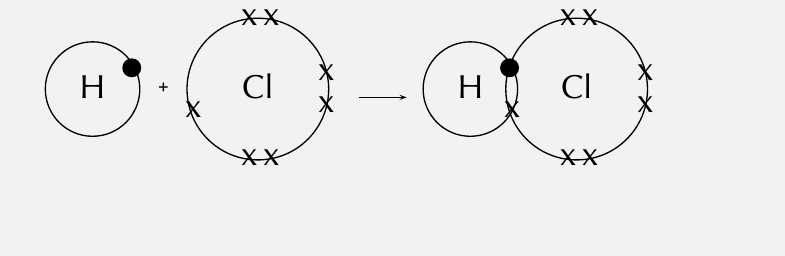
Worked Example 1: Formation of hydrogen chloride (HCl)
Question: How do hydrogen and chlorine atoms bond covalently to form a molecule of hydrogen chloride?
Solution:
Step 1: Determine the electron configuration of each bonding atom. A chlorine atom has 17 electrons with electron configuration [Ne]3s²3p⁵. A hydrogen atom has only one electron with electron configuration 1s¹.
Step 2: Determine how many electrons are paired or unpaired. Chlorine has seven valence electrons, with one of these electrons unpaired. Hydrogen has one valence electron and it is unpaired.
Step 3: Work out how the electrons are shared. The hydrogen atom needs one more electron to complete its outermost energy level. The chlorine atom also needs one more electron to complete its outermost energy level. Therefore, one pair of electrons must be shared between the two atoms, forming a single covalent bond.
Example
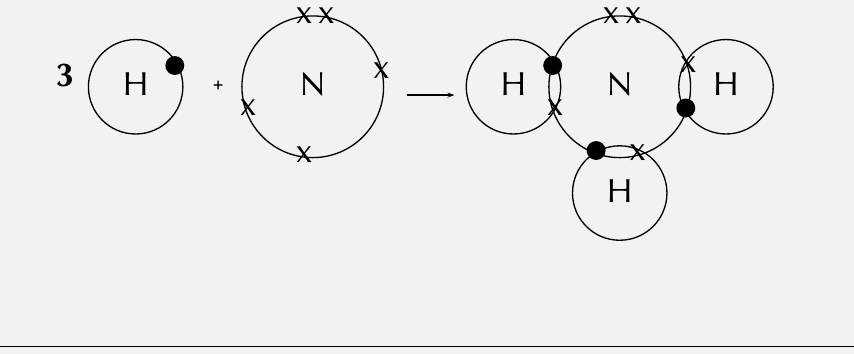
Worked Example 2: Formation of ammonia (NH₃)
Question: How do nitrogen and hydrogen atoms bond to form a molecule of ammonia (NH₃)?
Solution:
Step 1: Give the electron configuration. A nitrogen atom has seven electrons with electron configuration [He]2s²2p³. A hydrogen atom has only one electron with electron configuration 1s¹.
Step 2: Give the number of valence electrons. Nitrogen has five valence electrons, with three of these electrons unpaired. Hydrogen has one valence electron and it is unpaired.
Step 3: Work out how the electrons are shared. Each hydrogen atom needs one more electron to complete its valence energy shell. The nitrogen atom needs three more electrons to complete its valence energy shell. Therefore, three pairs of electrons must be shared between the four atoms involved, forming three single covalent bonds.
Example
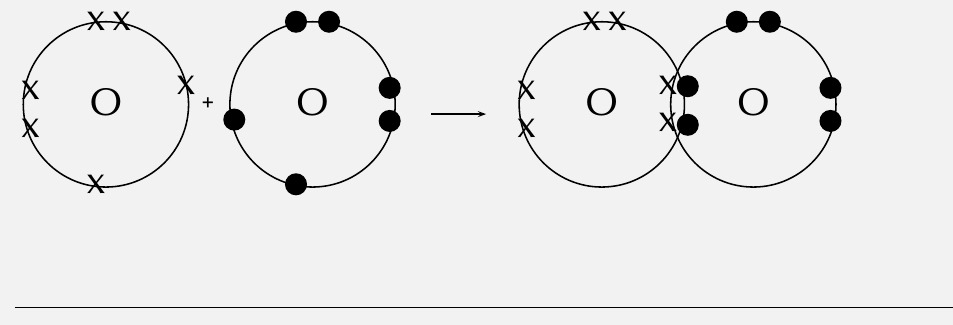
Worked Example 3: Formation of oxygen gas (O₂)
Question: How do oxygen atoms bond covalently to form an oxygen molecule?
Solution:
Step 1: Determine the electron configuration of the bonding atoms. Each oxygen atom has eight electrons with electron configuration [He]2s²2p⁴.
Step 2: Determine the number of valence electrons for each atom and how many are paired and unpaired. Each oxygen atom has six valence electrons, with each atom having two unpaired electrons.
Step 3: Work out how the electrons are shared. Each oxygen atom needs two more electrons to complete its valence energy shell. Therefore, two pairs of electrons must be shared between the two oxygen atoms so that both outermost energy levels become full. A double bond forms.
Properties of covalent compounds
Covalent compounds have several distinctive properties that set them apart from ionic compounds and metals:
-
Lower melting and boiling points: Covalent compounds generally have lower melting and boiling points compared to ionic compounds.
-
Greater flexibility: Covalent compounds are generally more flexible than ionic compounds. The molecules in covalent compounds can move around to some extent and can sometimes slide over each other (as happens with graphite, which makes pencil lead feel slightly slippery). In ionic compounds, all the ions are held tightly in fixed positions.
-
Poor water solubility: Covalent compounds generally do not dissolve well in water. For example, plastics are covalent compounds and many plastics are water resistant.
-
Poor electrical conductivity: Covalent compounds generally do not conduct electricity when dissolved in water. For example, iodine dissolved in pure water does not conduct electricity.
Note
These properties arise from the nature of covalent bonding itself. Since electrons are shared rather than transferred, covalent compounds don't have the strong electrostatic attractions found in ionic compounds, which explains their lower melting points and poor electrical conductivity.
Summary
Key Points to Remember:
- Covalent bonds form between non-metal atoms through electron sharing
- Single bonds share 2 electrons, double bonds share 4 electrons, triple bonds share 6 electrons
- Valency refers to the number of electrons in the outer shell available for bonding
- Covalent compounds have lower melting points, are more flexible, and don't conduct electricity well
- Always determine electron configurations first, then count unpaired valence electrons to predict bonding patterns