Ionic Bonding (Grade 10 NSC Matric Physical Sciences): Revision Notes
📚Revision Notes
Ionic Bonding
What is ionic bonding?
Ionic bonding occurs when electrons move completely from one atom to another. This type of chemical bond forms when there is a large difference in electronegativity between two atoms.
Electronegativity is a measure of how strongly an atom attracts electrons. When the electronegativity difference between two atoms is greater than 1.7, ionic bonding typically occurs. This usually happens between a metal atom and a non-metal atom.
Important
Definition: Ionic bond
An ionic bond is a type of chemical bond where one or more electrons are transferred from one atom to another.
How ionic bonds form
The process of ionic bond formation involves three main steps that demonstrate the complete transfer of electrons between atoms:
-
Electron transfer: The metal atom (with low electronegativity) loses one or more electrons to the non-metal atom (with high electronegativity)
-
Ion formation:
- The metal atom becomes a positively charged ion called a cation
- The non-metal atom becomes a negatively charged ion called an anion
-
Electrostatic attraction: The oppositely charged ions are held together by strong electrostatic forces
Note
Remember the helpful phrase: "Metal Gives, Non-metal Gets" - this describes the direction of electron transfer in ionic bonding.
Worked examples of ionic bond formation
Understanding ionic bonding becomes clearer when we examine specific examples of how different atoms interact to form ionic compounds.
Example
Worked Example: Sodium chloride (NaCl)
In sodium chloride, the electronegativity difference between sodium (0.93) and chlorine (3.16) is 2.1, which is large enough for ionic bonding.
Step-by-step process:
- Sodium has one valence electron, chlorine has seven valence electrons
- Chlorine's higher electronegativity attracts sodium's valence electron
- Sodium loses an electron:
- Chlorine gains an electron:
- The electron transfers from sodium to chlorine:
Balanced equation:
Note that chlorine exists as a diatomic molecule (), so two sodium atoms are needed to react with one chlorine molecule.
Example
Worked Example: Magnesium oxide (MgO)
Magnesium (electronegativity 1.31) and oxygen (electronegativity 3.44) also form ionic bonds.
Step-by-step process:
- Magnesium has two valence electrons, oxygen has six valence electrons
- Oxygen's higher electronegativity attracts both of magnesium's valence electrons
- Magnesium loses two electrons to form
- Oxygen gains two electrons to form
- The attractive force between these oppositely charged ions holds the compound together
Balanced equation:
Since oxygen is diatomic (), two magnesium atoms react with one oxygen molecule to produce two units of magnesium oxide.
Crystal lattice structure of ionic compounds
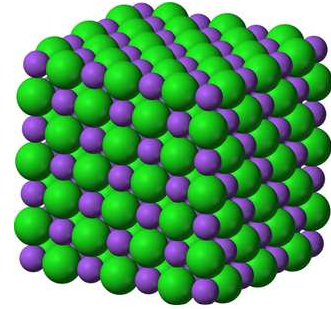
Ionic compounds don't exist as individual molecules. Instead, they form large structures called crystal lattices, which give these compounds their unique properties and characteristics.
Note
Understanding Crystal Lattices
In a crystal lattice:
- Ions are arranged in a regular, repeating three-dimensional pattern
- Each positive ion is surrounded by negative ions, and vice versa
- The ratio of positive to negative ions depends on their charges
- For example, in NaCl, there's a 1:1 ratio of Na⁺ to Cl⁻ ions
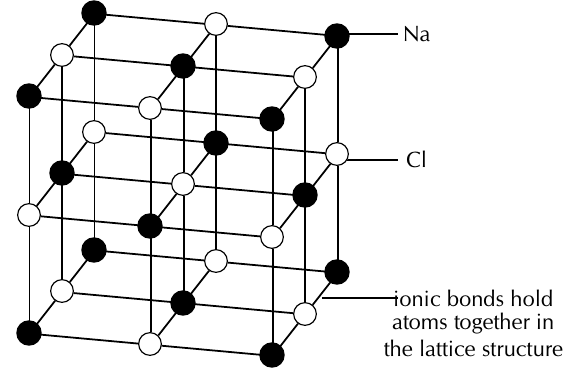
The crystal lattice structure maximises the attractive forces between oppositely charged ions while minimises repulsion between like-charged ions.
Properties of ionic compounds
Ionic compounds share several characteristic properties due to their structure and bonding. These properties make them easily distinguishable from other types of compounds:
-
Lattice structure: Ions are arranged in regular, three-dimensional crystal lattices
-
Crystalline solids: Ionic compounds form crystals at room temperature with defined geometric shapes
-
High melting and boiling points: The strong electrostatic attraction between ions requires significant energy to break, making ionic compounds hard with high melting and boiling points
-
Brittleness: Ionic compounds are brittle and break along planes when stressed, as this causes like-charged ions to align and repel each other
-
Electrical conductivity:
- Solid crystals do not conduct electricity (ions are fixed in position)
- Ionic solutions do conduct electricity (ions are free to move)
Important
Common Mistake to Avoid
Don't confuse the electrical conductivity of ionic compounds in different states. Solid ionic compounds are insulators, but when dissolved or molten, the same compounds become excellent conductors because the ions can move freely.
Summary
Key Points to Remember:
- Ionic bonding occurs when electrons transfer completely from metal atoms to non-metal atoms
- Large electronegativity differences (>1.7) favour ionic bond formation
- Metal atoms become cations (positive ions), non-metal atoms become anions (negative ions)
- Ionic compounds form crystal lattice structures, not individual molecules
- Ionic compounds are hard, brittle, have high melting points, and conduct electricity only when dissolved or molten