Lewis Structures (Grade 10 NSC Matric Physical Sciences): Revision Notes
📚Revision Notes
Lewis Structures
What are Lewis structures?
Lewis structures (also called Lewis dot diagrams) are a way to show how atoms bond together in molecules. They help us understand how electrons are arranged when atoms form chemical compounds. Before we can draw Lewis structures, we need to understand what happens during chemical bonding.
When atoms join together, they form chemical bonds. A chemical bond is the physical process that causes atoms and molecules to be attracted to each other and held together in more stable chemical compounds. This happens when electrons are either shared between atoms (covalent bonding) or transferred from one atom to another (ionic bonding).
Note
The key thing to remember is that it's the valence electrons (electrons in the outermost energy level) that are involved in bonding. Atoms try to fill their outer energy levels to become more stable, just like noble gases which have completely full outer energy levels.
Understanding Lewis notation
Lewis notation uses dots and crosses to represent the valence electrons on different atoms. The chemical symbol of the element represents the nucleus and inner electrons of the atom.
To work out which electrons are valence electrons, you need to look at the electronic configuration of the atom. The last energy level contains the valence electrons.
Important
Critical Concept: The valence electrons are found in the outermost energy level of an atom's electronic configuration. These are the only electrons involved in chemical bonding.
Step-by-step approach to drawing Lewis structures:
- Find the valence electrons: Look at the electronic configuration to identify electrons in the outermost energy level
- Draw the atom: Write the chemical symbol and place dots around it to represent valence electrons
- Show bonding: Use dots and crosses between atoms to show shared electron pairs in covalent bonds
Example
Simple Examples: Lewis Notation
- A hydrogen atom (1 valence electron): H•
- A chlorine atom (7 valence electrons): •Cl• with dots arranged around it
- Hydrogen chloride molecule: H•Cl• - the dot and cross between them represent the shared pair of electrons in the covalent bond
Lewis structures for common molecules
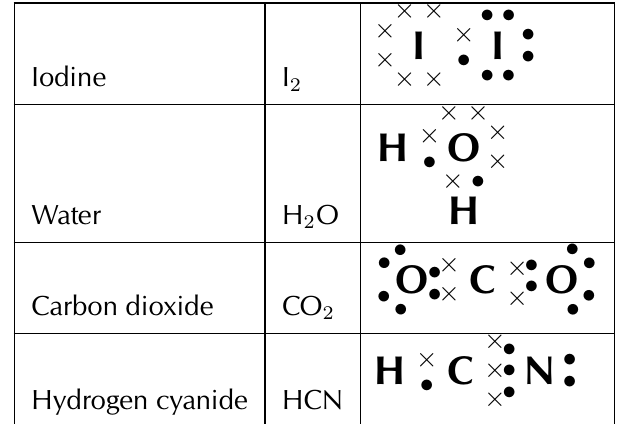
Lewis structures work for different types of molecules by showing how electrons are shared. The key principle is that the dots and crosses between atoms represent pairs of electrons that are shared in the covalent bond.
Example
Common Molecular Examples:
Single bonds:
- Iodine (I₂): Two iodine atoms share one pair of electrons
- Water (H₂O): Oxygen forms single bonds with two hydrogen atoms
- Hydrogen chloride (HCl): Hydrogen and chlorine share one electron pair
Multiple bonds:
- Carbon dioxide (CO₂): Shows double bonds - carbon forms two bonds with each oxygen atom, so two pairs of valence electrons link them
- Hydrogen cyanide (HCN): Shows a triple bond between carbon and nitrogen atoms
Note
Bond Types Summary: Single bonds have one shared pair, double bonds have two shared pairs, and triple bonds have three shared pairs of electrons.
Practical tips for Lewis structures
When drawing Lewis structures, there are several important considerations that will help you get them right every time.
- Count valence electrons carefully: This determines how the atom can bond
- Remember electron pairing: Covalent bonds always involve pairs of electrons
- Use the electronic configuration: For example, chlorine's configuration ends in 3s²3p⁵, so it has 7 valence electrons
- Multiple bonds: When you see molecules like CO₂, remember that double bonds are shown by two pairs of dots/crosses between the atoms
Note
Helpful Tip: Always start by working out the valence electrons from the electronic configuration, then think about how atoms can share electrons to become stable.
Exam guidance
Important
NSC Physical Sciences Exam Requirements
In NSC Physical Sciences exams, you may be asked to:
- Draw Lewis structures for given molecules
- Identify the number of valence electrons in different atoms
- Explain why certain atoms bond in particular ways
- Recognise single, double, and triple bonds from Lewis diagrams
Always start by working out the valence electrons from the electronic configuration, then think about how atoms can share electrons to become stable.
Summary
Summary
Key Points to Remember:
- Lewis structures use dots and crosses to show valence electrons and how they're shared in covalent bonds
- Valence electrons are found in the outermost energy level of an atom's electronic configuration
- Single bonds involve one shared electron pair, double bonds involve two pairs, and triple bonds involve three pairs
- The chemical symbol represents the nucleus and inner electrons, while dots show the valence electrons
- Atoms bond to fill their outer energy levels and become more stable, like noble gases