Metallic Bonding (Grade 10 NSC Matric Physical Sciences): Revision Notes
📚Revision Notes
Metallic Bonding
What is metallic bonding?
Metallic bonding is a unique type of chemical bonding that occurs between metal atoms. Unlike covalent bonding (where electrons are shared between specific atoms) or ionic bonding (where electrons are transferred), metallic bonding involves a completely different arrangement of electrons.
Important
Definition: Metallic bond
Metallic bonding is the electrostatic attraction between the positively charged atomic nuclei of metal atoms and the delocalised electrons in the metal.
The nature of the metallic bond
The structure of metallic bonds is quite different from other types of chemical bonds. In metals, something very special happens to the valence electrons - they become delocalised. This means these electrons don't stay around just one specific nucleus like they do in other types of bonding.
In a metallic bond, the positive atomic nuclei (sometimes called "atomic kernels") are surrounded by what we call a "sea of delocalised electrons". These electrons are free to move around throughout the entire metal structure and are attracted to all the nuclei simultaneously.
Note
Think of it like this: imagine the metal atoms as islands in an ocean, and the delocalised electrons are like the water that flows freely around all the islands. These mobile electrons create the attraction that holds the metal atoms together.
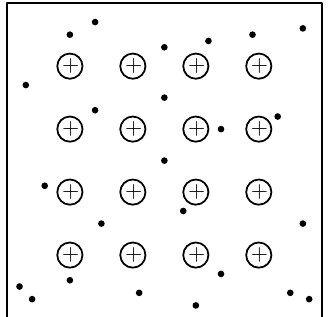
This diagram shows how the electrons can move freely through the metal structure, creating a flexible bonding network.
Properties of metals
The unique structure of metallic bonding gives metals their characteristic properties. Understanding why metals behave the way they do helps us appreciate how the bonding affects the material's behaviour.
Note
1. Metals are shiny
Metals have a distinctive metallic lustre because the delocalised electrons can absorb and re-emit light energy. When light hits the surface, these mobile electrons interact with the light waves and reflect them back, giving metals their characteristic shine.
Note
2. Metals conduct electricity
This is one of the most important properties of metals. Because the electrons are delocalised and free to move throughout the metal structure, they can carry electrical current from one end of the metal to the other. When a voltage is applied, these electrons flow easily through the metal.
Note
3. Metals conduct heat
Heat conduction in metals also relies on the delocalised electrons. The positive nuclei are packed closely together and can transfer heat energy efficiently. The mobile electrons help transfer this thermal energy quickly throughout the metal structure.
Note
4. Metals have high melting points and high density
Metallic bonds are generally strong bonds, which means it takes a lot of energy to break them apart. This results in high melting points. Additionally, because the nuclei are packed tightly together in the crystal structure, metals tend to have high density.
Crystal lattice structures
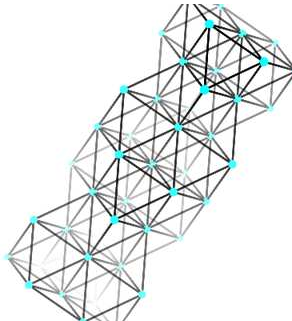
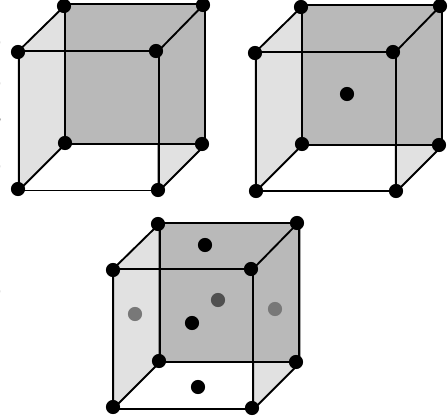
Metals form regular, repeating patterns called crystal lattices. These structures show how the metal atoms are arranged in three-dimensional space.
Note
These diagrams show different types of crystal lattice arrangements. Each dot represents a metal atom's position, and the lines show how they're connected in the crystal structure. Different metals form different types of lattice structures, but they all involve the same principle of delocalised electrons holding the structure together.
Practical understanding
To better understand metallic bonding, it's helpful to think about building physical models. You could use coloured balls to represent the metal atoms and think about how to show the delocalised electrons that move freely between them. Unlike covalent bonding where you'd connect specific atoms with sticks, or ionic bonding where you'd show distinct positive and negative ions, metallic bonding requires showing electrons that belong to the entire structure rather than individual atoms.
This is why metals behave so differently from other materials - the shared "sea of electrons" gives them their unique combination of strength, conductivity, and malleability.
Important
Exam tips
- Remember that delocalised electrons are the key feature that distinguishes metallic bonding from other types
- Be able to explain how the electron structure relates to each property (conductivity, shininess, etc.)
- Practice drawing diagrams that show delocalised electrons around positive nuclei
- Understand that metallic bonds are generally strong, leading to high melting points
Summary
Key Points to Remember:
- Metallic bonding involves delocalised electrons forming a "sea of electrons" around positive metal nuclei
- Delocalised electrons are free to move throughout the entire metal structure, not attached to specific atoms
- Four key properties: metals are shiny, conduct electricity, conduct heat, and have high melting points/density
- The mobile electrons explain why metals can conduct electricity and heat so effectively
- Crystal lattices show the regular, repeating arrangement of metal atoms in three-dimensional structures