Writing Formulae (Grade 10 NSC Matric Physical Sciences): Revision Notes
📚Revision Notes
Writing Formulae
Introduction to chemical formulae
Chemical formulae are essential tools that show the composition of compounds. They tell us which elements are present and in what ratios. When writing formulae, you need to understand the difference between compounds formed through different types of bonding.
For covalent compounds, atoms share electrons to form molecules. For ionic compounds, atoms transfer electrons to form crystals with repeating lattice structures. This difference affects how we calculate their masses.
Note
Understanding the bonding type is crucial because it determines both how we name compounds and how we calculate their masses. This fundamental concept will appear throughout your chemistry studies.
Common compound ions and their formulae
Many compounds contain polyatomic ions - groups of atoms that carry a charge and act as a single unit. Learning these common ions and their formulae is crucial for writing chemical formulae correctly.
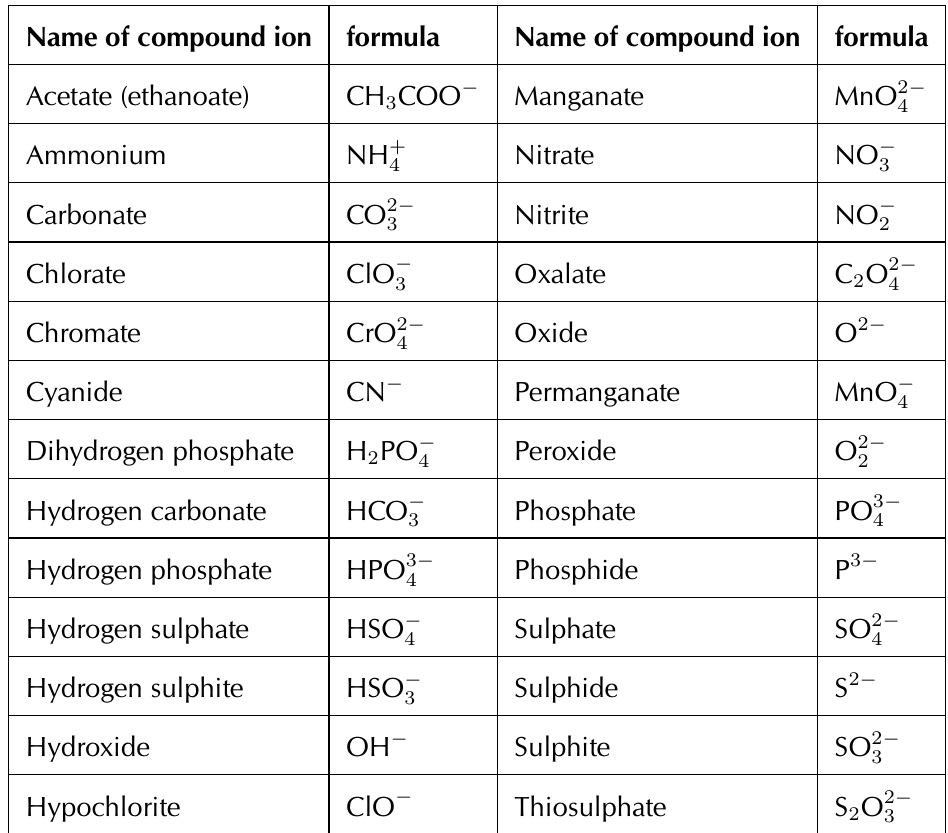
These polyatomic ions combine with other ions to form compounds. For example:
- Ammonium (NH₄⁺) combines with chloride (Cl⁻) to form ammonium chloride (NH₄Cl)
- Calcium (Ca²⁺) combines with carbonate (CO₃²⁻) to form calcium carbonate (CaCO₃)
Important
Exam Success Tip: Memorise the most common polyatomic ions, especially nitrate (NO₃⁻), sulphate (SO₄²⁻), carbonate (CO₃²⁻), and ammonium (NH₄⁺). These appear frequently in exam questions.
Calculating molecular and formula masses
Understanding the difference
When calculating masses, the type of bonding determines which term we use:
- Relative molecular mass (M): Used for covalent compounds that form discrete molecules
- Formula mass: Used for ionic compounds that form crystal lattices
Worked example: molecular mass calculation
Example
Worked Example: Calculating Molecular Mass of Ammonia
Let's calculate the relative molecular mass of ammonia (NH₃):
Step 1: Identify the atoms present
- 1 nitrogen atom
- 3 hydrogen atoms
Step 2: Find relative atomic masses
- Nitrogen = 14.0
- Hydrogen = 1.01
Step 3: Calculate total mass
Therefore, one molecule of NH₃ has a relative molecular mass of 17.03 units.
Worked example: formula mass calculation
Example
Worked Example: Calculating Formula Mass of Sodium Chloride
For ionic compounds like sodium chloride (NaCl), we calculate the formula mass because no individual molecules exist - only a crystal lattice.
Step 1: Identify the ions present
- 1 sodium ion (Na⁺)
- 1 chloride ion (Cl⁻)
Step 2: Find relative atomic masses
- Sodium = 23.0
- Chlorine = 35.45
Step 3: Calculate formula mass
The formula unit of NaCl has a formula mass of 58.45 units.
Key differences to remember
| Covalent Compounds | Ionic Compounds |
|---|---|
| Form discrete molecules | Form crystal lattices |
| Use relative molecular mass | Use formula mass |
| Calculate mass of one molecule | Calculate mass of one formula unit |
| Example: NH₃, CO₂, H₂O | Example: NaCl, CaCO₃, MgSO₄ |
Practice approach for formula writing
Important
Systematic Method for Writing Formulae with Polyatomic Ions
When writing formulae for compounds containing polyatomic ions:
Step 1: Identify the cation (positive ion) and anion (negative ion) Step 2: Determine the charges on each ion Step 3: Balance the charges to make the compound neutral Step 4: Write the formula using subscripts to show the number of each ion needed
Example: Barium sulphate
- Barium ion: Ba²⁺ (charge = +2)
- Sulphate ion: SO₄²⁻ (charge = -2)
- Since charges are equal and opposite: BaSO₄
Example: Ammonium sulphate
- Ammonium ion: NH₄⁺ (charge = +1)
- Sulphate ion: SO₄²⁻ (charge = -2)
- Need 2 ammonium ions to balance: (NH₄)₂SO₄
Exam tip: When a polyatomic ion appears more than once in a formula, put it in brackets with a subscript outside, like (NH₄)₂SO₄.
Summary
Key Points to Remember:
- Polyatomic ions are groups of atoms that act as single charged units in compounds
- Molecular mass is used for covalent compounds (molecules), formula mass is used for ionic compounds (crystals)
- To calculate masses, multiply the relative atomic mass of each element by the number of atoms present, then add together
- The formula unit represents the simplest ratio of ions in an ionic compound
- Always ensure formulae are electrically neutral by balancing positive and negative charges