Pure Substances (Grade 10 NSC Matric Physical Sciences): Revision Notes
📚Revision Notes
Pure Substances
What are pure substances?
A pure substance is any material that does not contain a mixture of different substances. Pure substances are fundamentally different from mixtures because they cannot be easily separated into different components using simple physical methods.
Pure substances fall into two main categories:
- Elements - substances that cannot be broken down further by chemical means
- Compounds - substances made up of two or more different elements joined together in fixed ratios
Breaking down pure substances into their individual parts requires much more complex chemical processes compared to separating mixtures.
Note
The key distinction is that pure substances have uniform composition throughout, while mixtures contain multiple substances that retain their individual properties and can be separated by physical means.
Testing for pure substances
Scientists can identify pure substances using several key properties:
Melting and boiling points: Pure substances have sharp, defined melting and boiling points at specific temperatures. This means they melt or boil at one exact temperature rather than over a range of temperatures. Impure substances (mixtures) show temperature ranges instead of sharp points.
Chromatography: This technique separates substances based on how they move through a medium. When chromatography is performed on a pure substance, only one substance appears at the end of the process. If multiple substances appear, the original sample was a mixture.
Important
Sharp melting and boiling points are one of the most reliable indicators of purity. If a substance melts or boils over a range of temperatures, it's likely a mixture, not a pure substance.
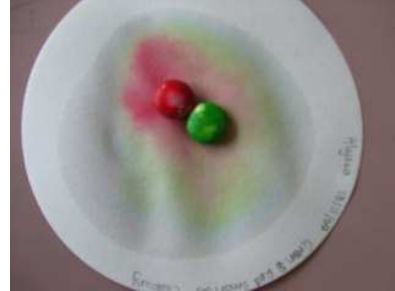
The chromatography experiment shows how different coloured components in a substance can be separated, helping to determine if a substance is pure or mixed.
Elements
An element is a chemical substance that cannot be divided or broken down into other chemical substances using ordinary chemical methods. The smallest unit of an element is called an atom.
Key characteristics of elements:
- Cannot be broken down into simpler substances chemically
- Each element has a unique chemical symbol (usually 1-2 letters)
- All known elements are organised in the periodic table
- There are 112 officially named elements and about 118 known elements total
Element symbols and the periodic table
Every element has a unique chemical symbol that scientists use worldwide. These symbols are standardised and appear on the periodic table.
Note
Chemical symbols are universal - scientists around the world use the same symbols regardless of their language. This makes chemistry a truly international science!
| Element name | Element symbol | Element name | Element symbol |
|---|---|---|---|
| Hydrogen | H | Phosphorus | P |
| Helium | He | Sulphur | S |
| Lithium | Li | Chlorine | Cl |
| Beryllium | Be | Argon | Ar |
| Boron | B | Potassium | K |
| Carbon | C | Calcium | Ca |
| Nitrogen | N | Iron | Fe |
| Oxygen | O | Nickel | Ni |
| Fluorine | F | Copper | Cu |
| Neon | Ne | Zinc | Zn |
| Sodium | Na | Silver | Ag |
| Magnesium | Mg | Platinum | Pt |
| Aluminium | Al | Gold | Au |
| Silicon | Si | Mercury | Hg |
Important
Learn the symbols for common elements, especially those with symbols that don't match their English names (like Fe for iron, Au for gold, Na for sodium).
Compounds
A compound is a chemical substance that forms when two or more different elements combine together in a fixed ratio. This means the elements always combine in the same proportions.
Key characteristics of compounds:
- Made up of two or more different elements
- Elements are joined together in specific, unchanging ratios
- Have a chemical formula showing which elements are present and in what ratio
- Properties are completely different from the individual elements they contain
Chemical formulas and representation
Chemical formulas describe the exact ratio of atoms in a compound. For example:
- Water () contains 2 hydrogen atoms for every 1 oxygen atom
- Sodium chloride () contains 1 sodium atom for every 1 chlorine atom
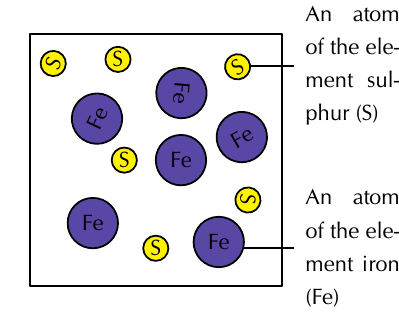
The crystal structure diagram shows how iron (Fe) atoms and sulphur (S) atoms are arranged in an iron sulphide compound. Notice how the atoms are positioned in a regular, repeating pattern.
Note
Representing substances with symbols:
- Elements: Use their chemical symbol (e.g., , )
- Compounds: Write element symbols together with subscripts (e.g., , )
- Mixtures: Write as separate substances (e.g., "a mixture of and ")
Worked example: Classifying substances
Example
Worked Example: Classifying Substances
Question: For each substance, state whether it is a pure substance or mixture. If it's a mixture, classify it as homogeneous or heterogeneous. If it's a pure substance, identify it as an element or compound.
- a. Blood (made up of plasma and cells)
- b. Argon
- c. Silicon dioxide ()
- d. Sand and stones
Solution:
Step 1: Apply the definitions
- Elements are found on the periodic table and cannot be broken down chemically
- Compounds consist of two or more elements in fixed ratios
- Mixtures contain multiple substances that can be separated physically
- Homogeneous mixtures look uniform; heterogeneous mixtures show visible differences
Step 2: Classify each substance
a. Blood - This contains plasma and cells mixed together, but you cannot see the separate components easily = homogeneous mixture
b. Argon - This appears on the periodic table as a single element = pure substance (element)
c. Silicon dioxide () - This contains silicon and oxygen atoms in a fixed ratio (1:2) = pure substance (compound)
d. Sand and stones - You can visually distinguish between sand particles and stones = heterogeneous mixture
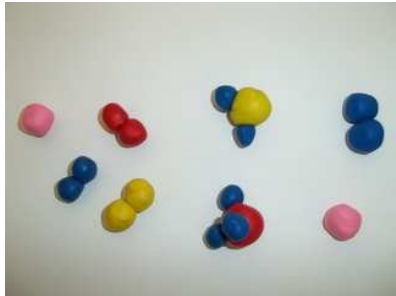
When using models to represent different substances, remember that elements use one type of particle, compounds show different particles joined together, and mixtures show separate particles not chemically joined.
Summary
Key Points to Remember:
- Pure substances include both elements and compounds - they are NOT mixtures
- Elements cannot be broken down chemically and have unique symbols on the periodic table
- Compounds contain two or more elements joined in fixed ratios with chemical formulas
- Testing methods: Pure substances have sharp melting/boiling points and produce only one substance in chromatography
- Chemical formulas show the exact ratio of atoms in compounds (like or )