Balancing Chemical Equations (Grade 10 NSC Matric Physical Sciences): Revision Notes
📚Revision Notes
Balancing Chemical Equations
The law of conservation of mass
Before learning to balance chemical equations, you must understand the fundamental principle that governs all chemical reactions.
Important
The law of conservation of mass states that the mass of a closed system of substances will remain constant, regardless of the processes acting inside the system. Matter can change form, but cannot be created or destroyed.
This means that in any chemical equation, the mass of the reactants must be equal to the mass of the products. To ensure this balance, the number of atoms of each element in the reactants must equal the number of atoms of those same elements in the products.
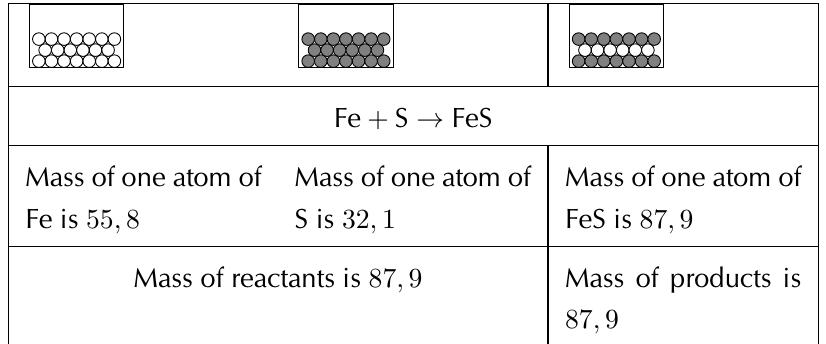
Consider the reaction between iron and sulphur to form iron sulphide. The atomic masses show us that the total mass remains constant throughout the reaction. This demonstrates conservation of mass in action.
When we calculate the mass of molecules, we use relative atomic masses. You'll notice that the mass of the reactants always equals the mass of the product when the equation is properly balanced. A balanced chemical equation will always reflect both the law of conservation of mass and the law of conservation of atoms.
Note
The law of conservation of mass applies to all chemical reactions in closed systems. This fundamental principle means that atoms are neither created nor destroyed during chemical reactions - they are simply rearranged to form new compounds.
Steps to balance a chemical equation through inspection
Balancing chemical equations follows a systematic approach. Here are the six essential steps:
Step 1: Identify the reactants and the products in the reaction and write their chemical formulae.
Step 2: Write the equation by putting the reactants on the left of the arrow and the products on the right.
Step 3: Count the number of atoms of each element in the reactants and the number of atoms of each element in the products.
Step 4: If the equation is not balanced, change the coefficients of the molecules until the number of atoms of each element on either side of the equation balance.
Step 5: Check that the atoms are in fact balanced.
Step 6: Add any extra details to the equation, such as phase symbols.
Important
Critical Rule: When balancing equations, only change the coefficients (the numbers in front of the formulae). Never change the subscripts in the chemical formulae, as this would change the identity of the compound.
Worked examples
Example
Worked Example 1: Balancing magnesium and hydrochloric acid
Question: Balance the following equation:
Solution:
Step 1: Identify the reactants and products The reactants and products are already identified in the question.
Step 2: Write the equation for the reaction This has already been done in the question.
Step 3: Count the number of atoms of each element in the reactants and products
- Reactants: Mg = 1 atom; H = 1 atom; Cl = 1 atom
- Products: Mg = 1 atom; H = 2 atoms; Cl = 2 atoms
Step 4: Balance the equation The equation is not balanced since there are two chlorine atoms in the product and only one in the reactants. If we add a coefficient of 2 to the HCl, this increases the number of H and Cl atoms in the reactants:
Step 5: Check that the atoms are balanced
- Reactants: Mg = 1; H = 2; Cl = 2
- Products: Mg = 1; H = 2; Cl = 2
The equation is now balanced.
Example
Worked Example 2: Balancing methane combustion
Question: Balance the following equation:
Solution:
Step 1: Count the number of atoms of each element in the reactants and products
- Reactants: C = 1; H = 4; O = 2
- Products: C = 1; H = 2; O = 3
Step 2: Balance the equation If we add a coefficient of 2 to H₂O, the number of hydrogen atoms in the products becomes 4, which matches the reactants:
Now we need to balance the oxygen atoms. The products now have 4 oxygen atoms (2 from CO₂ and 2 from 2H₂O), so we need a coefficient of 2 in front of O₂:
Step 3: Check that the atoms balance
- Reactants: C = 1; H = 4; O = 4
- Products: C = 1; H = 4; O = 4
The equation is now balanced.
Example
Worked Example 3: Balancing glucose respiration
Question: In our bodies, sugar () reacts with the oxygen we breathe to produce carbon dioxide, water and energy. Write the balanced equation for this reaction.
Solution:
Step 1: Identify the reactants and products in the reaction
- Reactants: sugar () and oxygen ()
- Products: carbon dioxide () and water ()
Step 2: Write the equation
Step 3: Count the number of atoms of each element in the reactants and products
- Reactants: C = 6; H = 12; O = 8
- Products: C = 1; H = 2; O = 3
Step 4: Balance the equation Start with carbon as it only appears once on each side. Add a coefficient of 6 in front of CO₂:
Now balance hydrogen by adding a coefficient of 6 to H₂O:
Finally, balance oxygen. The products now have 18 oxygen atoms, and the reactants already have 6 from glucose, so we need 12 more from O₂. Therefore, add a coefficient of 6 to O₂:
Step 5: Check the balance
- Reactants: C = 6; H = 12; O = 18
- Products: C = 6; H = 12; O = 18
The equation is now balanced.
Example
Worked Example 4: Including state symbols
Question: Solid zinc metal reacts with aqueous hydrochloric acid to form an aqueous solution of zinc chloride and hydrogen gas. Write a balanced equation for this reaction.
Solution:
Step 1: Identify the reactants and products The reactants are zinc (Zn) and hydrochloric acid (HCl). The products are zinc chloride (ZnCl₂) and hydrogen (H₂).
Step 2: Write the equation
Step 3: Balance the equation The zinc atoms balance, but the chlorine and hydrogen atoms do not. Add a coefficient of 2 to HCl:
Step 4: Check that all atoms balance All atoms are now balanced.
Step 5: Add state symbols From the question description: zinc is solid, hydrochloric acid and zinc chloride are in aqueous solution, and hydrogen is a gas:
State symbols and other information
The state (phase) of compounds can be expressed in chemical equations by placing the correct label on the right-hand side of the formula. The four main labels are:
- (g) for gaseous compounds
- (ℓ) for liquids
- (s) for solid compounds
- (aq) for an aqueous (water) solution
To show that heat is needed for a reaction, a Greek delta (Δ) is placed above the arrow. For example:
Note
Exam tip: When writing formulae in balanced chemical equations, remember that we write only the empirical formula for ionic compounds (like FeS) but the molecular formula for covalent compounds. This represents one unit of the compound or network structure.
Summary
Key Points to Remember:
-
The law of conservation of mass states that matter cannot be created or destroyed in chemical reactions - the total mass of reactants equals the total mass of products.
-
Balance equations by adjusting coefficients only - never change the subscripts in chemical formulae as this changes the compound's identity.
-
Follow the systematic 6-step approach: identify, write, count, balance, check, and add state symbols.
-
State symbols indicate physical states: (s) solid, (ℓ) liquid, (g) gas, (aq) aqueous solution.
-
Always ensure the same number of atoms of each element appears on both sides of the balanced equation.