Stoichiometric Calculations (Grade 10 NSC Matric Physical Sciences): Revision Notes
📚Revision Notes
Stoichiometric Calculations
What is stoichiometry?
Stoichiometry is the calculation of quantities of reactants and products in chemical reactions. It helps us answer important questions like "how much product will form?" or "how much reactant do we need to make a specific amount of product?"
Understanding stoichiometry is essential for predicting and controlling chemical reactions in both laboratory and industrial settings.
Note
Stoichiometry comes from the Greek words "stoicheion" (element) and "metron" (measure), literally meaning "measuring elements." This branch of chemistry is fundamental to all quantitative chemical analysis and industrial chemical processes.
The central role of moles in chemical calculations
Moles serve as the fundamental unit that connects all quantities in chemical reactions. Think of moles as the "bridge" that allows us to convert between different measurements.
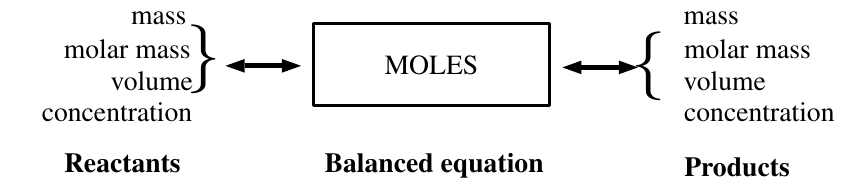
The diagram shows how moles connect:
- Reactants: mass, molar mass, volume, and concentration
- Products: mass, molar mass, volume, and concentration
Important
This relationship is crucial because balanced chemical equations give us mole ratios, not mass or volume ratios directly. You must always work through moles when converting between different types of measurements in chemical reactions.
Step-by-step approach to stoichiometric problems
When solving stoichiometric calculations, always follow this systematic approach:
Important
The Universal Stoichiometry Method:
- Write the balanced chemical equation
- Calculate the number of moles of the given substance
- Find the mole ratio from the balanced equation
- Calculate the answer using the mole ratio
This method works for all stoichiometric problems, whether you're calculating masses, volumes, or concentrations.
Worked example: Gas volume calculations
Example
Worked Example: Gas Volume Stoichiometry
Problem: What volume of oxygen at STP is needed for complete combustion of 2 dm³ of propane?
Solution:
Step 1: Write the balanced equation
Step 2: Find the mole ratio
- Since all reactants are gases, we can use volume ratios directly. From the balanced equation, the ratio of oxygen to propane is 5:1.
Step 3: Calculate the answer
- If 1 volume of propane needs 5 volumes of oxygen, then 2 dm³ of propane needs 10 dm³ of oxygen.
Worked example: Mass calculations in reactions
Example
Worked Example: Mass-to-Mass Stoichiometry
Problem: What mass of iron sulfide forms when 5.6 g of iron completely reacts with sulfur?
Solution:
Step 1: Write the balanced equation
Step 2: Calculate moles of iron
Step 3: Find the mole ratio
- From the equation, 1 mol Fe produces 1 mol FeS. Therefore, 0.1 mol Fe produces 0.1 mol FeS.
Step 4: Calculate mass of iron sulfide
Understanding theoretical yield
Theoretical yield is the maximum amount of product that can be formed from a given amount of reactant, calculated using stoichiometry. In real laboratory conditions, chemists rarely obtain this theoretical amount.
The actual yield is the amount of product actually obtained in the laboratory. This is usually less than the theoretical yield because:
- Some reactant may not react completely
- Side reactions may occur
- Some product may be lost during separation
Note
Understanding the difference between theoretical and actual yield is crucial for evaluating the efficiency of chemical processes. In industrial chemistry, maximizing actual yield while minimizing waste is a key economic and environmental concern.
Calculating percentage yield
We compare actual and theoretical yields using the percentage yield formula:
This tells us how efficient our reaction was.
Important
Percentage yield can never exceed 100% in a properly conducted experiment. If you calculate a value over 100%, check your calculations for errors or consider whether impurities might be present in your product.
Worked example: Industrial fertiliser production
Example
Worked Example: Industrial Percentage Yield Calculation
Problem: Sulfuric acid reacts with ammonia to produce ammonium sulfate fertiliser. If 2.0 kg of sulfuric acid produces 2.2 kg of fertiliser, what is the percentage yield?
Solution:
Step 1: Write the balanced equation
Step 2: Calculate moles of sulfuric acid
Step 3: Find the mole ratio
- From the equation, 1 mol H₂SO₄ produces 1 mol (NH₄)₂SO₄
- Therefore, 20.38 mol H₂SO₄ produces 20.38 mol (NH₄)₂SO₄
Step 4: Calculate theoretical yield
Step 5: Calculate percentage yield
Worked example: Multi-step calculations
Example
Worked Example: Multi-Step Stoichiometric Calculation
Problem: Barium chloride reacts with sulfuric acid to produce barium sulfate and hydrochloric acid. If you have 2 g of BaCl₂, how much HCl is produced?
Solution:
Step 1: Write the balanced equation
Step 2: Calculate moles of barium chloride
Step 3: Find the mole ratio
- From the equation, 1 mol BaCl₂ produces 2 mol HCl
- Therefore, 0.0096 mol BaCl₂ produces 0.0192 mol HCl
Step 4: Calculate mass of HCl
Summary
Key Points to Remember:
- Moles are the bridge - always convert to moles first, then use mole ratios from balanced equations
- Start with a balanced equation - this gives you the correct mole ratios between reactants and products
- Follow the step-by-step method - write equation, calculate moles, find ratio, calculate answer
- Theoretical yield is the maximum possible - actual yield is usually less due to practical limitations
- Percentage yield measures efficiency - use the formula (actual ÷ theoretical) × 100 to compare expected vs obtained results