Ions in Aqueous Solution (Grade 10 NSC Matric Physical Sciences): Revision Notes
📚Revision Notes
Ions in Aqueous Solution
Introduction to aqueous reactions
Many chemical reactions and all biological processes occur in water. We describe these as aqueous reactions because they take place in aqueous solutions. Water possesses unique properties that make it essential for life on Earth. This is why reactions in aqueous solutions happen so frequently in nature.
Almost all reactions in aqueous solutions involve ions. Understanding how ions behave in water is crucial for studying three main types of aqueous reactions:
Note
Three Main Types of Aqueous Reactions:
- Precipitation reactions
- Acid-base reactions
- Redox reactions
Before examining these reaction types, we must first understand how ions exist and behave in aqueous solutions.
Water as a solvent
Water is rarely found in its pure form in nature. Due to water's unique molecular structure, substances dissolve easily in it. This property is vital for life - without water's ability to dissolve substances, life on Earth would be impossible.
In natural water systems like rivers and oceans, dissolved oxygen enables fish to breathe. In plants, dissolved nutrients can be absorbed and transported. In the human body, water carries dissolved substances from one part of the body to another.
Note
Why Water's Solvent Properties Matter:
Water's exceptional ability to dissolve substances is what makes it the "universal solvent." This property enables countless biological and chemical processes that sustain life on Earth.
Water as a polar molecule
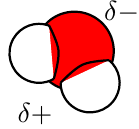
Water is a polar molecule. When we examine water's structure using Lewis diagrams, we can see why this is the case.
The water molecule contains two electron pairs that do not participate in bonding. This region of the molecule has higher electron density than the side where hydrogen atoms are bonded. The oxygen side becomes more negative than the hydrogen side.
We describe the oxygen side as delta negative (δ-) and the hydrogen side as delta positive (δ+). This means one part of the molecule carries a slightly positive charge (positive pole) while another part carries a slightly negative charge (negative pole). A molecule with two poles is called a dipole.
Important
Understanding Molecular Polarity
The unequal distribution of electron density in water creates permanent positive and negative poles. This polarity is what gives water its special properties as a solvent and makes it essential for dissolving ionic compounds.
Dissolution of ionic compounds in water
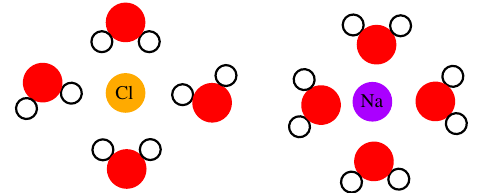
The polar nature of water enables ionic compounds to dissolve in it. Consider sodium chloride (NaCl) as an example. The positive sodium ions (Na⁺) are attracted to the negative pole of water molecules, while the negative chloride ions (Cl⁻) are attracted to the positive pole of water molecules.
When sodium chloride dissolves in water, polar water molecules work their way between individual ions in the crystal lattice. The water molecules surround both the negative chloride ions and positive sodium ions, then pull them away into solution. This process is called dissociation.
Example
Step-by-Step Dissolution Process:
Step 1: Water molecules approach the ionic crystal
- Positive ends of water molecules align with negative ions (Cl⁻)
- Negative ends of water molecules align with positive ions (Na⁺)
Step 2: Water molecules penetrate the crystal lattice
- Polar water molecules work between the ions
- Electrostatic attractions weaken the ionic bonds
Step 3: Hydration and separation
- Water molecules completely surround individual ions
- Ions are pulled away from the crystal into solution
Note that the positive side of water molecules attracts negative chlorine ions, while the negative side of water molecules attracts positive sodium ions. When a substance dissociates or dissolves, we say that dissolution has occurred. Dissolving represents a physical change that can be reversed by removing (evaporating) the water.
Key definitions
Summary
Important Terms:
Dissociation: A general process where ionic compounds separate into smaller ions, usually in a reversible manner.
Dissolution: The process where ionic crystals break up into ions in water.
Hydration: The process where ions become surrounded by water molecules.
Chemical equations for dissolution
The dissolution of sodium chloride can be represented by this equation:
The dissolution of potassium sulphate into potassium and sulphate ions provides another example:
Remember that molecular substances (covalent compounds) may also dissolve, but most do not form ions. Glucose serves as an example:
Note
Distinguishing Ionic and Molecular Dissolution
Notice how ionic compounds separate into individual ions when they dissolve, while molecular compounds like glucose remain as intact molecules in solution. This difference is crucial for understanding solution behavior.
Molecular substances that ionise
Some molecular substances will form ions when they dissolve. Hydrogen chloride provides an example of a molecular substance that ionises to form hydrogen and chloride ions:
Important
Exception to the Rule
While most molecular substances don't form ions when dissolved, some do ionise in water. These substances, like HCl, undergo a chemical reaction with water molecules, forming ions in the process. This is different from simple dissolution.
Remember!
Summary
Key Points to Remember:
- Water is a polar molecule with δ+ and δ- regions that enable it to dissolve ionic substances
- Dissociation occurs when ionic compounds separate into individual ions in water
- Hydration describes how water molecules surround dissolved ions
- Most ionic compounds dissolve and form ions, while most molecular compounds dissolve but do not form ions