States of Matter and the Kinetic Molecular Theory (Grade 10 NSC Matric Physical Sciences): Revision Notes
📚Revision Notes
States of Matter
What is matter made of?
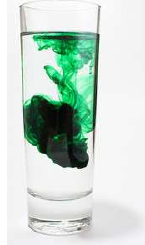
Everything around us consists of tiny moving particles. We can observe this particle nature of matter through a process called diffusion.
Diffusion is the movement of particles from areas where they are highly concentrated to areas where they are less concentrated.
Note
When you place a drop of food colouring into water, you can watch the colour slowly spread throughout the water. This happens because the particles in the food colouring are constantly moving and mixing with the water particles. If matter were not made of moving particles, the colouring would simply sit in one spot without spreading.
This constant random movement of particles was first observed by scientist Robert Brown in 1828, when he noticed pollen grains moving erratically in water. This motion is now called Brownian motion, which demonstrates the continuous movement of particles in matter.
The three states of matter
Matter exists in three main states: solid, liquid, and gas. Each state has distinct characteristics:
Important
- Solid: Has a fixed shape and fixed volume
- Liquid: Takes the shape of its container but has a fixed volume
- Gas: Completely fills its container (no fixed shape or volume)
Phase changes between states
Matter can change from one state to another by adding or removing thermal energy (heat). These changes are called phase changes or changes of state.
Melting and freezing
Melting point is the specific temperature at which a solid changes its state to become a liquid. The process of changing from solid to liquid is called melting.
Freezing point is the specific temperature at which a liquid changes its state to become a solid. The process of changing from liquid to solid is called freezing.
Important
Critical concept: Melting point = Freezing point for the same substance. This is a common exam question!
Evaporation and boiling
Evaporation is the process where a liquid changes to a gas. This can happen at the surface of a liquid at various temperatures. When enough energy is added to cause gas bubbles to form throughout the liquid, this is called boiling.
Boiling point is the specific temperature at which a liquid changes its state to become a gas throughout the entire liquid.
Condensation and sublimation
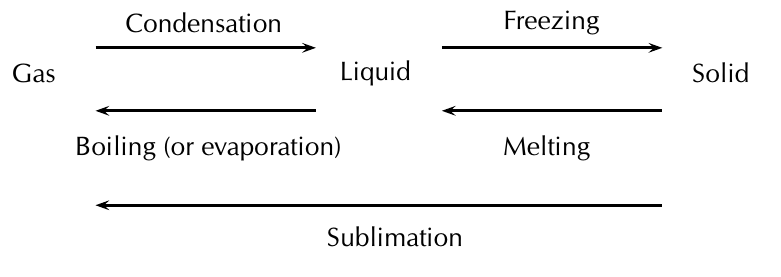
Condensation is the process where a gas changes directly to a liquid.
Sublimation is the process where a solid changes directly to a gas, without becoming a liquid first. The reverse process (gas to solid) is called deposition.
Note
This diagram shows all the possible phase changes between the three states of matter. Notice that you can move between any two states by adding or removing thermal energy.
If you know the melting point and boiling point of any substance, you can predict what state it will be in at any given temperature.
Worked example: heating and cooling curves experiment
Example
Worked Example: Investigating Heating and Cooling Curves
Aim: To investigate the heating and cooling curves of water.
Apparatus needed:
- Beakers
- Ice
- Bunsen burner
- Thermometer
- Water
Method:
- Place ice in a beaker and measure its initial temperature
- Heat the ice while recording the temperature every minute
- Continue heating until at least 3 minutes after all ice has melted
- Plot a graph of temperature versus time for the heating process
- Heat water in a separate beaker until it boils, then remove from heat
- Record the cooling temperature every minute until the beaker is cool to touch
Safety note: Always handle hot beakers carefully using tongs - never touch them with bare hands.
Results table
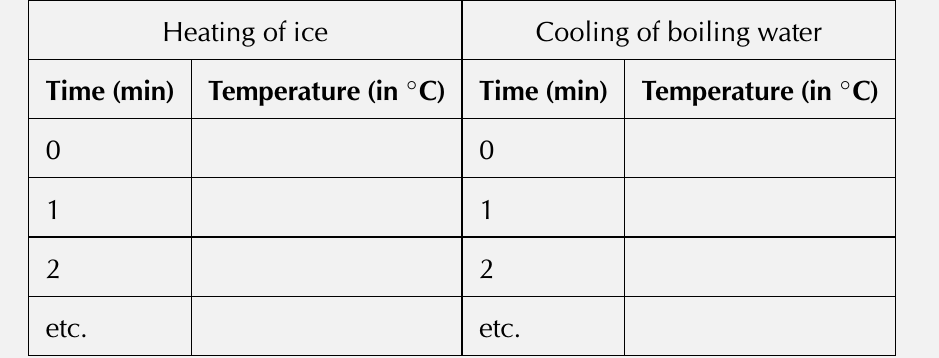
Students record their temperature measurements at regular time intervals for both the heating of ice and cooling of boiling water.
Expected results and interpretation
When you plot the data as graphs, you should observe specific patterns:
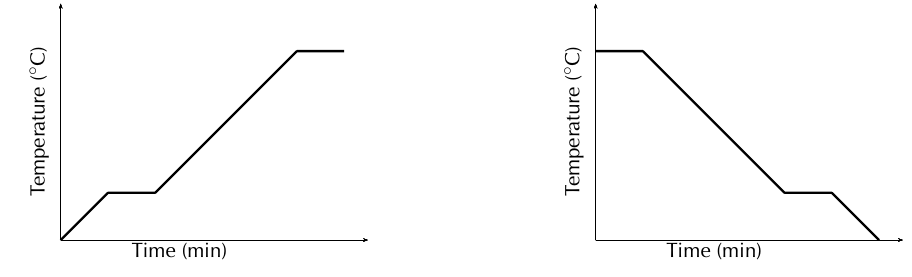
Heating curve observations:
- Temperature increases as ice warms up
- Temperature remains constant while ice melts (at 0°C)
- Temperature increases again as liquid water heats up
- Temperature remains constant while water boils (at 100°C)
Cooling curve observations:
- Temperature decreases from boiling point
- Temperature may remain constant if water freezes
- Temperature continues decreasing as solid cools
Important
Why temperature stays constant during phase changes
During melting and boiling, all the thermal energy goes into breaking the bonds between particles rather than increasing their kinetic energy. This is why temperature remains constant even though heat is still being added. Similarly, during freezing and condensation, energy is released as bonds form, keeping temperature constant.
Exam tips
Summary
Key Points for Exams:
- Remember that melting point = freezing point for the same substance
- Boiling point = condensation point for the same substance
- Temperature stays constant during actual phase changes
- Phase changes require energy input (melting, boiling) or release energy (freezing, condensation)
- Be able to interpret heating and cooling curve graphs
- Know all six phase change processes and their names
Remember!
Summary
Key Points to Remember:
- All matter consists of constantly moving particles, demonstrated by diffusion and Brownian motion
- The three states of matter are solid, liquid, and gas, each with distinct properties
- Phase changes occur at specific temperatures (melting point, boiling point) and require energy transfer
- During phase changes, temperature remains constant while bonds between particles are broken or formed
- Heating and cooling curves show these constant temperature periods as flat horizontal lines on graphs