Electronic Configuration (Grade 10 NSC Matric Physical Sciences): Revision Notes
📚Revision Notes
Electronic Configuration
Understanding how electrons are arranged around the nucleus of an atom is fundamental to chemistry. This arrangement, called electronic configuration, determines how atoms interact with each other and forms the basis for predicting chemical behaviour.
The energy of electrons
All electrons in an atom carry the same charge and have identical mass, but they possess different amounts of energy. Electrons with the lowest energy are positioned closest to the nucleus, where the attractive force from the positively charged nucleus is strongest. As we move further from the nucleus, electrons have higher energy levels because they can overcome more of the nuclear attraction.
Note
This energy difference creates a layered structure around the atom, with electrons occupying specific energy regions at different distances from the nucleus. Think of this like an onion with multiple layers - each layer represents a different energy level.
Electron arrangement in energy levels
Electrons are organised in energy levels (also called shells) that surround the nucleus. These energy levels are numbered starting from 1 for the innermost level, then 2, 3, and so on. The further an energy level is from the nucleus, the higher its energy.
Important
Maximum Electron Capacity per Energy Level:
Each energy level has a maximum number of electrons it can accommodate:
- First energy level: Can hold up to 2 electrons
- Second energy level: Can hold up to 8 electrons
- Third energy level: Can hold up to 8 electrons
Let's examine some examples of how electrons fill these energy levels:
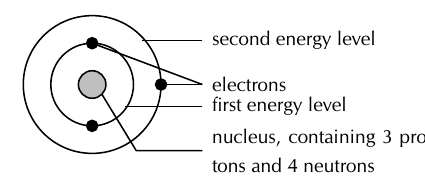
Lithium atom
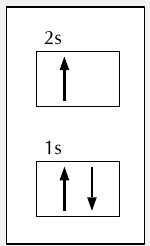
Lithium has an atomic number of 3, meaning it contains 3 electrons in a neutral atom. The first two electrons occupy the first energy level, while the third electron is found in the second energy level.
Electron filling pattern
When atoms have more electrons, they follow a predictable filling pattern. The electrons always occupy the lowest available energy level first before moving to higher levels. This creates stable, layered arrangements around the nucleus.
Atomic orbitals
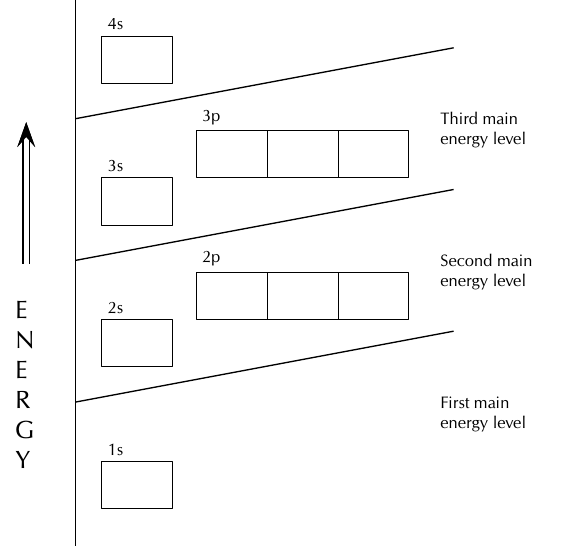
The electron arrangement becomes more detailed when we consider atomic orbitals. These are specific regions within energy levels where electrons are likely to be found.
Important
Atomic orbital: A region in space around an atom's nucleus where an electron may be located.
Within each energy level, there are different types of orbitals:
- s orbitals: Found in all energy levels, each can hold 2 electrons
- p orbitals: Found from the second energy level onwards, with 3 p orbitals per level, each holding 2 electrons (6 total)
- d orbitals: Found from the third energy level onwards, with 5 d orbitals per level
Note
The diagram above shows how orbitals are arranged by increasing energy. Notice that the 4s orbital actually has lower energy than the 3d orbitals, which affects how electrons fill these positions.
Rules for electron arrangement
Several important rules govern how electrons occupy orbitals:
Important
Fundamental Rules for Electron Arrangement:
- Each orbital can hold a maximum of two electrons
- Electrons occupy the lowest energy orbitals first
- Within the same energy level, electrons fill orbitals singly before pairing up
Hund's rule and Pauli's exclusion principle
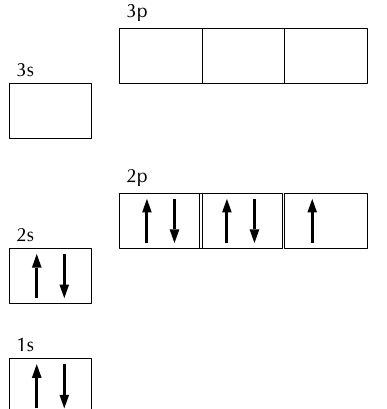
Hund's rule states that electrons prefer to occupy separate orbitals of the same energy rather than pair up in the same orbital. Think of this like people choosing seats on a bus - they'll take empty seats before sitting next to someone.
Pauli's exclusion principle explains that when two electrons do share an orbital, they must have opposite spins. We represent this using arrows pointing in opposite directions (↑↓).
Aufbau diagrams
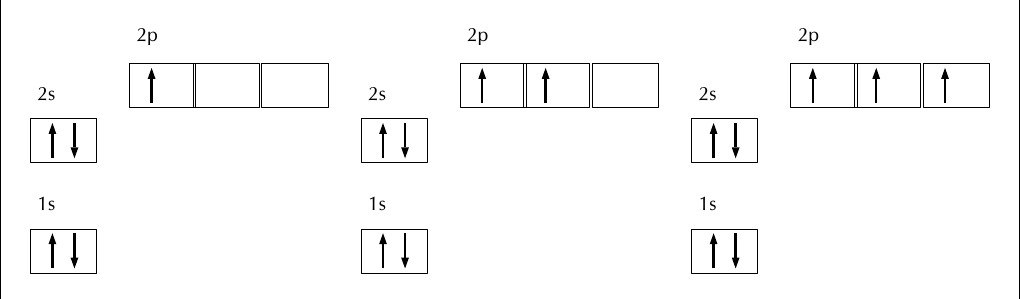
Aufbau diagrams provide a visual method for showing electron arrangements using arrows to represent electrons and their spins. The term "Aufbau" comes from German meaning "building up," which describes how we construct the electron configuration step by step.
Drawing Aufbau diagrams
Follow these steps to create an Aufbau diagram:
- Count the total electrons in the atom
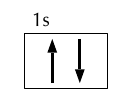
- Fill the 1s orbital with the first two electrons (↑↓)
- Fill the 2s orbital with the next two electrons
- Add one electron to each 2p orbital before pairing
- Continue this pattern through successive energy levels
Example
Worked Example: Nitrogen Atom Configuration
Question: Draw the electron configuration for nitrogen (N) and create an Aufbau diagram.
Solution:
- Step 1: Nitrogen has 7 electrons
- Step 2: Place 2 electrons in 1s orbital: 1s²
- Step 3: Place 2 electrons in 2s orbital: 2s²
- Step 4: Place remaining 3 electrons singly in 2p orbitals: 2p³
Final electron configuration: 1s²2s²2p³
Spectroscopic electron configuration notation
A shorthand method exists for writing electron configurations called spectroscopic notation. This system uses numbers to indicate energy levels, letters for orbital types, and superscripts for the number of electrons.
Note
Spectroscopic Notation Examples:
- Lithium: 1s²2s¹
- Fluorine: 1s²2s²2p⁵
- Neon: 1s²2s²2p⁶
The number indicates the energy level, the letter shows the orbital type, and the superscript tells us how many electrons occupy that orbital.
Condensed electron configuration
For elements with many electrons, we can write a shortened version using noble gas notation. For example, magnesium can be written as [Ne]3s² instead of 1s²2s²2p⁶3s².
Core and valence electrons
Electrons in atoms can be classified into two important categories:
Important
Electron Classifications:
Core electrons: All electrons in energy levels closer to the nucleus, excluding the outermost level. These electrons are not typically involved in chemical bonding.
Valence electrons: Electrons in the outermost energy level of an atom. These electrons determine the atom's chemical properties and bonding behaviour.
Understanding the distinction between core and valence electrons is crucial because valence electrons are responsible for how atoms interact with each other during chemical reactions.
The importance of electron configuration
Why does electron arrangement matter so much in chemistry? The answer lies in chemical stability and reactivity.
Chemical stability
Atoms are most stable when their outermost energy level is completely filled. This principle, known as the octet rule, explains why noble gases (with full outer shells) are unreactive. All other elements tend to gain, lose, or share electrons to achieve this stable configuration.
Chemical reactivity
The number of valence electrons determines how an atom will behave chemically:
- Elements with similar numbers of valence electrons exhibit similar chemical properties
- Atoms with nearly empty outer shells tend to lose electrons (metals)
- Atoms with nearly full outer shells tend to gain electrons (non-metals)
Note
This connection between electron configuration and chemical behaviour allows chemists to predict and explain how different elements will react with each other.
Electron configuration for ions
When atoms gain or lose electrons to form ions, their electron configurations change:
- Cations (positive ions): Formed when atoms lose electrons, typically from the outermost level
- Anions (negative ions): Formed when atoms gain electrons, filling the outermost level
Example
Worked Example: Oxide Ion (O²⁻)
Question: Determine the electron configuration for the oxide ion (O²⁻).
Solution:
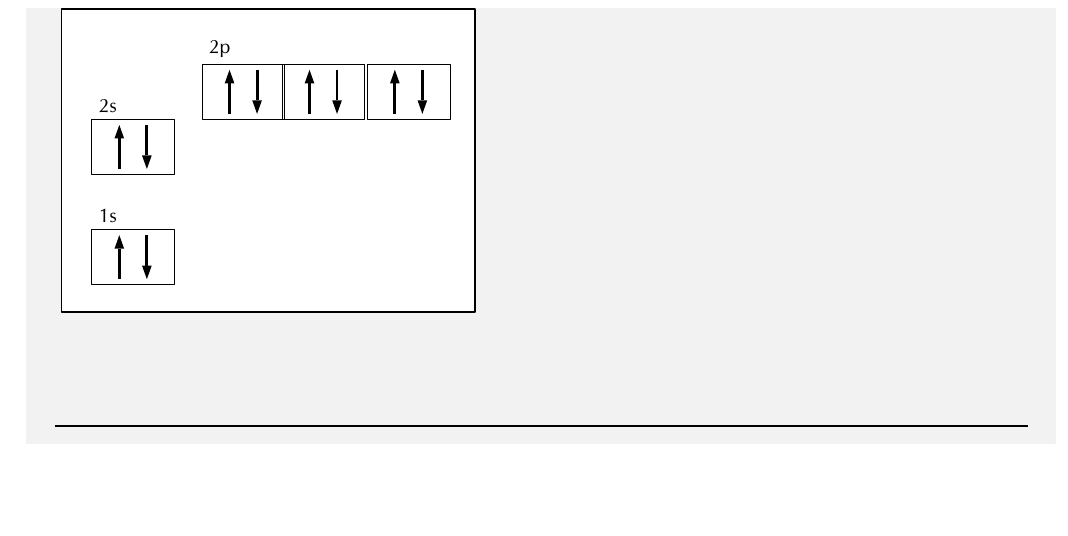
- Step 1: Oxygen has 8 electrons; the oxide ion has gained 2 more, giving 10 total electrons
- Step 2: Fill orbitals following normal rules: 1s²2s²2p⁶
- Step 3: This configuration matches neon, explaining why the oxide ion is stable
Orbital shapes
Different orbital types have characteristic three-dimensional shapes that affect how atoms bond:
- s orbitals: Spherical shape
- p orbitals: Dumbbell or figure-eight shape
- d orbitals: More complex shapes with multiple lobes
These shapes determine the geometry of molecules and influence chemical properties.
Flame tests and electron transitions
When atoms absorb energy, electrons can move to higher energy levels. When they return to lower levels, they emit light of specific colours. This principle is used in flame tests to identify different elements by the characteristic colours they produce.

Note
Each element produces a unique colour because its electron configuration creates specific energy differences between levels. This connection between electron arrangement and light emission demonstrates the practical importance of understanding electronic configuration.
Summary
Key Points to Remember:
- Electronic configuration describes how electrons are arranged in atoms and directly determines chemical properties
- Energy levels fill from lowest to highest energy, with specific capacities (2, 8, 8...)
- Aufbau diagrams use arrows to show electron arrangements and spins in orbitals
- Valence electrons in the outermost level control chemical behaviour, while core electrons remain uninvolved in bonding
- Atoms achieve stability by having complete outer electron shells, like noble gases