Models of the Atom (Grade 10 NSC Matric Physical Sciences): Revision Notes
📚Revision Notes
Models of the Atom
Introduction to atomic models
The understanding of atomic structure has developed over many centuries through the work of numerous scientists. Atoms are the basic building blocks of all matter in the universe. Everything around us - from the air we breathe to the stars in the sky - is made up of different combinations of atoms.
Scientists have created various models to help us understand what atoms might look like and how they behave. These models have evolved as new discoveries were made about atomic structure.
Note
Model: A representation of a system in the real world. Models help us to understand systems and their properties.
It's important to remember that atomic models are simplified representations. They give us a good idea of atomic structure, but they cannot always be absolutely accurate. Models help scientists explain observations and make predictions about how atoms behave.
Historical development of atomic theory
The concept of atoms began with ancient Greek philosophers Democritus and Leucippus in the fifth century BC. The Greek word "atomos" means indivisible because they believed that atoms could not be broken into smaller pieces.
Today we know that atoms actually consist of:
- A positively charged nucleus at the centre
- Negatively charged electrons surrounding the nucleus
Before scientists properly understood atomic structure, they developed many different models to describe what atoms might look like.
Dalton's atomic model
John Dalton proposed that all matter is made up of very small particles called atoms. This built upon the ideas of the ancient Greeks, particularly Democritus, who had suggested that matter consists of small, indivisible objects.
Key features of Dalton's model:
- Atoms are solid, indivisible spheres
- All atoms of the same element are identical
- Atoms cannot be created or destroyed
- Atoms combine in simple whole number ratios to form compounds

When Dalton proposed his model, electrons and the nucleus were still unknown. His model represented atoms as simple, solid spheres - like tiny billiard balls.
Important
Dalton's atomic theory was revolutionary because it provided the first scientific explanation for the law of conservation of mass and the law of definite proportions in chemical reactions.
Thomson's plum pudding model
After J.J. Thomson discovered the electron in 1897, scientists realised that atoms contained even smaller particles. However, the atomic nucleus had not yet been discovered.
Thomson proposed the "plum pudding model" in 1904:
- The atom consists of a "soup" of positive charge
- Negative electrons are scattered throughout this positive charge
- The electrons float in the positive charge like plums in a pudding
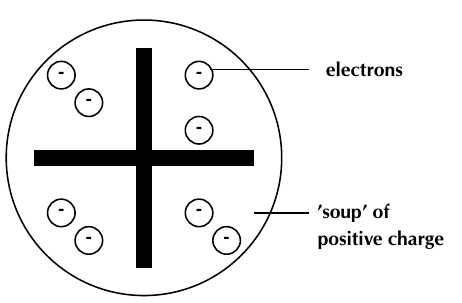
This model explained how atoms could contain both positive and negative charges while remaining electrically neutral overall. However, it still didn't accurately describe the true structure of atoms.
The discovery of radiation by Marie and Pierre Curie provided the next crucial step. They found that some elements (radioactive elements) emit particles that can pass through matter. This discovery would soon lead to a better understanding of atomic structure.
Rutherford's model of the atom
Ernest Rutherford conducted experiments that led to a major change in atomic theory. His experiments revealed that atoms have a very different structure than Thomson had proposed.
Rutherford's model described the atom as:
- A tiny, dense, positively charged core called the nucleus
- Much lighter, negatively charged electrons orbiting around the nucleus
- Mostly empty space between the nucleus and electrons
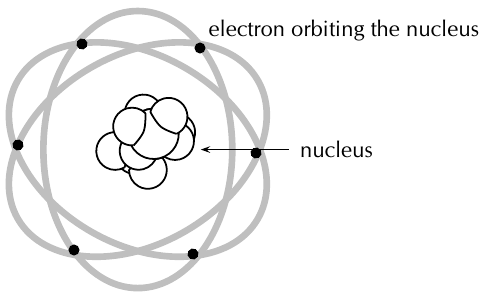
This model is sometimes called the planetary model because the electrons orbit the nucleus like planets orbiting the sun. It showed that the atom is mostly empty space, with almost all the mass concentrated in the tiny nucleus at the centre.
Example
Rutherford's Gold Foil Experiment
Rutherford fired alpha particles at a thin gold foil and observed their scattering patterns:
Step 1: Most alpha particles passed straight through (showing atoms are mostly empty space)
Step 2: Some particles were deflected at large angles (showing a concentrated positive charge)
Step 3: A few particles bounced back completely (proving the existence of a dense nucleus)
This experiment revolutionised our understanding of atomic structure.
Bohr's model of the atom
Niels Bohr identified problems with Rutherford's model. For example, it couldn't explain why atoms only emit light at certain specific wavelengths.
Bohr solved this problem by proposing that:
- Electrons can only orbit the nucleus in certain special orbits
- These orbits exist at different energy levels around the nucleus
- Electrons cannot exist between these fixed energy levels
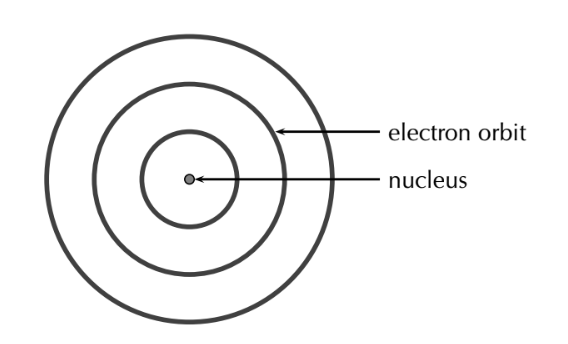
Bohr's model introduced the concept of electron shells or energy levels. This explained why atoms emit light only at specific wavelengths - electrons jump between these fixed energy levels, releasing specific amounts of energy as light.
Note
Bohr's model successfully explained the hydrogen spectrum and introduced the concept of quantised energy levels, which became fundamental to quantum mechanics.
James Chadwick's contribution
Rutherford predicted in 1920 that another type of particle must exist in the nucleus alongside protons. He reasoned that if the nucleus contained only positively charged protons, the repulsive forces between them would cause the nucleus to break apart.
To keep the atom electrically neutral while maintaining nuclear stability, there had to be neutral particles in the nucleus. In 1932, James Chadwick discovered and measured the mass of these particles, called neutrons.
The discovery of neutrons completed our understanding of the basic atomic structure:
- Protons: positively charged particles in the nucleus
- Neutrons: neutral particles in the nucleus
- Electrons: negatively charged particles orbiting the nucleus
Important
Chadwick's discovery of neutrons explained how atoms of the same element could have different masses (isotopes) and provided the missing piece needed to understand nuclear stability.
Modern atomic models
Although Bohr's model is commonly used in schools, scientists continue developing new and improved theories about atomic structure. One of the most important contributions to atomic theory has been the development of quantum theory.
Scientists like Schrödinger, Heisenberg, Born and many others have contributed to quantum theory, which provides our most accurate modern understanding of how atoms behave.
These modern models are much more complex than the simple planetary model, but the basic concept of a nucleus surrounded by electrons remains fundamental to our understanding of atomic structure.
Note
Modern quantum mechanical models describe electrons as existing in probability clouds rather than fixed orbits, giving us the most accurate picture of atomic structure we have today.
Summary
Key Points to Remember:
- Atomic models have evolved over time as scientists made new discoveries about atomic structure
- Dalton's model showed atoms as solid, indivisible spheres - the first modern atomic theory
- Thomson's plum pudding model included electrons scattered throughout positive charge after the discovery of electrons
- Rutherford's planetary model revealed the nucleus and showed that atoms are mostly empty space
- Bohr's model introduced fixed electron orbits at specific energy levels, explaining atomic spectra