Structure of the Atom (Grade 10 NSC Matric Physical Sciences): Revision Notes
📚Revision Notes
Structure of the Atom
Introduction to atomic structure
Understanding the structure of atoms helps us explain why materials have different properties and how they bond with each other. Scientists have developed detailed knowledge about what atoms look like inside, which forms the foundation of chemistry.
Atoms consist of a positively charged nucleus at the centre, surrounded by one or more negatively charged electrons that orbit around it. The nucleus can be broken down further into smaller building blocks, which we'll explore in detail.
Note
The nucleus contains almost all of an atom's mass but occupies only a tiny fraction of its volume. This creates a structure that is mostly empty space, which has important implications for understanding atomic behavior.
Subatomic particles
Atoms are built from three fundamental particles, each with specific properties that determine how atoms behave. Let's examine each particle in detail.
The electron
Electrons are extremely tiny particles that carry a negative electric charge. Each electron has:
- Mass: kg
- Charge: -1 unit of electric charge ( C)
Electrons orbit around the nucleus and are responsible for chemical bonding between atoms. They are much lighter than the other atomic particles, being about 1800 times lighter than protons.
The proton
Protons are found inside the nucleus and carry a positive electric charge. Each proton has:
- Mass: kg
- Charge: +1 unit of electric charge ( C)
The number of protons in an atom determines what element it is. For example, all carbon atoms have exactly 6 protons. Protons are much heavier than electrons - approximately 1800 times heavier.
The neutron
Neutrons are also located in the nucleus but carry no electric charge - they are electrically neutral. Each neutron has:
- Mass: kg
- Charge: 0 (no charge)
Neutrons are slightly heavier than protons and help hold the nucleus together. Together, protons and neutrons are called nucleons.
Summary of particle properties
| Particle | Mass (kg) | Units of charge | Charge (C) |
|---|---|---|---|
| Proton | +1 | ||
| Neutron | 0 | 0 | |
| Electron | -1 |
Note
Memory Aid - PEN
- Proton = Positive charge
- Electron = nEgative charge
- Neutron = Neutral (no charge)
Atomic number and mass number
The chemical properties of an element depend on the number of protons in its nucleus. This leads us to two crucial concepts that help identify and describe atoms.
Atomic number (Z)
The atomic number tells us what element we're dealing with. It represents the number of protons in the nucleus of an atom and is represented by the letter Z.
Important
Definition: Atomic number (Z)
The number of protons in an atom
You can find the atomic number on the periodic table, where it appears as a whole number ranging from 1 to about 118. Each element has its own unique atomic number - no two elements can have the same number of protons.
Atomic mass number (A)
The atomic mass number tells us about the total number of particles in the nucleus. It represents the total number of protons plus neutrons and is represented by the letter A.
Important
Definition: Atomic mass number (A)
The number of protons and neutrons in the nucleus of an atom
To find the number of neutrons in an atom, we use the formula: where N = number of neutrons
Standard notation
Scientists use a standardised way to represent atoms that shows both the atomic number and mass number. This notation follows the format:
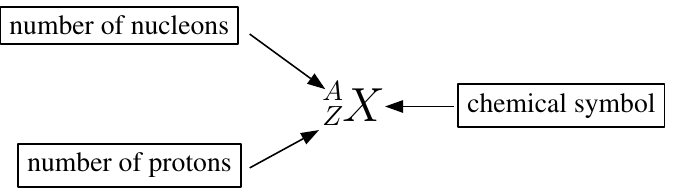
The standard notation shows:
- A (top): mass number (number of nucleons)
- Z (bottom): atomic number (number of protons)
- X: chemical symbol of the element
For example, an iron nucleus with 26 protons and 30 neutrons would be written as:
Where and , giving us neutrons.
Nuclear notation format
Example
Worked Example: Sodium Atom Structure
Let's work through a complete example using sodium to show how all these concepts connect.
Question: Use standard notation to represent sodium and determine the number of protons, neutrons and electrons.
Solution:
Step 1: Find the element symbol
Sodium = Na
Step 2: Find the number of protons
From the periodic table, sodium has 11 protons, so
Step 3: Find the number of electrons
Since sodium is neutral, it has the same number of electrons as protons = 11 electrons
Step 4: Find the mass number A
From the periodic table, for sodium
Step 5: Calculate the number of neutrons
neutrons
Step 6: Write in standard notation
Sodium is represented as:
Answer: Sodium has 11 protons, 12 neutrons, and 11 electrons.
Relative atomic mass
The relative atomic mass of an element takes into account that most elements exist as different isotopes (atoms with the same number of protons but different numbers of neutrons).
Important
Definition: Relative atomic mass
The average mass of all naturally occurring isotopes of an element, measured in atomic mass units
The relative atomic mass is the number you find on the periodic table for each element. It's usually not a whole number because it represents a weighted average of all the isotopes of that element.
Ions and electrical neutrality
In a neutral atom, the number of electrons equals the number of protons, so the positive and negative charges balance out. However, atoms can gain or lose electrons to form ions - charged atoms.
When an atom gains electrons, it becomes negatively charged. When it loses electrons, it becomes positively charged. Importantly, gaining or losing electrons doesn't change what element the atom is - that's determined solely by the number of protons.
Note
Ion Examples:
- Na⁺ is a sodium ion that has lost one electron (11 protons, 10 electrons)
- Cl⁻ is a chlorine ion that has gained one electron (17 protons, 18 electrons)
Summary
Key Points to Remember:
- Atoms consist of a tiny nucleus surrounded by electrons in mostly empty space
- Three subatomic particles: protons (+), neutrons (neutral), electrons (-)
- Atomic number (Z) = number of protons and determines the element
- Mass number (A) = total number of protons and neutrons
- Standard notation shows mass number over atomic number:
- Neutral atoms have equal numbers of protons and electrons
- Ions are formed when atoms gain or lose electrons