Chemical Properties of the Groups (Grade 10 NSC Matric Physical Sciences): Revision Notes
📚Revision Notes
Chemical Properties of the Groups
Introduction to group properties
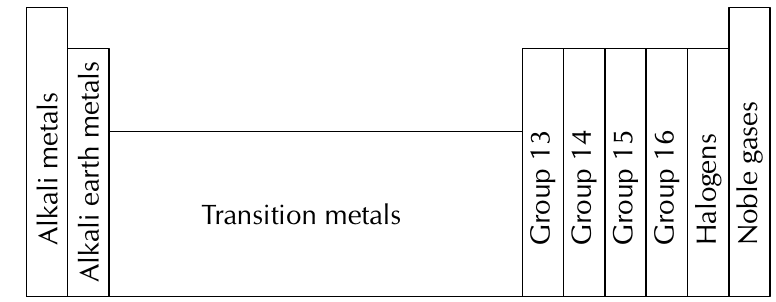
Elements in the same group (vertical columns) of the periodic table display very similar chemical properties. This happens because elements in the same group have similar electron configurations, particularly in their outer electron shells. The characteristics of each group are mostly determined by how many valence electrons the atoms have.
Note
The vertical columns in the periodic table are called groups, while the horizontal rows are called periods. Elements in the same group share similar chemical behaviors due to having the same number of valence electrons.
Group classifications and names
Several groups have special names that help identify their unique properties:
Note
Common Group Names in the Periodic Table:
- Group 1: Alkali metals (excluding hydrogen)
- Group 2: Alkali earth metals
- Groups 3-12: Transition metals
- Group 15: Pnictogens (sometimes used)
- Group 16: Chalcogens (sometimes used)
- Group 17: Halogens
- Group 18: Noble gases
Important points about group classifications
Important
Key Points About Group Classifications:
- Hydrogen appears in Group 1 but is not an alkali metal
- Halogens and alkali earth metals are very reactive groups
- Noble gases are inert (unreactive) due to their complete outer electron shells
- Transition metals occupy the large central block of the periodic table
Periodic trends within groups
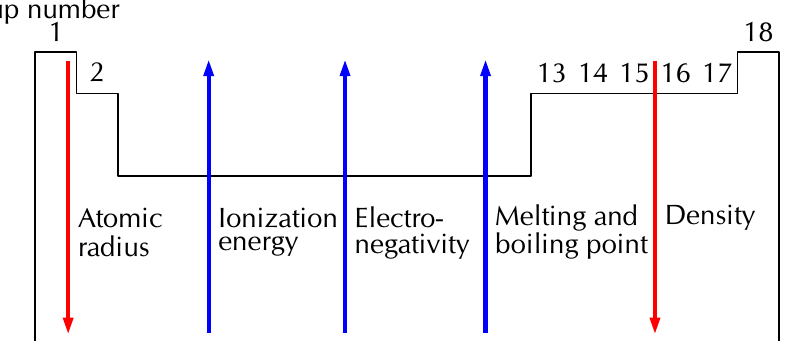
When you move down a group, several key properties change in predictable patterns. Understanding these trends helps you predict the behaviour of unfamiliar elements.
Important
Memorizing Group Trends:
Properties that INCREASE down a group:
- Atomic radius - Atoms get larger as you add more electron shells
- Density - Generally increases due to more massive atoms
Properties that DECREASE down a group:
- First ionisation energy - Easier to remove outer electrons when they're further from the nucleus
- Electronegativity - Atoms have less attraction for electrons in chemical bonds
- Melting and boiling points - Generally decrease (though there are exceptions)
Group 1: alkali metals in detail
The alkali metals (lithium, sodium, potassium, rubidium, caesium) show clear patterns that demonstrate how group properties work.
Electron configurations
All Group 1 elements have one valence electron in their outer shell:
Example
Electron Configurations of Group 1 Elements:
- Lithium:
- Sodium:
- Potassium:
- Rubidium:
- Caesium:
Notice how each element has exactly one electron in its outermost s-orbital.
Chemical bonding patterns
Group 1 elements form compounds with very predictable ratios because they lose their single valence electron to form +1 ions:
Example
Worked Example: Group 1 Compound Formation
Halogen compounds (1:1 ratio):
- LiCl, NaCl, KCl, RbCl, CsCl
Oxide compounds (2:1 ratio):
- , , , ,
This happens because Group 1 atoms lose their single valence electron to form +1 ions, so two Group 1 atoms are needed to balance one ion.
Trends down Group 1
The following table shows how properties change as you move down Group 1:
| Property | Trend | Explanation |
|---|---|---|
| Atomic radius | Increases | More electron shells added |
| First ionisation energy | Decreases | Outer electron further from nucleus |
| Electronegativity | Decreases | Less attraction for bonding electrons |
| Melting/boiling point | Decreases | Weaker metallic bonding |
| Density | Increases | Atoms become more massive |
Group 2: alkali earth metals
The alkali earth metals (beryllium, magnesium, calcium, strontium, barium) follow similar trends to Group 1 but with some important differences.
Note
Key Differences Between Group 1 and Group 2:
- Have two valence electrons instead of one
- Form +2 ions when they react
- Generally less reactive than alkali metals
- Higher melting and boiling points than corresponding alkali metals
This occurs because Group 2 elements have a higher charge density on their ions and stronger metallic bonding.
Other important groups
Group 17: halogens
The halogens are highly reactive non-metals with distinctive properties:
- Very reactive non-metals that readily gain electrons
- Form -1 ions when they react
- Include fluorine, chlorine, bromine, iodine
- Reactivity decreases down the group (opposite to metals!)
Group 18: noble gases
The noble gases are unique in their lack of reactivity:
- Inert (unreactive) under normal conditions
- Have complete outer electron shells (octet rule satisfied)
- Include helium, neon, argon, krypton, xenon
- Used in applications requiring unreactive environments
Note
Noble gases were once called "inert gases" because they were thought to never react. We now know that some of the heavier noble gases can form compounds under extreme conditions.
Using trends to predict properties
You can use group trends to predict properties of unfamiliar elements. This is a powerful tool in chemistry!
Example
Worked Example: Predicting Properties of Francium
If francium (Fr) is below caesium in Group 1, we can predict:
Electronic structure: (follows the pattern)
Compared to caesium, francium will have:
- Lower first ionisation energy (easier to remove the outer electron)
- Lower melting and boiling points (weaker metallic bonding)
- Larger atomic radius (more electron shells)
Chemical compounds: It will form compounds like FrCl and Fr₂O
Summary
Key Points to Remember:
- Elements in the same group have similar chemical properties due to similar electron configurations
- Moving down a group: atomic radius and density increase while ionisation energy and electronegativity decrease
- Group 1 metals form 1:1 compounds with halogens and 2:1 oxides due to losing one electron each
- You can predict properties of unknown elements using established group trends
- Group names like alkali metals, halogens, and noble gases indicate specific chemical behaviours
Exam tips
Important
Essential Exam Strategies:
- Remember the direction of trends: Use memory aids like "RAD" (Radius And Density increase down groups)
- Know the group names: Especially alkali metals, halogens, and noble gases
- Understand the why: Trends occur due to changing atomic structure down groups
- Practice predictions: Use known trends to work out properties of unfamiliar elements
- Watch for exceptions: Some properties don't follow perfect trends