The Doppler Effect with Sound (Grade 12 NSC Matric Physical Sciences): Revision Notes
📚Revision Notes
The Doppler Effect with Sound
What is the Doppler effect?
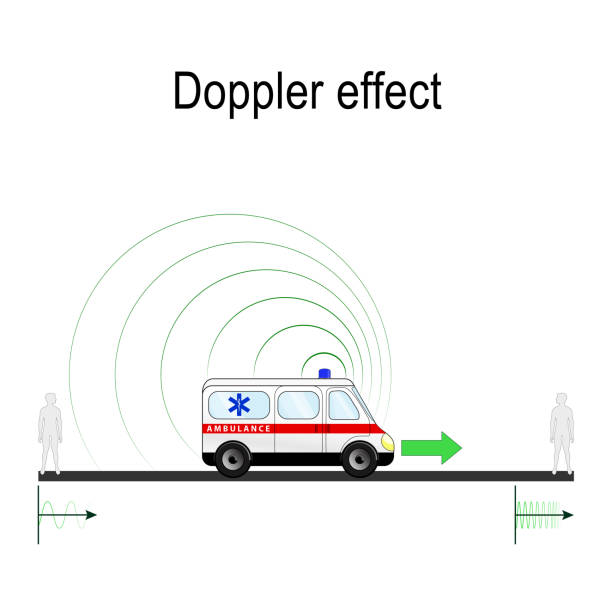
The Doppler effect occurs when there is relative motion between a wave source and an observer. This phenomenon is commonly experienced when you hear an ambulance or train approaching - the pitch sounds higher as it comes towards you and lower as it moves away.
Note
Definition: The Doppler effect is the change in the observed frequency of a wave when the source or the detector moves relative to the transmitting medium.
Key terms
- Observer (or listener): The person or device detecting the sound waves
- Source: The object emitting the sound waves
- Relative motion: Movement between the source and observer
Note
The Doppler effect occurs in two main situations:
- When the source moves relative to a stationary observer
- When the observer moves relative to a stationary source
Case 1: Moving source, stationary observer
When a sound source remains stationary, it emits waves as concentric circles spreading outward in all directions. The distance between consecutive wave crests (wavelength) remains constant.
However, when the source starts moving, something interesting happens. As the source moves, it emits new wave crests while the previous ones continue spreading outward. This creates a pattern where:
- In front of the moving source: Wave crests become bunched together (shorter wavelength, higher frequency)
- Behind the moving source: Wave crests become spread apart (longer wavelength, lower frequency)
Important
Key Insight: The source's motion changes the spacing between wave crests, which directly affects the frequency an observer detects.
What you hear
- When a car approaches you: The sound waves reaching you have a shorter wavelength and higher frequency, so you hear a higher pitch
- When the car moves away from you: The sound waves reaching you have a longer wavelength and lower frequency, so you hear a lower pitch
This explains why an ambulance siren changes pitch as it passes by - it's higher when approaching and lower when moving away.
Case 2: Moving observer, stationary source
Now consider the situation where the source (like a police car) is stationary, but the observers are moving.
The frequency an observer measures depends on how many complete wave cycles they encounter per unit time.
How motion affects what you hear
- Observer moving towards the source: Encounters more wave crests per unit time, measuring a higher frequency
- Observer moving away from the source: Encounters fewer wave crests per unit time, measuring a lower frequency
Note
Key Insight: Motion between source and observer changes the frequency detected, even though the source continues emitting at its original frequency.
The Doppler effect formula
The mathematical relationship between the source frequency and observed frequency is:
Where:
- = frequency perceived by the observer (listener)
- = frequency of the source
- = speed of sound waves
- = speed of the listener
- = speed of the source
Sign conventions
Important
Critical Sign Rules:
- Source moves towards listener: is negative
- Source moves away from listener: is positive
- Listener moves towards source: is positive
- Listener moves away from source: is negative
Memory tip
Think of it this way: when source and observer move towards each other, you get addition effects that increase frequency. When they move apart, you get subtraction effects that decrease frequency.
Worked example 1: Ambulance siren
Example
Worked Example: Ambulance Siren Frequency Change
Question: An ambulance siren emits sound at 700 Hz. You are standing on the pavement. If the ambulance drives past at 20 m·s⁻¹, what frequency do you hear when: a) The ambulance approaches you b) The ambulance moves away from you
Take the speed of sound as 340 m·s⁻¹.
Solution:
Step 1: Analyse the question This is a moving source problem. The observer (you) is stationary, so .
Step 2: Identify the given values
- Hz
- m·s⁻¹
- (stationary observer)
- m·s⁻¹ (approaching) or m·s⁻¹ (moving away)
Step 3: Calculate when ambulance approaches
Step 4: Calculate when ambulance moves away
Answer: When approaching: 743.75 Hz; When moving away: 661.11 Hz
Worked example 2: Moving observer
Example
Worked Example: Moving Observer Frequency
Question: What frequency does a person driving at 15 m·s⁻¹ towards a factory whistle hear if the whistle blows at 800 Hz? Assume the speed of sound is 340 m·s⁻¹.
Solution:
Step 1: Analyse the question This is a moving observer problem. The source is stationary, so .
Step 2: Identify values
- m·s⁻¹
- m·s⁻¹ (moving towards source)
- m·s⁻¹ (stationary source)
- Hz
Step 3: Calculate the frequency
Answer: The driver hears a frequency of 835.29 Hz.
Worked example 3: Train approaching station
Example
Worked Example: Train Station Scenario
Question: A train approaches a station at 20 m·s⁻¹ with its whistle blowing at 458 Hz. An observer on the platform hears a change in pitch as the train approaches, passes, and moves away.
- Name the phenomenon that explains the change in pitch (1 mark)
- Calculate the frequency heard while the train approaches (4 marks)
- How will the frequency change as the train moves away? (1 mark)
Solution:
Question 1: Doppler effect (1 mark)
Question 2: Calculate approach frequency
(4 marks)
Question 3: The frequency decreases (1 mark)
Real-world applications: Ultrasound and medical diagnosis
The Doppler effect has important applications in medicine. Ultrasound devices use sound waves with frequencies greater than 20,000 Hz to examine blood flow in the body.
How medical Doppler works
- Sound waves are sent into the body and reflected by moving blood cells
- Blood moving towards the detector reflects waves at a higher frequency
- Blood moving away from the detector reflects waves at a lower frequency
- The frequency shift indicates blood flow speed and direction
Note
This technique, called sonography or ultrasonography, helps doctors detect:
- Blocked arteries
- Blood flow problems
- Heart valve issues
- Circulation problems in unborn babies
Summary
Key Points to Remember:
- The Doppler effect changes the observed frequency when there is relative motion between source and observer
- Approaching motion (source and observer moving towards each other) produces higher frequency
- Receding motion (source and observer moving apart) produces lower frequency
- Use the formula with correct sign conventions
- The effect has important applications in medical diagnosis using ultrasound technology