Series and Parallel Resistor Networks (Revision) (Grade 12 NSC Matric Physical Sciences): Revision Notes
📚Revision Notes
Series and Parallel Resistor Networks (Revision)
Fundamental electrical quantities
When analysing electric circuits, we work with three fundamental quantities that are closely related through Ohm's Law.
Electrical current (I) is the rate of flow of electric charge through a circuit. Current is measured in amperes (A) and represents how much charge passes through a point per unit time.
Potential difference or voltage (V) relates to the energy gained or lost per unit charge as it moves between two points in a circuit. When charge moves through a battery, it gains energy. When it moves through a resistor, it loses energy. Voltage is measured in volts (V).
Resistance (R) is an internal property of circuit elements that opposes the flow of electric charge. Work must be done to move charge through a resistor. Resistance is measured in ohms (Ω).
Note
These three quantities are interconnected — understanding their relationship is crucial for circuit analysis. Current flows due to potential difference, but the amount of current depends on the resistance present in the circuit.
Ohm's law
For resistors at constant temperature, the ratio remains constant. This constant ratio is called the resistance of the conductor.
Important
Ohm's Law states: The electric current through a metal conductor at constant temperature is proportional to the voltage across the conductor.
Formula:
This relationship means that at constant temperature, the resistance of a conductor remains constant, regardless of the voltage applied or current passing through it.
Note
Temperature changes can cause deviations from Ohm's Law. If a graph of current versus voltage becomes non-linear, this indicates that temperature was not kept constant during the investigation.
Series resistor networks
Definition: Resistors are connected in series when they are consecutive elements in the sequence of the circuit with no branches between them.
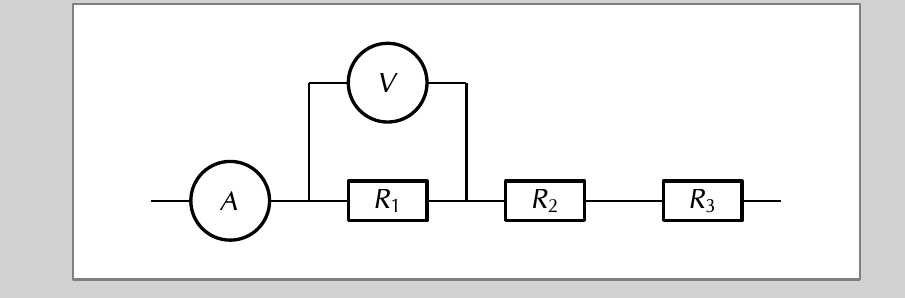
Key properties of series circuits
Equivalent resistance:
Voltage distribution:
Current:
Why these properties make sense
The series properties align with fundamental conservation laws:
- Conservation of charge: Since charges cannot be created or destroyed, and there are no branches for charge to accumulate, the current must remain the same throughout the series network.
- Conservation of energy: The total work done to move charge through the entire network equals the sum of work done through each individual resistor. Since voltage represents energy per unit charge, the voltages must add up.
Example
Worked Example: Series Circuit Analysis
A series circuit contains three resistors: , , and (unknown value). The circuit is connected to a battery and carries a current of . Calculate the potential differences across each resistor and determine the resistance of .
Solution:
Step 1:
Step 2:
Step 3:
Step 4:
Final answers:
Parallel resistor networks
Definition: A parallel configuration occurs when current splits into multiple branches, with each branch containing one or more components.
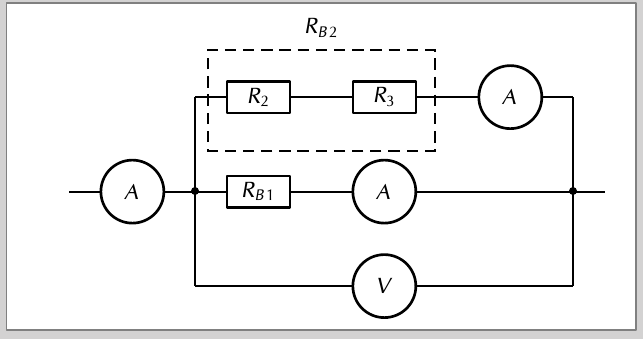
Key properties of parallel circuits
Equivalent resistance:
Voltage:
Current distribution:
Why these properties make sense
The parallel properties also align with conservation laws:
- Conservation of charge: The total number of charges entering the parallel network must equal the total number leaving. Since charges cannot accumulate at junction points, the currents must add up.
- Conservation of energy: Each parallel branch connects to the same two points in the circuit, so the energy per unit charge (voltage) must be the same for each branch.
Example
Worked Example: Parallel Circuit Analysis
Two resistors are connected in parallel: and . The circuit is connected to a battery. Calculate the total current flowing in the circuit.
Solution:
Step 1: Equivalent resistance
Step 2: Total current
Final answer: The total current flowing in the circuit is .
Alternative approach for parallel circuits
- Current through :
- Current through :
- Total current:
Note
Both methods give the same result, but the equivalent resistance method is often quicker for finding total current.
Problem-solving strategy
When approaching circuit problems, follow these systematic steps:
Note
Circuit Analysis Strategy:
- Identify the circuit type — series, parallel, or combination
- List known values — voltages, currents, and resistances
- Choose appropriate formulas — series or parallel relationships
- Apply Ohm's Law systematically to find unknown quantities
- Check your answer — ensure it makes physical sense
Important
Important exam tips:
- Always draw and label circuit diagrams clearly
- Show all working steps systematically
- Remember that series adds resistances directly, while parallel uses reciprocals
- Check that your calculated values are reasonable
- Units are crucial — ensure consistent use of volts, amperes, and ohms
Mixed series-parallel networks
Real circuits often combine series and parallel elements. Treat each section independently by applying the appropriate rules, then combine the results systematically.
Note
For complex networks, work step by step:
- Identify which components are in series or parallel
- Calculate equivalent resistance for each section
- Combine sections until you have the total circuit resistance
- Work backwards to find currents and voltages in individual components
Summary
Key Points to Remember:
- Ohm's Law: applies to individual components and complete circuits
- Series circuits: Same current throughout, voltages add up, resistances add up
- Parallel circuits: Same voltage across branches, currents add up, reciprocal rule for resistance
- Conservation laws: Charge and energy conservation explain why circuit rules work
- Problem-solving: Always identify circuit type first, then apply appropriate formulas systematically