Work (Grade 12 NSC Matric Physical Sciences): Revision Notes
📚Revision Notes
Work
Definition and formula
In physics, work has a very specific meaning that differs from our everyday understanding of the word. While we might say someone is "working hard" when they lift heavy objects, physics defines work more precisely.
Work is done when a force acts in the same direction as, or against the direction of, an object's motion. The key requirement is that there must be both a force applied and displacement (movement) of the object.
The mathematical definition is:
Where:
- = work done (measured in joules, J)
- = magnitude of the applied force (measured in newtons, N)
- = magnitude of displacement (measured in metres, m)
- = angle between the force vector and displacement vector
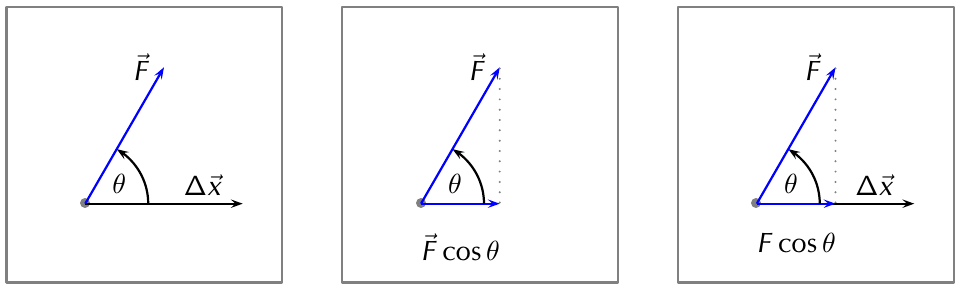
Note
The angle θ is measured between the force vector and the displacement vector, not necessarily between the force and the horizontal. This distinction is crucial for solving work problems correctly.
Understanding force components
The cosine term () in the work formula is crucial because it determines how much of the applied force actually contributes to the work done. When a force is applied at an angle, only the component of the force parallel to the displacement does work.
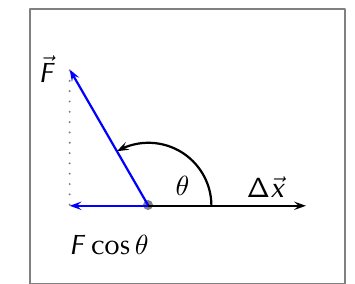
represents the horizontal component of the force that acts in the direction of motion. This is the only part of the force that contributes to work being done.
Important
Only the component of force that is parallel to the displacement does work. Forces perpendicular to the direction of motion contribute zero work, regardless of their magnitude.
Positive, negative and zero work
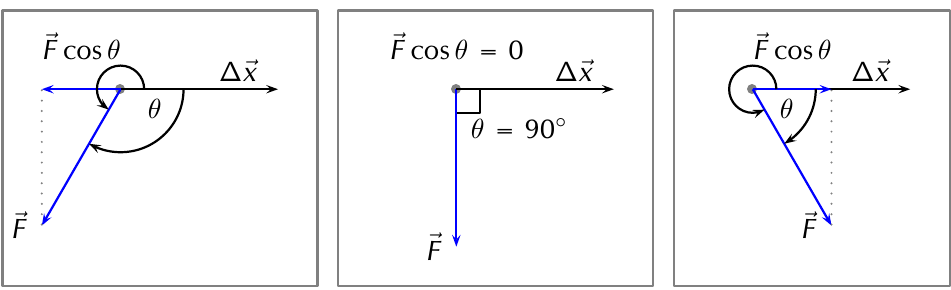
The sign of the work done depends on the angle between the force and displacement:
Positive work (θ < 90°)
When the force component acts in the same direction as the displacement, positive work is done. This means energy is transferred TO the object, increasing its energy.
Negative work (θ > 90°)
When the force component acts opposite to the displacement direction, negative work is done. This means energy is transferred FROM the object, decreasing its energy.
Zero work (θ = 90°)
When the force is perpendicular to the displacement, no work is done because .
When is work done?
It's important to understand that work is only done when there is a component of force parallel to the displacement. Forces perpendicular to motion do no work.
Examples where work IS done:
- Pushing a car forwards while it moves forwards
- Pulling a box up a slope
- Friction opposing motion (negative work)
Examples where work IS NOT done:
- Holding a heavy object stationary above your head
- The normal force on an object moving horizontally
- Centripetal force on an object moving in a circle
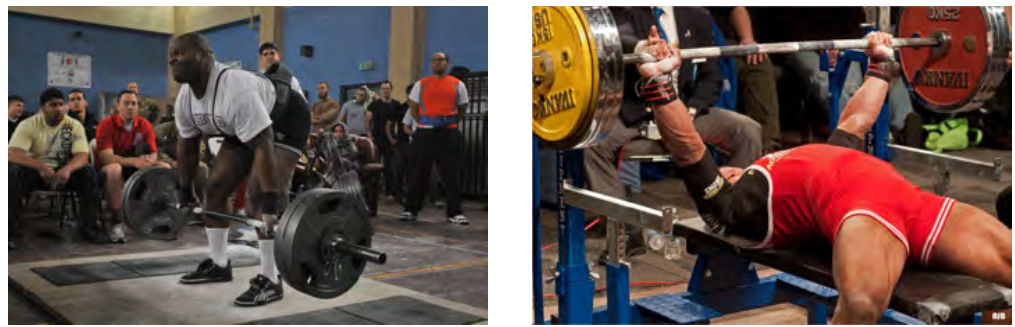
In weightlifting, work is only done during the lifting phase when the weights move upward. When holding weights stationary, no work is done despite the effort required.

Consider this strongman carrying heavy sleds. From a physics perspective, if he carries them horizontally at constant height, he does no work on the sleds because the force he applies (upward to balance gravity) is perpendicular to the horizontal displacement.
Note
This example illustrates an important distinction: physical effort does not always equate to work in the physics sense. The strongman exerts considerable effort to support the sleds against gravity, but if there's no displacement in the direction of the applied force, no work is done.
Worked example 1: Car accelerating
Example
Worked Example: Car Accelerating
Question: A car travels along a straight horizontal road. A force of 500 N is applied to the car in the direction it is travelling, speeding it up. The car covers a distance of 20 m. Calculate the work done on the car.
Solution:
Step 1: Identify given information
- Force applied: N
- Displacement: m
- Force and displacement are in the same direction:
Step 2: Apply the work formula
The answer is positive because the force and displacement are in the same direction, so energy is transferred to the car.
Worked example 2: Car braking
Example
Worked Example: Car Braking
Question: The same car now slows down when a braking force of 300 N is applied opposite to its direction of motion while it travels 25 m forwards. Calculate the work done on the car.
Solution:
Step 1: Identify given information
- Force applied: N
- Displacement: m
- Force and displacement are in opposite directions:
Step 2: Apply the work formula
The answer is negative because the force opposes the motion, so energy is transferred from the car.
Worked example 3: Box pulled at an angle
Example
Worked Example: Box Pulled at an Angle
Question: Calculate the work done on a box if it is pulled 5 m along the ground by applying a force of F = 20 N at an angle of 60° to the horizontal.
Solution:
Step 1: Identify given information
- Force applied: N
- Displacement: m along the ground
- Angle between force and displacement:
Step 2: Apply the work formula
The answer is positive because the component of force parallel to the displacement is in the same direction as the motion.
Key exam tips
Important
Essential Exam Strategies:
- Always identify the angle between the force and displacement vectors, not between the force and the horizontal
- Remember that work can be positive, negative, or zero
- Check that your answer makes physical sense - does energy increase or decrease?
- Pay attention to the direction of forces and motion
- Use the component of force parallel to displacement, which is
Summary
Key Points to Remember:
- Work is energy transfer - positive work increases an object's energy, negative work decreases it
- Only the parallel component matters - forces perpendicular to motion do no work
- Work formula: - memorise this and understand each component
- Units are joules (J) - which equals newton-metres (N⋅m)
- Zero work doesn't mean zero effort - holding something stationary requires effort but does no work in physics terms