Work-Energy Theorem (Grade 12 NSC Matric Physical Sciences): Revision Notes
📚Revision Notes
Work-Energy Theorem
Conservative and non-conservative forces
Understanding the difference between conservative and non-conservative forces is essential for applying the work-energy theorem effectively.
Conservative forces are forces that conserve mechanical energy in a system. When only conservative forces act on an object, the total mechanical energy (kinetic energy + potential energy) remains constant. Examples include gravitational forces and spring forces.
Non-conservative forces are forces that do not conserve mechanical energy. When non-conservative forces act on an object, the total mechanical energy of the system changes. Examples include friction, air resistance, and applied forces.
Important
When non-conservative forces do work on an object, the total mechanical energy changes. If positive work is done, the object gains energy. If negative work is done, the object loses energy.
Investigation of non-conservative forces
We can investigate how non-conservative forces affect an object's mechanical energy by examining a ball rolling across different surfaces.

Consider a ball rolling from point A to point B on a horizontal surface. The total mechanical energy at each point equals the sum of kinetic energy and gravitational potential energy:
Note
On a smooth surface (no friction):
Since the surface is horizontal , the equations become:
Without friction, no non-conservative forces act on the ball. Therefore, mechanical energy is conserved, and .
On a rough surface (with friction): When friction acts on the ball, it becomes a non-conservative force that does negative work. The ball moves slower at point B than at point A because mechanical energy is lost to friction.
Since , we have .
The mechanical energy lost by the ball equals the work done against friction. This demonstrates that non-conservative forces change an object's total mechanical energy.
The work-energy theorem
When a net force does work on an object, there is always a change in the object's kinetic energy. This relationship leads us to the work-energy theorem.
Important
DEFINITION: Work-energy theorem
The work-energy theorem states that the work done on an object by the net force is equal to the change in its kinetic energy:
Where:
- = net work done on the object (J)
- = change in kinetic energy (J)
- = final kinetic energy (J)
- = initial kinetic energy (J)
The work-energy theorem is another example of energy conservation principles.
Worked example 1: Falling brick
Example
Worked Example: Falling Brick
QUESTION A 1 kg brick is dropped from a height of 10 m. Calculate the work done on the brick between the moment it is released and when it hits the ground. Assume air resistance can be neglected.
SOLUTION
Step 1: Determine what is given and what is required
- Mass of brick: kg
- Initial height: m
- Final height: m
- Required: work done on the brick
Step 2: Determine the approach The brick falls freely, so energy is conserved. The work done equals the change in kinetic energy. Initially, the brick has no kinetic energy because it starts from rest. When it hits the ground, all potential energy converts to kinetic energy.
Step 3: Determine the brick's potential energy at J
Step 4: Determine the work done Initially: J and J Finally: J and J
From the work-energy theorem: J
Therefore, 98 J of work was done on the brick.
Worked example 2: Car braking
Example
Worked Example: Car Braking
QUESTION The driver of a 1000 kg car travelling at 16.7 m·s⁻¹ applies the brakes when seeing a red light. The brakes provide a frictional force of 8000 N. Determine the stopping distance of the car.
SOLUTION
Step 1: Determine what is given and what is required
- Mass of car: kg
- Initial speed: m·s⁻¹
- Frictional force of brakes: N
- Required: stopping distance
Step 2: Determine the approach We apply the work-energy theorem. All the car's kinetic energy is lost to friction, so the change in kinetic energy equals the work done by the brakes.
Step 3: Determine the kinetic energy of the car J
Step 4: Determine the work done The stopping distance is . Since the applied force and displacement are in opposite directions, .
Step 5: Apply the work-energy theorem The change in kinetic energy equals the work done: m
Step 6: Write the final answer The car stops in 17.4 m.
Worked example 3: Block on an inclined plane
Example
Worked Example: Block on an Inclined Plane
QUESTION A 2 kg block is pulled up along a smooth incline of length 10 m and height 5 m by applying a non-conservative force. At the end of the incline, the block is released from rest to slide down to the bottom. Find:
- the work done by the non-conservative force
- the kinetic energy of the block at the end of the round trip
- the speed at the end of the round trip
SOLUTION
Step 1: Analyse the given information Three forces act on the block while going up:
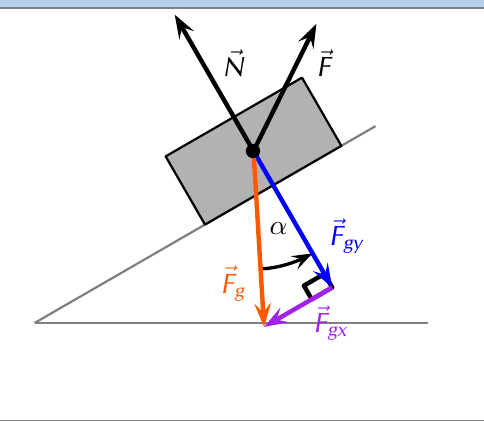
- Weight of the block:
- Normal force: (applied by the block)
- Non-conservative force:
During the downward journey, only two forces act: weight and normal force.
Step 2: Work done by non-conservative force during round trip The work done by the non-conservative force is .
Since acts only during the upward journey and the block is released at the end of the upward journey:
The kinetic energies at the beginning and end of the upward motion are both zero.
Since the net work done during upward motion is zero:
Step 3: Work done by normal force during upward motion The normal force is perpendicular to the direction of motion, so it does no work:
Step 4: Work done by gravity during upward motion For upward motion, the component of gravitational force parallel to the slope opposes the motion. The angle between force and displacement is , so .
The magnitude of . The work done by gravity during upward motion is: J
Therefore, the work done by the non-conservative force during the round trip is: J
Step 5: Kinetic energy at the end of round trip Using the work-energy theorem for the entire motion:
The total work done during the round trip includes work by all forces: J
Therefore: J
Step 6: Speed of the block
m·s⁻¹
The speed at the end of the round trip is 9.90 m·s⁻¹.
The positive work done by the non-conservative force is cancelled by the negative work done by gravity during downward motion. The net work results in a change in kinetic energy as per the work-energy theorem.
Summary
Key Points to Remember:
-
The work-energy theorem states that net work done on an object equals the change in its kinetic energy:
-
Conservative forces conserve mechanical energy, while non-conservative forces change total mechanical energy
-
When applying the work-energy theorem, always identify all forces acting on the object and determine which do work
-
The angle between force and displacement is crucial - use to calculate work done by individual forces
-
In problems involving inclined planes, remember to resolve gravitational force into components parallel and perpendicular to the slope