Introducing Homeostasis (VCE SSCE Biology): Revision Notes
📚Revision Notes
Introducing Homeostasis
What is homeostasis?
Homeostasis is a complex process that maintains the internal environment of an organism within set limits so that cells and systems can function properly.
All living things have specific requirements for survival. Plants need the right amount of light, fish need water at the correct temperature and salinity, and humans need appropriate temperature, food, and water. At the cellular level, these requirements become even more specific. Since all living organisms are composed of cells, and these cells must function correctly for the organism to survive, maintaining the right cellular environment is crucial.
Note
The "Goldilocks Principle" for Cells
Cells have very particular needs - they function best when conditions in their environment fall within an optimal range. Think of cells as having a "just right" zone, similar to Goldilocks finding the perfect porridge. When their environmental demands are not met, cells cannot behave or function properly, which can ultimately affect the entire organism.

Cells inhabit the internal environment of our bodies. The internal environment refers to the conditions inside your body - the fluid surrounding your cells, your blood composition, your body temperature, and other factors. This is distinct from the external environment, which is the world outside your body.
Key parameters maintained by homeostasis
Several critical parameters must be maintained within specific ranges for cells to function normally:
- Temperature: Your optimal internal body temperature is approximately
- pH (acidity level): The optimal pH of blood is
- Blood sugar levels: Blood glucose is maintained between
- Sodium concentration: Normal levels are
- Potassium concentration: Normal levels are
- Fluid balance: The amount of water in your body must remain stable
Important
When these parameters fall outside their optimal ranges, cells cannot function normally and may potentially become damaged or die.
How the external environment affects the internal environment
The external environment constantly influences your internal environment. For example, when you stand outside in freezing conditions, the cold causes your body temperature to drop. Conversely, when you're exposed to heat, your body temperature rises, you begin to sweat, and you lose fluid. All these changes alter the internal environment of your body, creating unfavourable conditions for your cells.
However, you don't immediately become ill when exposed to temperature changes. Your cells don't instantly die when the external environment changes. This is because your body is constantly working to maintain homeostasis - adjusting and compensating to keep your internal environment stable despite external fluctuations.
Homeostatic mechanisms
Homeostasis doesn't happen by accident. Your body uses specific mechanisms and systems to maintain stable internal conditions. These homeostatic processes can be explained using the stimulus-response model and feedback loops.
The stimulus-response model
The stimulus-response model provides a framework for understanding how changes in the environment influence an organism's function. This model can be broken down into five key components that work together in sequence:

1. Stimulus
A stimulus is a change in the external or internal environment of an organism. For example, a stimulus might be a rise in external temperature, a decrease in blood sugar levels, or increased pressure on a body part. The stimulus is the initial change that triggers the homeostatic response.
2. Receptor
A receptor is a structure that detects a signal or external change. Receptors are usually proteins, either embedded in cell membranes or located in the cytosol, which detect changes in the environment. In many cases, an entire cell can function as a receptor.
When a receptor detects a stimulus, it converts that stimulus into a chemical or electrical signal that can be transmitted to the modulator. This conversion process is essential because it allows information about the environment to be communicated through the body.
There are several types of receptors in the human body, each specialised to detect different kinds of stimuli:
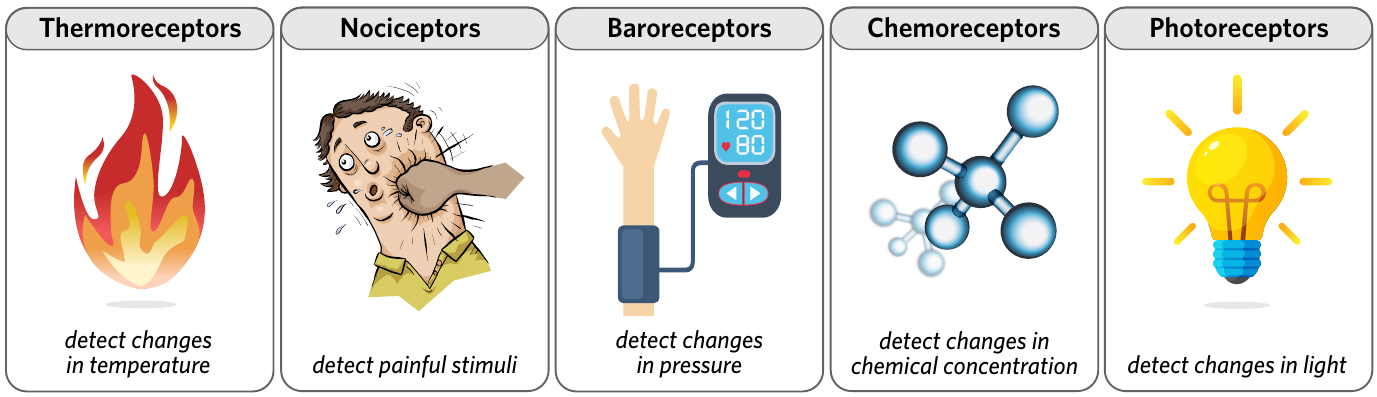
- Thermoreceptors: Detect changes in temperature
- Nociceptors: Detect painful stimuli
- Baroreceptors: Detect changes in pressure
- Chemoreceptors: Detect changes in chemical concentration
- Photoreceptors: Detect changes in light
3. Modulator (Processing Centre)
The modulator, also known as the processing centre, is the location where information from receptors is sent and compared to a set point. In some homeostatic mechanisms, the modulator is part of the brain; in others, it's a specific type of cell.
The modulator performs a critical function: it compares the information received from receptors with an ideal condition the body aims to maintain. For example, if the modulator is monitoring temperature, it compares the current temperature to the set point of . Based on this comparison, the modulator releases molecules (often hormones) that go on to alter the functioning of an effector.
4. Effector
An effector is a molecule (usually a hormone), cell, or organ that responds to a signal from the modulator and produces a response. Effectors are the "workers" that actually carry out the body's response to the stimulus.
A hormone is a signalling molecule released from endocrine glands that regulates the growth or activity of target cells. Many homeostatic mechanisms use hormones as effectors to communicate signals throughout the body.
5. Response
The response is the action of a cell, organ, or organism caused by a stimulus. The response is any change in the function of a target cell, organ, or organism after stimulation from the initial signal. The response represents the body's attempt to counteract or adjust to the original stimulus.
Example
Worked Example: The Stimulus-Response Model in Everyday Life
Consider what happens when you see a dog and decide to pat it:
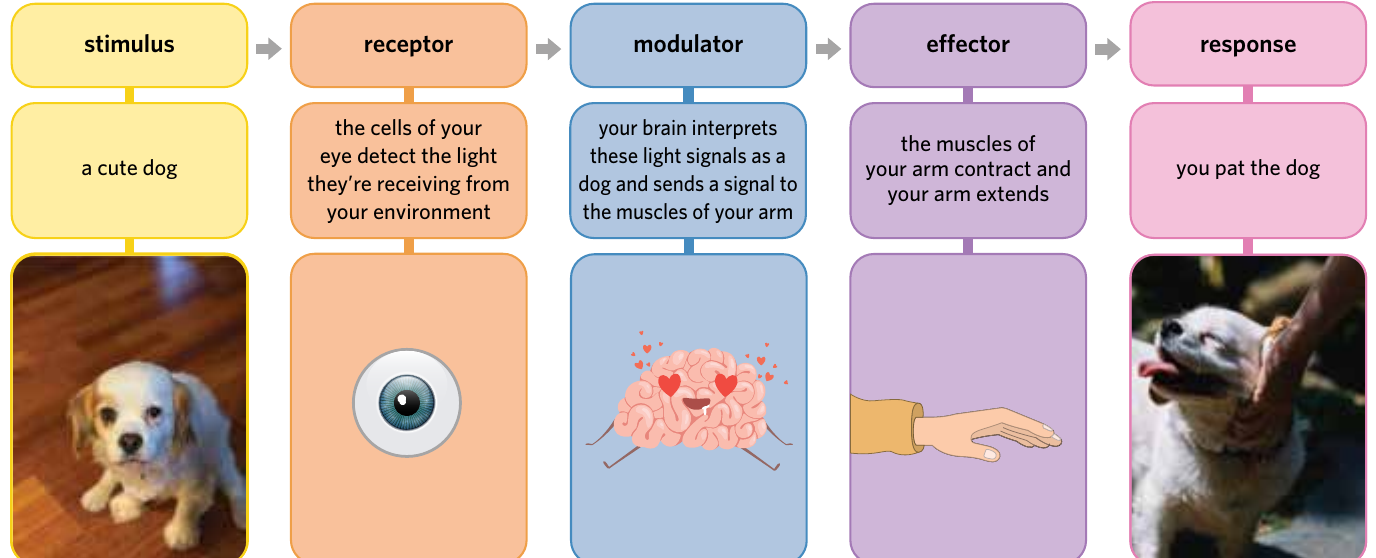
- Stimulus: You see a cute dog
- Receptor: The cells in your eye detect the light from your environment
- Modulator: Your brain interprets these light signals as representing a dog and decides it should be patted, sending a signal to the muscles of your arm
- Effector: The muscles of your arm contract and your arm extends
- Response: You pat the dog
This example demonstrates how the stimulus-response model describes a wide range of biological processes, not just homeostasis.
Positive feedback systems
Positive feedback systems are stimulus-response processes in which the response increases the initial stimulus. In other words, the output amplifies the input, creating a cycle that intensifies the original change.
Note
Positive feedback systems are relatively rare in the body and do not form part of homeostasis. This is because homeostasis aims to maintain stability, whereas positive feedback creates increasing change. However, positive feedback is useful in situations where the body needs to rapidly complete a process.
Example: childbirth and oxytocin
Example
Worked Example: Positive Feedback During Childbirth
One important example of a positive feedback system occurs during childbirth:
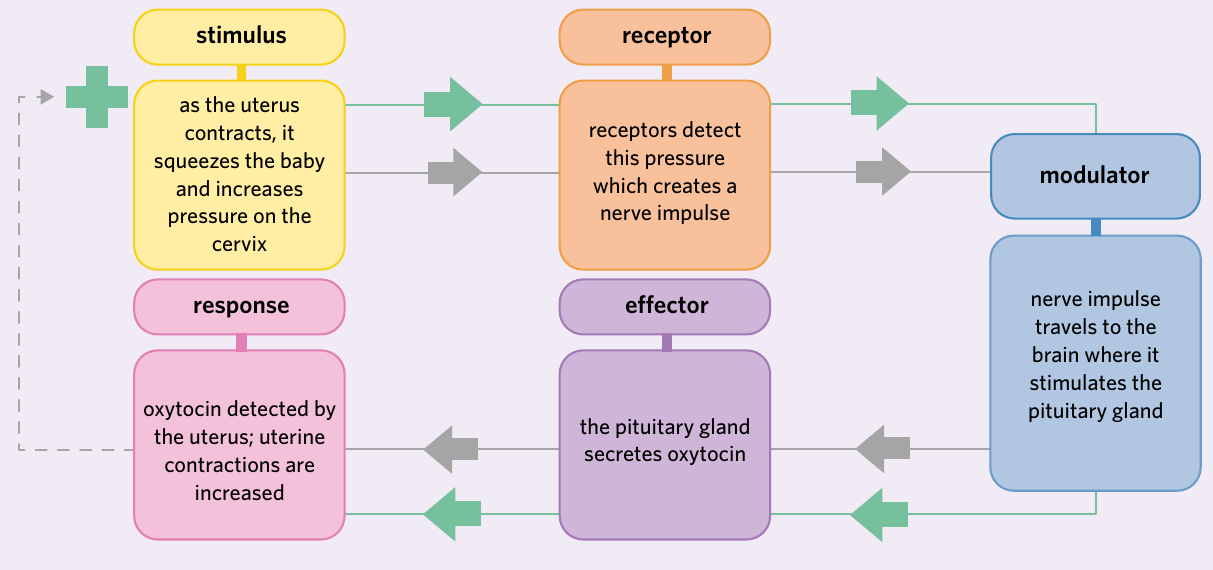
- Stimulus: As the uterus contracts, it squeezes the baby and increases pressure on the cervix
- Receptor: Receptors detect this pressure, creating a nerve impulse
- Modulator: The nerve impulse travels to the brain where it stimulates the pituitary gland
- Effector: The pituitary gland secretes the hormone oxytocin
- Response: Oxytocin is detected by the uterus, causing uterine contractions to increase
Notice that the response (increased uterine contractions) leads back to an increase in the original stimulus (more pressure on the cervix). This creates a positive feedback loop that continues to intensify until the baby is delivered. The increasing contractions help ensure that childbirth progresses and completes efficiently.
Negative feedback systems
Negative feedback systems are stimulus-response processes in which the response counters the stimulus. In other words, the response works to reverse the initial change, attempting to return the system to its original state.
Important
Negative vs Positive Feedback
Negative feedback is the primary mechanism used in homeostasis. These systems work to maintain a set point - the value the body aims to maintain for a given variable (for example, the set point for body temperature is ).
Unlike positive feedback which amplifies changes, negative feedback reverses them to maintain stability.
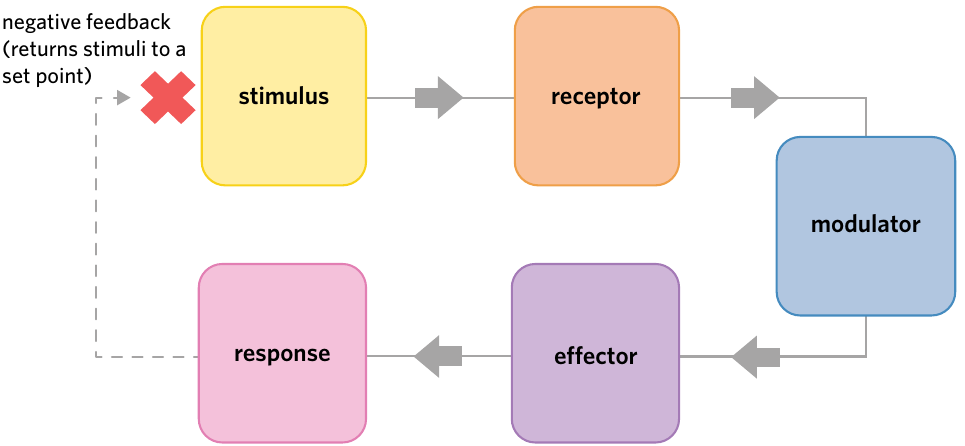
In a negative feedback system, when a stimulus causes a change away from the set point, receptors detect this change. The modulator then initiates a response that works to counteract the stimulus and bring the variable back toward the set point. Once the set point is reached, the stimulus is removed, and the negative feedback loop stops.
Example
Worked Example: Temperature Regulation
If the external temperature increases (stimulus), your body might respond by sweating. Sweating causes water to evaporate from your skin, removing heat from your body and lowering your body temperature. This response counters the initial stimulus (increased temperature) and helps return your body temperature to its set point.
Overcompensation in negative feedback
Negative feedback loops often overcompensate when responding to a stimulus. This means that when a variable is too high, the negative feedback mechanism works to reduce it but may reduce it too much, making it too low. When this happens, another negative feedback loop is triggered to increase the variable again.
Note
This constant adjustment creates a pattern where the variable oscillates slightly above and below the set point, rather than remaining perfectly constant. However, these oscillations keep the variable within the acceptable range needed for normal cell function.
Cellular signalling: an alternative model
Sometimes, particularly when discussing the stimulus-response model at the cellular level, it's presented as a three-step process. This simplified version groups the five components differently but describes the same fundamental processes:
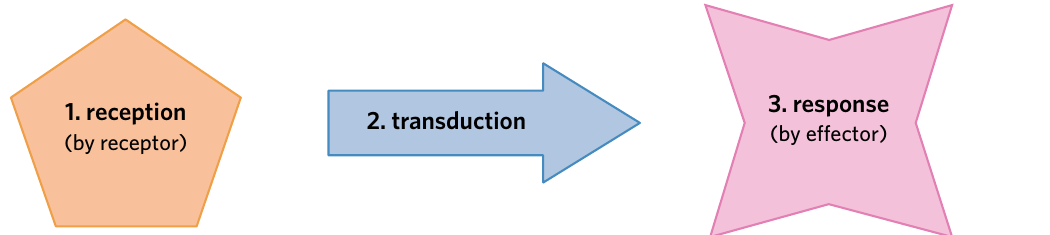
1. Reception (by receptor)
Reception involves the detection of a stimulus and the transmitting of this stimulus into a mechanical, electrical, or chemical signal. This corresponds to the stimulus and receptor stages of the five-component model.
2. Transduction
Transduction is the series of events that occur after the reception of a signal which results in the generation of a response. The transduction stage includes everything that happens between detecting the stimulus and producing the final response. This can involve sending signals between organisms, across the body, to neighbouring cells, or back to the original receptor cell. Transduction encompasses what the five-component model calls the modulator and effector stages.
3. Response (by effector)
Response is the change in the function of a target cell, organ, or organism. This is identical to the response stage in the five-component model.
Note
Both the five-component and three-step models describe the same biological processes - they simply organise the information differently. Understanding both versions can help you recognise and analyse stimulus-response mechanisms in different contexts.
Remember!
Summary
Key Points to Remember:
-
Homeostasis maintains a stable internal environment within set limits so that cells and systems can function properly, despite changes in the external environment.
-
The stimulus-response model consists of five components: stimulus (environmental change) → receptor (detects change) → modulator (compares to set point) → effector (carries out response) → response (action to address stimulus).
-
Different receptor types detect different stimuli: thermoreceptors (temperature), nociceptors (pain), baroreceptors (pressure), chemoreceptors (chemical changes), and photoreceptors (light).
-
Positive feedback systems amplify the stimulus and are rare in the body (example: oxytocin release during childbirth creating stronger contractions).
-
Negative feedback systems counter the stimulus and are the primary mechanism of homeostasis, working to return variables to their set point (example: sweating to reduce body temperature when overheated).