Regulation of Body Temperature (VCE SSCE Biology): Revision Notes
📚Revision Notes
Regulation of Body Temperature
Introduction
Thermoregulation is the homeostatic process that maintains a constant internal body temperature in organisms. For humans and other mammals, this involves keeping core body temperature at approximately 37°C. This precise control is essential because enzymes and other proteins function optimally within a narrow temperature range. If body temperature becomes too low, enzymes may become inactive; if too high, they may denature and lose function permanently.
Important
Critical Temperature Control
The human body must maintain its core temperature within a very narrow range. Even small deviations can have serious consequences:
- Too low: enzymes become inactive, slowing vital metabolic processes
- Too high: proteins denature and lose function permanently, which can be fatal
The human body constantly exchanges heat with its environment. Understanding how this heat transfer occurs, and how the body responds to temperature changes, is fundamental to understanding thermoregulation as a homeostatic mechanism.
Heat transfer in the body
The body can gain heat from or lose heat to the environment through physical processes. An important principle to remember is that heat always moves from areas of higher temperature to areas of lower temperature. When a hot cup of tea is left on a bench, it cools down because heat energy transfers from the hot liquid to the cooler surrounding air.
Four main mechanisms facilitate heat transfer between the body and its environment. Each method operates through different physical principles, and the body uses all four during thermoregulation.
Methods of heat transfer
Conduction is the transfer of heat through physical contact with another object. When two objects at different temperatures touch each other, heat energy moves from the warmer object to the cooler one through direct molecular contact. For example, when you touch a hot surface, heat from that surface is transferred to your fingers via conduction. Similarly, sitting on a cold bench results in heat loss from your body to the bench through conduction.
Note
Conduction in Daily Life
Conduction explains why metal objects feel colder than wooden objects at the same temperature - metal conducts heat away from your hand much more efficiently than wood, making it feel colder even though both objects are at room temperature.
Convection is the transfer of heat via the movement of a liquid or gas between areas of different temperature. This method involves the physical movement of fluids (liquids or gases) carrying heat energy with them. Warm fluids are less dense than cool fluids, so warm fluids tend to rise whilst cool fluids sink. This creates convection currents. For example, the temperature on the upper floor of a house is typically warmer than on the ground floor because hot air rises, carrying heat energy upwards through convection. In the body, blood flow is a major form of convection, as warm blood moving near the skin surface can transfer heat to or from the environment.
Evaporation is the loss of heat via the conversion of water from liquid to gas form. Converting a liquid into a gas requires significant energy input, known as the latent heat of vaporisation. When water evaporates from a surface, it absorbs heat energy from that surface to undergo the phase change. When you sweat, the water on your skin evaporates, taking heat energy away from your body and cooling you down. This is why sweating is such an effective cooling mechanism.
Radiation is the transfer of heat via electromagnetic waves such as light. Unlike the other three methods, radiation does not require physical contact with another object or a medium to travel through. The sun warms the Earth through radiation, as electromagnetic waves travel through the vacuum of space. Similarly, your body can absorb heat from the sun via radiation. Conversely, when you stand in a cold room with minimal clothing, your body loses heat to the environment via radiation.
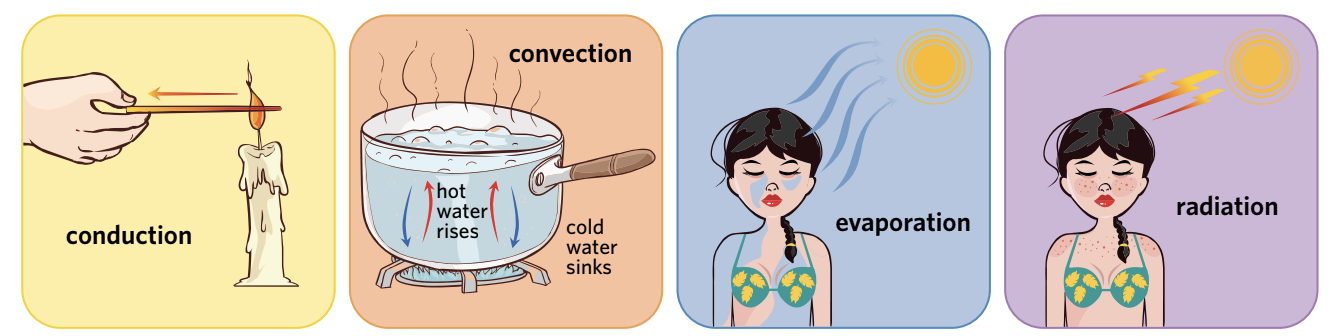
| Type of heat transfer | Explanation | Example |
|---|---|---|
| Conduction | The transfer of heat through physical contact with another object | When you touch something hot, heat from that object is transferred to your fingers via conduction |
| Convection | The transfer of heat via the movement of a liquid or a gas between areas of a different temperature | The temperature is warmer in the second storey of your house because hot air rises, taking heat energy with it |
| Evaporation | The loss of heat via the conversion of water from liquid to gas form | When you sweat, the water on your skin evaporates. Turning a liquid into a gas requires a lot of energy, and when sweat evaporates it takes away heat energy from your skin making you cool down |
| Radiation | The transfer of heat via electromagnetic waves such as light (i.e. doesn't require physical contact with another object) | The sun warms you via radiation. Conversely, when you stand in a cold room and you aren't wearing much clothing, you lose heat to your environment via radiation |
The body uses and manipulates these heat transfer mechanisms to maintain a constant internal temperature through various physiological responses.
Thermoregulation
Heat balance in the body
The overall body temperature of an organism represents a balance between three factors: heat entering the system from the environment, heat generated internally through metabolism, and heat lost to the environment. This relationship can be expressed mathematically:
This equation shows that body temperature will increase if heat input and metabolic heat production exceed heat loss, and will decrease if heat loss exceeds heat gain.
Endotherms and ectotherms
Species can be classified into two groups based on their primary source of heat energy. Endotherms are animals that produce the majority of their own heat via metabolic processes. They are sometimes called "warm-blooded" animals. Mammals and birds are endotherms. These organisms generate substantial heat internally through cellular metabolism, particularly through cellular respiration in their cells. This internal heat production allows endotherms to maintain a relatively constant body temperature even when environmental temperatures fluctuate.
Ectotherms are animals that obtain heat primarily from the environment, rather than from their own metabolic heat. They are sometimes called "cold-blooded" animals. Reptiles, amphibians, and fish are examples of ectotherms. These organisms produce very little metabolic heat and instead rely on external heat sources, such as sunlight or warm surfaces, to regulate their body temperature.
Note
Humans as Endotherms
Humans are endotherms, generating significant metabolic heat internally. However, humans also gain heat from environmental sources (such as sunlight or heaters) and lose heat to the environment (such as when stepping out of a warm shower into cold air). This is why thermoregulation is necessary - to maintain a constant internal temperature despite these external influences.
The thermoregulation feedback system
Thermoregulation operates through homeostasis, using a stimulus-response model combined with negative feedback loops to counter changes in environmental or internal temperature. This system involves five key components working together to maintain core body temperature at 37°C.
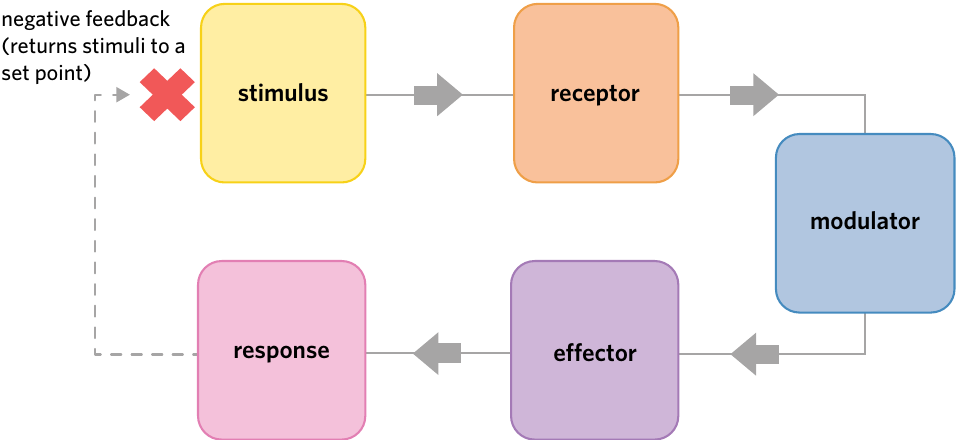
The general negative feedback loop consists of:
- Stimulus: A change that disrupts the normal state
- Receptor: Detects the change
- Modulator: Processes information and coordinates response
- Effector: Carries out the response
- Response: The action that counteracts the stimulus
Important
Negative Feedback Prevents Over-correction
The negative feedback loop ensures that once the response has corrected the change, signals are sent back to stop the response. This prevents over-correction and maintains stability - without this feedback, the body could swing between being too hot and too cold indefinitely.
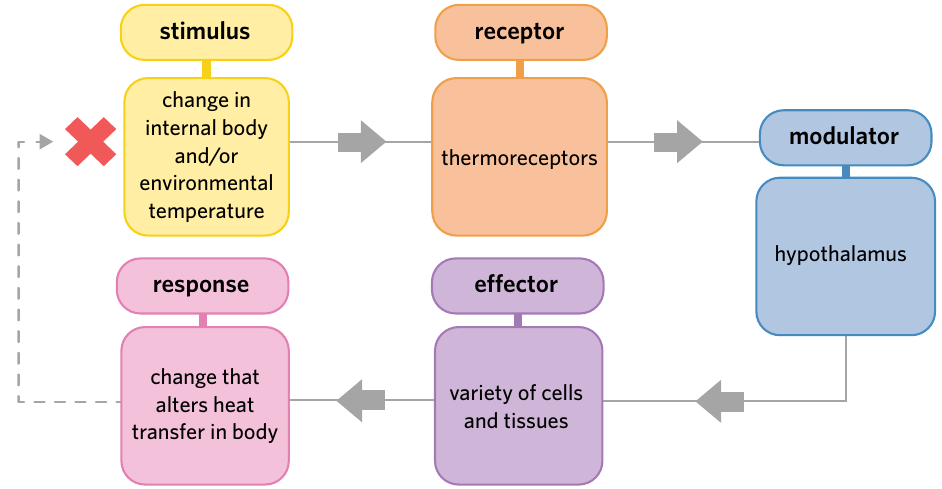
For thermoregulation specifically, this model operates as follows:
Stimulus: The stimulus is a change in core body temperature or environmental temperature. This could be an increase or decrease in temperature.
Receptor: Thermoreceptors detect temperature changes. These specialised receptors are located in two main areas - near the brain to monitor internal core temperature, and in the skin to detect environmental temperature changes. When temperature deviates from the normal set point, thermoreceptors send signals to the modulator.
Modulator: The hypothalamus is the modulator in thermoregulation. The hypothalamus is a section of the brain in mammals that controls the maintenance of the body's internal environment. It receives input from thermoreceptors throughout the body and compares the current temperature to the set point (approximately 37°C). Based on this comparison, the hypothalamus coordinates the appropriate response.
Effector: The hypothalamus sends signals to a variety of effector cells and tissues throughout the body. These effectors are the structures that will carry out the response to change temperature.
Response: The effectors produce responses that alter heat transfer in the body. These responses work through the four heat transfer mechanisms (conduction, convection, evaporation, and radiation) to either increase or decrease body temperature, bringing it back toward the set point.
The key feature of this system is negative feedback. Once the response has successfully returned body temperature to the set point, this information feeds back to the receptors and hypothalamus, which then reduce or stop the response. This prevents the body from over-correcting and ensures temperature remains stable.
The specific effectors and responses differ depending on whether the body needs to lose heat (when too hot) or conserve and generate heat (when too cold).
Body responses to increased temperature
When the body detects a rise in internal or environmental temperature - such as on a hot day or during exercise - the hypothalamus receives signals from thermoreceptors and responds by activating multiple effectors. All of these responses work toward the same goal: increasing the amount of heat lost to the environment and decreasing the amount of heat produced within the body.
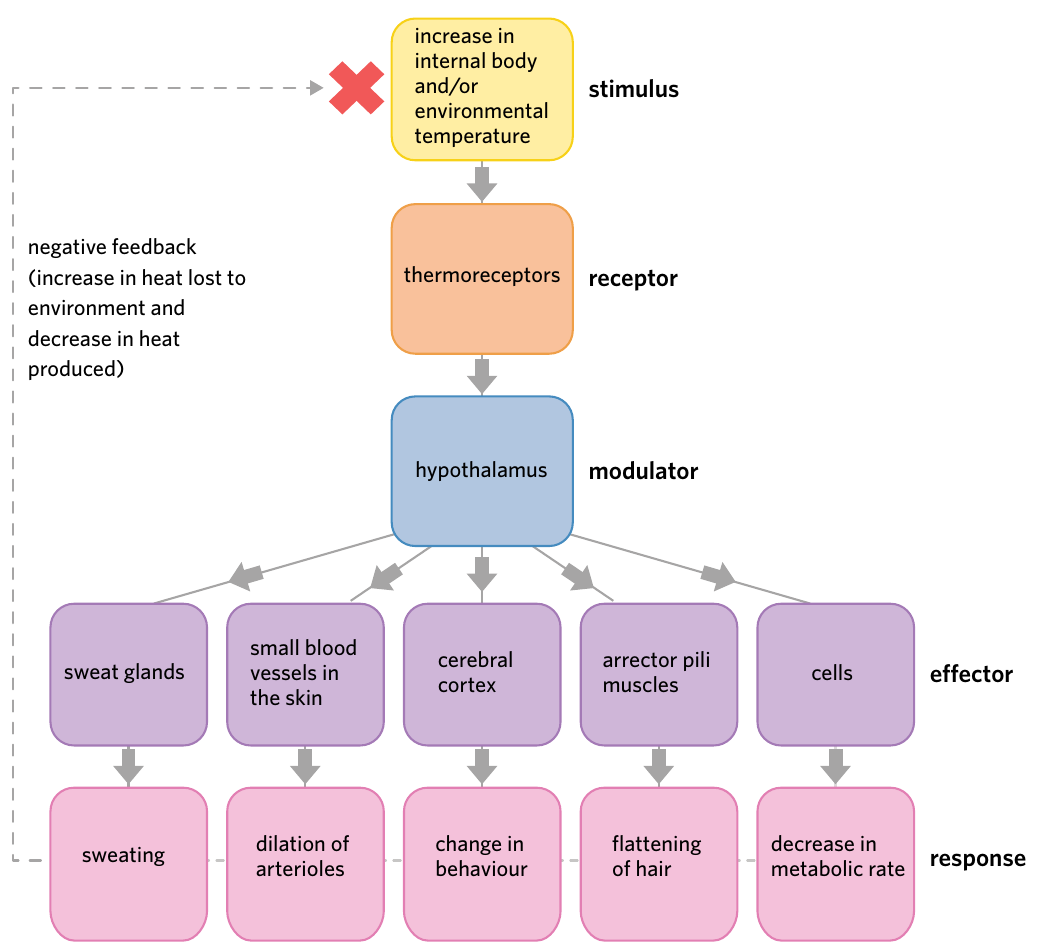
The main effectors and their responses include:
Sweat glands are activated to produce sweat, which is secreted onto the skin surface. The water in sweat then evaporates from the skin. Evaporation requires significant energy, and this energy is taken from the skin in the form of heat. As sweat evaporates, it carries heat energy away from the body, cooling it down. This is one of the most effective cooling mechanisms in humans.
Example
How Sweating Cools You Down
Step 1: Sweat glands secrete water onto the skin surface
Step 2: Water molecules on the skin absorb heat energy from the body
Step 3: This energy allows water molecules to overcome intermolecular forces and evaporate (liquid → gas)
Step 4: As water molecules leave the skin surface as water vapor, they take the absorbed heat energy with them
Result: The skin temperature decreases, cooling the body
Small blood vessels in the skin undergo vasodilation, which is the widening of blood vessels. Specifically, arterioles (small arteries) near the skin surface dilate, increasing blood flow to the skin. Since blood carries heat from the body's core, bringing more warm blood to the surface allows more heat to be lost to the environment through convection and radiation. The increased surface blood flow explains why people appear flushed or red-faced when hot.
The cerebral cortex (the outer layer of the brain) initiates behavioural changes in response to heat. These conscious responses might include seeking shade, removing layers of clothing, drinking cold beverages, or turning on a fan. These behavioural responses can be very effective at reducing heat gain from the environment.
Arrector pili muscles in the skin relax. Arrector pili muscles are small muscles attached to hair follicles. When these muscles relax, body hair lies flat against the skin surface. This flattening increases air flow across the skin, which enhances heat loss through convection. In humans, this response is less effective than in other mammals with thicker fur, but the mechanism still exists.
Cellular metabolism is reduced. The hypothalamus sends signals to cells throughout the body to slow their metabolic processes. Since metabolism generates heat as a byproduct, decreasing metabolic rate reduces the amount of heat produced internally. This helps prevent further increases in body temperature.
Note
Negative Feedback in Action
These responses work together through negative feedback. As heat is lost to the environment and internal heat production decreases, body temperature falls back toward 37°C. The thermoreceptors detect this return to normal temperature, and signals are sent to reduce the cooling responses, preventing the body from becoming too cold.
Body responses to decreased temperature
When internal or external temperature decreases - such as in cold weather or after swimming in cold water - thermoreceptors throughout the body detect the change and signal the hypothalamus. The hypothalamus then stimulates multiple effectors to produce responses. In this case, all responses aim to decrease the amount of heat lost to the environment and increase the amount of heat produced by the body.
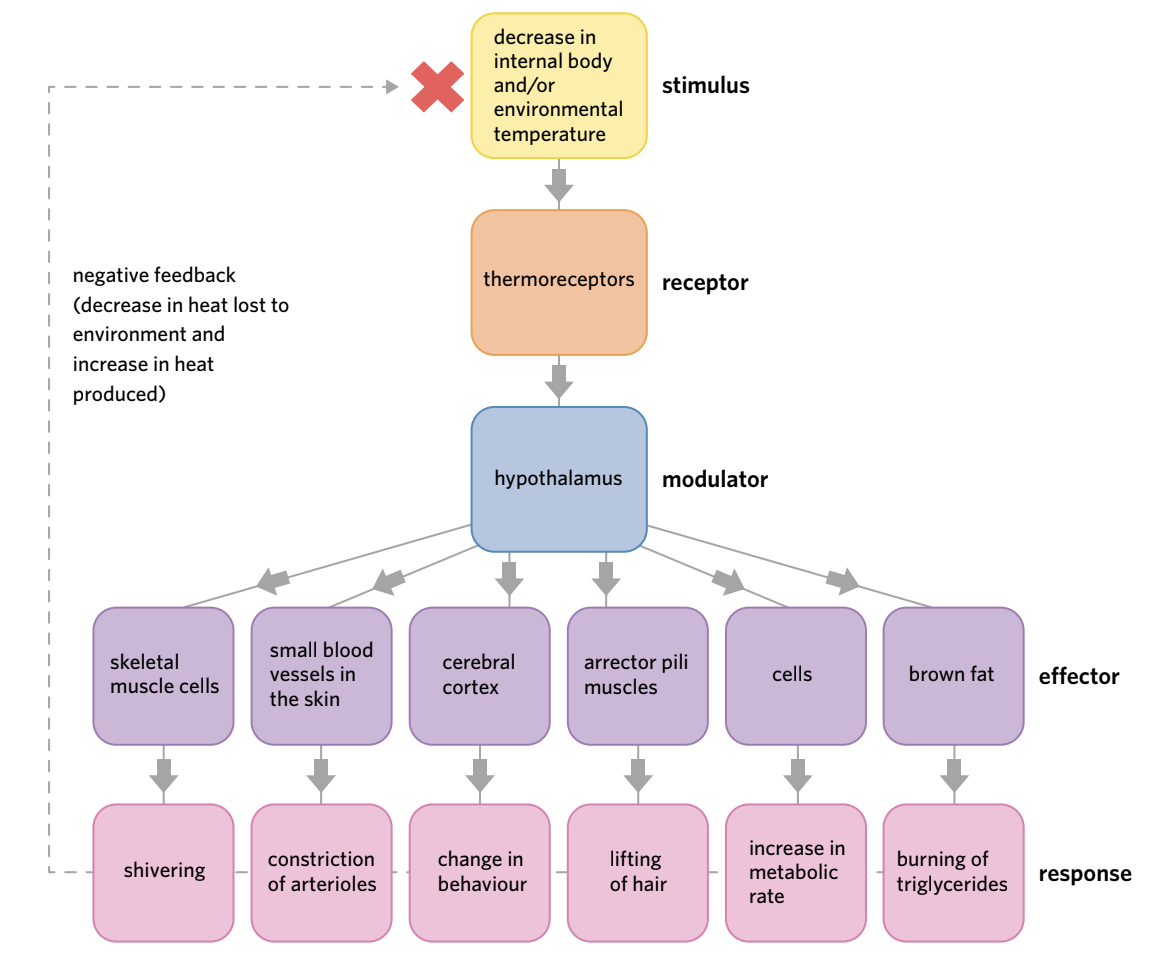
The main effectors and their responses include:
Skeletal muscles are stimulated to contract rapidly in a process called shivering. Skeletal muscle is a type of muscle that is voluntarily controlled and is usually attached to bones. During shivering, muscles contract and relax rapidly without producing coordinated movement. This intense muscular activity increases cellular metabolism, and the increased metabolism generates additional heat energy. Shivering can significantly increase heat production in the body.
Example
Shivering Generates Heat
Step 1: The hypothalamus detects decreased body temperature via thermoreceptors
Step 2: Signals are sent to skeletal muscles throughout the body
Step 3: Muscles rapidly contract and relax (shivering) without producing coordinated movement
Step 4: This intense muscular activity increases cellular respiration and metabolism
Step 5: Increased metabolism releases heat energy as a byproduct
Result: Body temperature rises back toward 37°C
Small blood vessels in the skin undergo vasoconstriction, which is the narrowing of blood vessels. The arterioles near the skin surface constrict, decreasing blood flow to the skin. Since blood carries heat from the core, reducing surface blood flow means less heat is lost to the environment through convection and radiation. This is why people appear pale when cold - less blood is flowing near the skin surface.
The cerebral cortex initiates behavioural responses to cold. These might include putting on additional layers of clothing, seeking warm shelter, consuming hot food or drinks, or increasing physical activity. Behavioural responses are often the first line of defence against cold temperatures and can be very effective.
Arrector pili muscles in the skin contract. When these small muscles contract, they pull on hair follicles, causing the hairs to stand up perpendicular to the skin surface. This creates visible "goosebumps" on the skin. The raised hairs trap a layer of still air close to the skin, and this air layer acts as insulation, reducing heat loss to the environment. In animals with thick fur, this response is highly effective; in humans with relatively little body hair, it is less effective but still occurs.
Cellular metabolism increases. The hypothalamus sends signals to cells throughout the body to increase their metabolic processes, particularly cellular respiration. Since metabolism produces heat as a byproduct, this increased metabolic rate generates more internal heat energy. Various metabolic pathways are activated to maximise heat production.
Brown fat cells are activated. Brown fat is a type of body fat that is activated when the human body experiences low temperatures. Unlike regular fat tissue (white fat), brown fat is specialised to generate heat. Brown fat cells contain numerous mitochondria and can rapidly burn stored triglycerides (fats) to produce heat energy without storing the energy as ATP. This process, called non-shivering thermogenesis, is particularly important in infants who have substantial brown fat deposits. Adults retain some brown fat, primarily around the neck and shoulders.
Note
Negative Feedback Maintains Balance
Through negative feedback, as these responses generate more heat and reduce heat loss, body temperature rises back toward 37°C. When thermoreceptors detect that temperature has returned to the set point, signals are sent to reduce or stop these warming responses, preventing overheating.
Exam tips
Important
Key Points for Exam Success
- Remember that all thermoregulation responses in humans work through the four heat transfer mechanisms: conduction, convection, evaporation, and radiation
- Be able to explain how each specific response (sweating, vasodilation, shivering, etc.) affects heat transfer
- Understand that the hypothalamus is always the modulator in thermoregulation
- Remember that negative feedback prevents over-correction - responses are reduced once temperature returns to normal
- Be prepared to draw and label stimulus-response diagrams for thermoregulation
- Know the difference between endotherms and ectotherms, but focus on human thermoregulation for this topic
- Remember the heat equation:
Remember!
Summary
Key Takeaways: Thermoregulation
-
Heat transfer occurs through four methods: conduction (direct contact), convection (fluid movement), evaporation (liquid to gas conversion), and radiation (electromagnetic waves)
-
Thermoregulation maintains core body temperature at 37°C through a negative feedback stimulus-response system involving thermoreceptors (receptors), the hypothalamus (modulator), and various effector tissues
-
When body temperature rises: the body responds with sweating (evaporation), vasodilation (increased surface blood flow), flattened hair, decreased metabolism, and behavioural changes to increase heat loss and decrease heat production
-
When body temperature falls: the body responds with shivering, vasoconstriction (decreased surface blood flow), raised hair (goosebumps), increased metabolism, burning of triglycerides in brown fat, and behavioural changes to decrease heat loss and increase heat production
-
Negative feedback ensures stability: once temperature returns to the set point, responses are reduced to prevent over-correction, maintaining homeostasis