Triglycerides & Phospholipids (AQA A-Level Biology): Revision Notes
📚Revision Notes
Triglycerides & Phospholipids
Lipids represent a diverse group of biological molecules that share several common characteristics. They contain carbon, hydrogen and oxygen atoms, but importantly have a much smaller proportion of oxygen compared to carbon and hydrogen than carbohydrates. This gives them distinct properties - they are insoluble in water but dissolve readily in organic solvents like alcohols and acetone.
Note
The key distinguishing feature of lipids compared to carbohydrates is their much lower proportion of oxygen atoms, which directly contributes to their hydrophobic (water-repelling) nature.
The two main groups of lipids are triglycerides (which include fats and oils) and phospholipids. Both play essential roles in living organisms, from energy storage to forming cell membranes.
Triglycerides
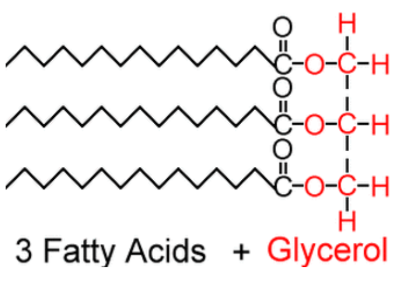
Triglycerides get their name from their structure - they consist of three (tri) fatty acids chemically bonded to a molecule of glycerol. The formation occurs through a condensation reaction, where each fatty acid forms an ester bond with glycerol, releasing water in the process. The reverse process, hydrolysis, breaks down triglycerides back into glycerol and three fatty acids.
Example
Worked Example: Triglyceride Formation
Step 1: Three fatty acid molecules approach one glycerol molecule
Step 2: Condensation reactions occur at each of the three -OH groups on glycerol
Step 3: Three ester bonds form, releasing three water molecules
Step 4: The resulting triglyceride has the structure: Glycerol backbone + 3 fatty acid chains
Since the glycerol component remains the same in all triglycerides, the differences between various fats and oils come entirely from the fatty acids involved. There are over 70 different fatty acids, each with a carboxyl group (-COOH) attached to a hydrocarbon chain.
Types of fatty acids
Fatty acids are classified based on their chemical structure, particularly the presence of double bonds between carbon atoms.
Saturated fatty acids contain no carbon-carbon double bonds. All carbon atoms in the chain are linked to the maximum possible number of hydrogen atoms - they are "saturated" with hydrogen. These molecules can pack closely together, making them solid at room temperature (like butter).
Monounsaturated fatty acids have one double bond between carbon atoms.
Polyunsaturated fatty acids contain multiple double bonds. These double bonds create kinks in the molecular structure, preventing the molecules from packing tightly together. This makes them liquid at room temperature (like oils).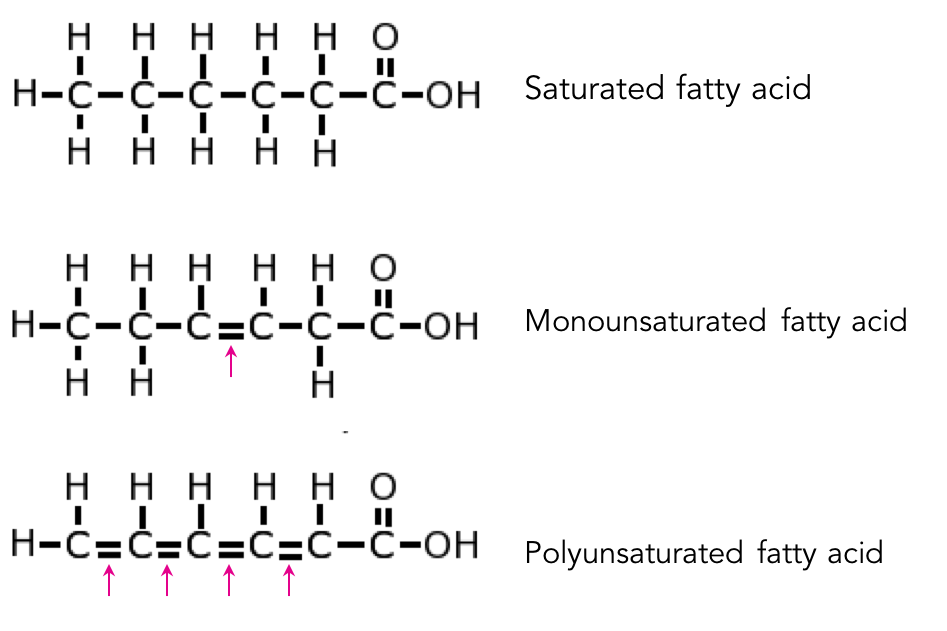
Structure-function relationships in triglycerides
The structure of triglycerides directly relates to their biological functions. They contain a high ratio of energy-storing carbon-hydrogen bonds relative to carbon atoms, making them excellent energy reserves. Their compact structure also gives them a favourable mass-to-energy ratio - much energy can be stored in a relatively small volume, which benefits animals by reducing the mass they must carry.
Being large, non-polar molecules, triglycerides remain insoluble in water. This prevents them from affecting the water potential of cells or disrupting osmotic balance. When oxidised, their high hydrogen-to-oxygen ratio means they release water, providing an additional water source for organisms in dry environments.
Phospholipids
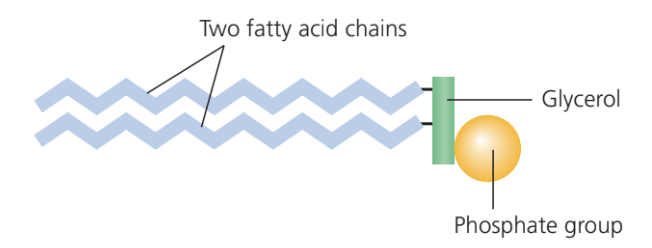
Phospholipids share a similar basic structure to triglycerides but with a key difference - one of the three fatty acid molecules is replaced by a phosphate molecule. This creates a molecule with two distinct regions that behave very differently around water.
- The phosphate group forms the hydrophilic head - it attracts and interacts with water molecules.
- The two remaining fatty acid chains create hydrophobic tails - these repel water but mix readily with fats and oils.
This dual nature makes phospholipids polar molecules - they have two ends that behave differently. When placed in water, phospholipid molecules arrange themselves so their hydrophilic heads face towards the water while their hydrophobic tails point away from it.

Structure-function relationships in phospholipids
The amphipathic nature of phospholipids (having both water-loving and water-hating parts) makes them perfect for forming cell membranes. In aqueous environments, they spontaneously arrange into bilayers - double layers where hydrophilic heads face outward towards the water and hydrophobic tails face inward, away from water.
Important
The phospholipid bilayer structure is fundamental to all cell membranes. This arrangement creates a selective barrier that allows cells to maintain different internal conditions from their external environment while still permitting controlled exchange of materials.
This bilayer structure creates a hydrophobic barrier between the inside and outside of cells, controlling which substances can cross the membrane. The hydrophilic phosphate heads help anchor the phospholipids at the membrane surface, maintaining structural stability.
Phospholipids can also combine with carbohydrates within cell membranes to form glycolipids, which play important roles in cell recognition and communication between cells.
Test for lipids
The emulsion test provides a simple way to detect the presence of lipids in a sample:
Example
Worked Example: Emulsion Test Procedure
Step 1: Use a completely dry, grease-free test tube
Step 2: Add 2 cm³ of the sample and 5 cm³ of ethanol
Step 3: Shake thoroughly to dissolve any lipids present
Step 4: Add 5 cm³ of water and shake gently
Step 5: A cloudy-white colour indicates lipids are present
Step 6: As a control, repeat using water instead of the sample - this should remain clear
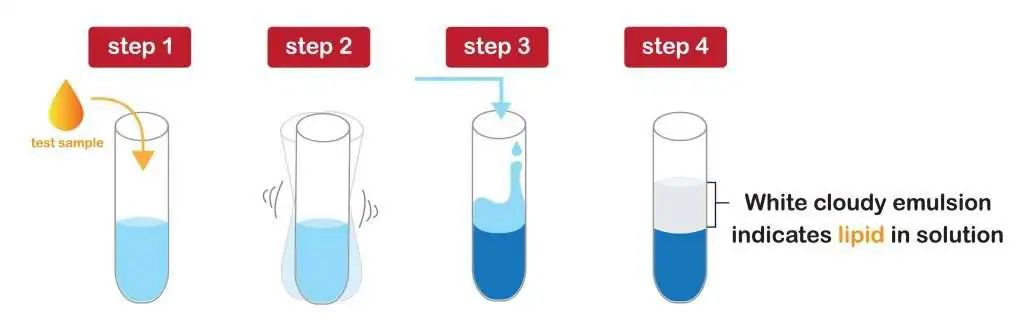
The cloudiness results from lipids dispersing finely throughout the water, forming an emulsion. Light passing through this emulsion gets refracted as it moves between oil and water droplets, creating the characteristic cloudy appearance.
Summary
Key Points to Remember:
- Triglycerides consist of three fatty acids bonded to glycerol via condensation reactions, serving primarily as energy storage molecules
- Saturated fatty acids have no double bonds and are solid at room temperature, while unsaturated fatty acids contain double bonds and remain liquid
- Phospholipids have a hydrophilic phosphate head and hydrophobic fatty acid tails, making them ideal for forming cell membrane bilayers
- Lipids provide energy, waterproofing, insulation, and protection while remaining insoluble in water
- The emulsion test uses ethanol and water to detect lipids, producing a cloudy-white appearance when positive