Monomers & Polymers (AQA A-Level Biology): Revision Notes
📚Revision Notes
Monomers & Polymers
What are monomers and polymers?
Monomers are small molecules that act as the basic building units for larger, more complex compounds. Think of them as individual LEGO blocks that can be joined together to create bigger structures.
Common examples of monomers include:
- Monosaccharides (such as glucose)
- Amino acids
- Nucleotides
When monomers join together, they create polymers - extended chains formed from many monomer molecules linked in sequence. These polymers can range from simple two-unit chains to massive molecules containing thousands of monomers.
Note
The relationship between monomers and polymers is like the relationship between individual LEGO blocks and the complex structures you can build with them - simple units combine to create something much more sophisticated and functional.
Chemical reactions linking monomers
Condensation reactions
Monomers connect to each other through condensation reactions. During this process, two molecules combine to form a larger molecule, and a water molecule (H₂O) is eliminated as a by-product.
Example
Worked Example: Maltose Formation
When two glucose molecules undergo condensation:
- The glucose monomers approach each other
- A glycosidic bond forms between them
- One water molecule (H₂O) is released as a by-product
- The result is maltose - a disaccharide polymer
Hydrolysis reactions
Hydrolysis is the reverse process of condensation. Water is added to break the bonds between molecules in a polymer, splitting it back into individual monomers.
Example
Worked Example: Starch Digestion
During digestion:
- Starch (a polysaccharide polymer) is present in food
- Digestive enzymes add water molecules to the glycosidic bonds
- The bonds break through hydrolysis
- Individual glucose monomers are released
- These monomers can be absorbed by the body for energy
Polymer formation in biological molecules
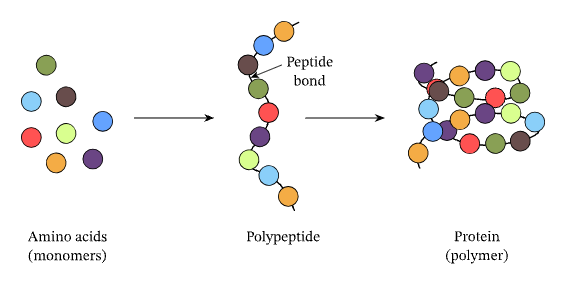
The progression from monomer to complex polymer is clearly demonstrated in protein formation:
Example
Worked Example: Protein Formation
Step 1: Amino acids (monomers) approach each other Step 2: They link together through peptide bonds (formed by condensation) Step 3: This creates a polypeptide chain Step 4: The polypeptide folds and may combine with other chains to form a complete protein (polymer)
Each peptide bond forms through condensation, removing water as amino acids connect.
Polymer structures
Polymers can adopt different structural arrangements:
- Linear polymers: Simple chains where monomers connect in a straight sequence
- Branched polymers: Main chains with side branches extending outward
- Crosslinked polymers: Chains connected by bonds between different polymer molecules
- Networked polymers: Complex three-dimensional structures with extensive cross-linking
Biological significance
These reactions are fundamental to all biological processes. Condensation builds polymers needed for cellular structures and functions, whilst hydrolysis breaks them back into monomers for energy release, recycling, and metabolic processes.
Important
The ability to build and break down biological polymers through these water-involving reactions allows organisms to construct complex molecules when needed and dismantle them when resources are required elsewhere. This reversible process is absolutely essential for life.
Summary
Key Points to Remember:
- Monomers are small building block molecules; polymers are long chains of connected monomers
- Condensation reactions join monomers together by removing water molecules
- Hydrolysis reactions break polymers apart by adding water molecules
- Key biological monomers include glucose, amino acids, and nucleotides
- These reactions are essential for building and breaking down proteins, carbohydrates, and other biological molecules