Water & its Functions (AQA A-Level Biology): Revision Notes
📚Revision Notes
Water & its Functions
Water forms a major component of all living cells and possesses unique characteristics that make it essential for life. These special properties arise from water's molecular structure and the resulting intermolecular forces.
Structure of the water molecule
Dipolar nature
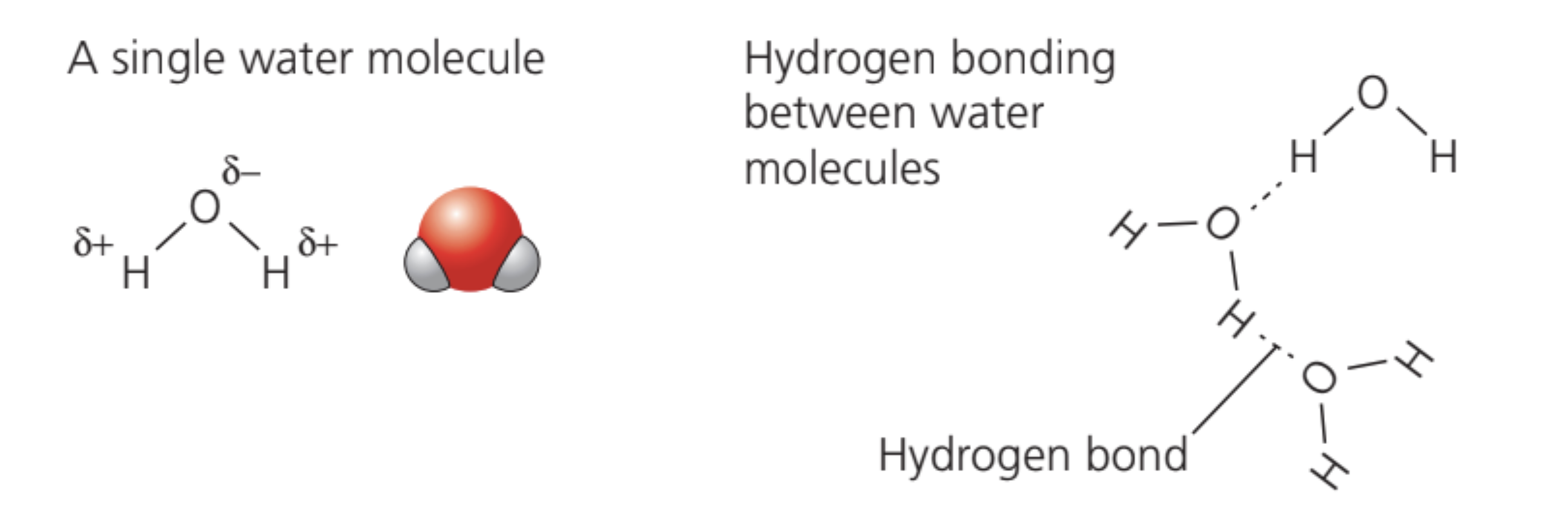
Each water molecule consists of two hydrogen atoms bonded to a single oxygen atom. The molecule exhibits an uneven distribution of electrical charge - the oxygen atom carries a slight negative charge whilst the hydrogen atoms possess a slight positive charge. This separation of charge creates positive and negative poles within the molecule, making water dipolar.
Note
The dipolar nature of water is key to understanding all of its biological properties. This uneven charge distribution is what allows water molecules to interact with each other and with other polar substances.
Hydrogen bonding
The opposite charges on different water molecules create attractive forces between them. The positive region of one water molecule attracts the negative region of neighbouring molecules, forming hydrogen bonds. Although individual hydrogen bonds are relatively weak (approximately one-tenth the strength of a covalent bond), collectively they create significant intermolecular forces that give water its distinctive properties.
Key properties of water
- Specific heat capacity
- Latent heat of vaporisation
- Cohesion and surface tension
Specific heat capacity
Water molecules remain connected through hydrogen bonding, requiring substantial energy input to separate them. This results in water having a high specific heat capacity - it takes considerable energy to increase water's temperature. This property enables water to act as a thermal buffer, resisting rapid temperature changes in both aquatic environments and within organisms.
Note
Since living things contain predominantly water, this buffering effect helps maintain stable internal temperatures, particularly important for terrestrial organisms facing temperature fluctuations.
Latent heat of vaporisation
The hydrogen bonds between water molecules mean that significant energy is needed to convert liquid water into vapour. This energy requirement is termed the latent heat of vaporisation. When organisms such as mammals produce sweat, the evaporation process removes substantial amounts of body heat, making perspiration a highly effective cooling mechanism.
Cohesion and surface tension
Cohesion describes how molecules tend to stick together. Water exhibits strong cohesive forces due to hydrogen bonding, allowing it to be drawn upward through narrow tubes like xylem vessels in plants. At the interface between water and air, molecules experience stronger attraction to the water body than to the surrounding air. This creates surface tension, which acts like an elastic membrane strong enough to support lightweight organisms such as pond skaters.
Importance of water to living organisms
Composition and environment
Water constitutes the primary component of all organisms - jellyfish contain up to 98% water, while mammals typically consist of 65% water. Life originally evolved in aquatic environments, and water remains the medium in which many species continue to exist.
Role in metabolism
Water participates directly in numerous metabolic processes:
- Hydrolysis reactions use water to break down complex molecules like proteins into amino acids
- Condensation reactions produce water when building larger molecules
- Most biochemical reactions occur in aqueous solutions
- Photosynthesis requires water as a raw material
Important
Water is not just a passive medium for biochemical reactions - it actively participates in many metabolic processes as both a reactant and a product.
Solvent properties
Water effectively dissolves numerous substances including:
- Gases like oxygen and carbon dioxide
- Waste products such as ammonia and urea
- Inorganic ions and small hydrophilic molecules including amino acids, monosaccharides, and ATP
- Enzymes, which function in solution
Additional biological functions
Water provides several other important features:
- Evaporation enables temperature regulation in organisms
- Its incompressible nature offers structural support (for example, the hydrostatic skeleton in earthworms and turgor pressure in plant cells)
- Transparency allows aquatic plants to photosynthesise and permits light penetration into eyes
Inorganic ions
Inorganic ions exist within organisms, found dissolved in cytoplasm and body fluids, as well as forming parts of larger molecules. Their concentrations vary considerably depending on their specific roles.
Each inorganic ion performs functions related to its particular properties. Important examples include:
- Iron ions in haemoglobin molecules transport oxygen
- Phosphate ions provide structural components for DNA molecules and store energy in ATP
- Hydrogen ions influence solution pH and enzyme activity
- Sodium ions facilitate glucose and amino acid transport across cell membranes
Summary
Key Points to Remember:
- Water is dipolar due to uneven charge distribution, enabling hydrogen bonding between molecules
- Hydrogen bonds give water its unique properties: high specific heat capacity, latent heat of vaporisation, and cohesion
- Water acts as a thermal buffer and cooling agent through evaporation
- Cohesion and surface tension allow water transport in plants and support for small organisms
- Water serves as the universal biological solvent and participates directly in hydrolysis and condensation reactions
- Inorganic ions perform specific functions based on their individual properties