Proteins: Enzymes (AQA A-Level Biology): Revision Notes
📚Revision Notes
Factors Affecting Enzyme Action
Understanding how different factors influence enzyme activity is essential for predicting and controlling biochemical reactions. Several key variables affect the rate at which enzymes catalyse reactions, and each follows distinct patterns that can be measured and graphed.
Measuring enzyme reaction rates
The rate of reaction can be determined by measuring how quickly products form or substrates are consumed over time. This is typically expressed as a change in concentration per unit of time.
Note
When investigating any factor's effect on enzyme activity, it is essential to control all other variables - if studying temperature effects, then pH, enzyme concentration, and substrate concentration must remain constant.
The relationship between an enzyme and its substrate is described as complementary rather than identical. Like a lock and key system, the active site has a shape that fits with the substrate, but they are not the same structure.
Effect of temperature on enzyme action
Temperature changes affect enzyme activity through two opposing mechanisms. Initially, increasing temperature raises the kinetic energy of molecules, causing them to move faster and collide more frequently. This leads to more enzyme-substrate complexes forming per unit time, increasing the reaction rate.
However, higher temperatures also cause bonds within the enzyme molecule to break. The enzyme's shape begins to change, particularly at the active site, making it more difficult for substrates to bind effectively. For many human enzymes, this process begins around 45°C.
Eventually, the enzyme becomes so disrupted that it stops functioning entirely - a process called denaturation (at approximately 60°C).
Important
Denaturation is irreversible; once it occurs, the enzyme cannot regain its original shape or activity. This typically happens around 60°C for most enzymes.
The combination of these two effects produces a characteristic curve when graphing temperature against reaction rate. The reaction rate increases with temperature up to an optimum temperature, then decreases sharply. The optimum temperature varies between enzymes - some work best around 10°C, while others function optimally at 80°C.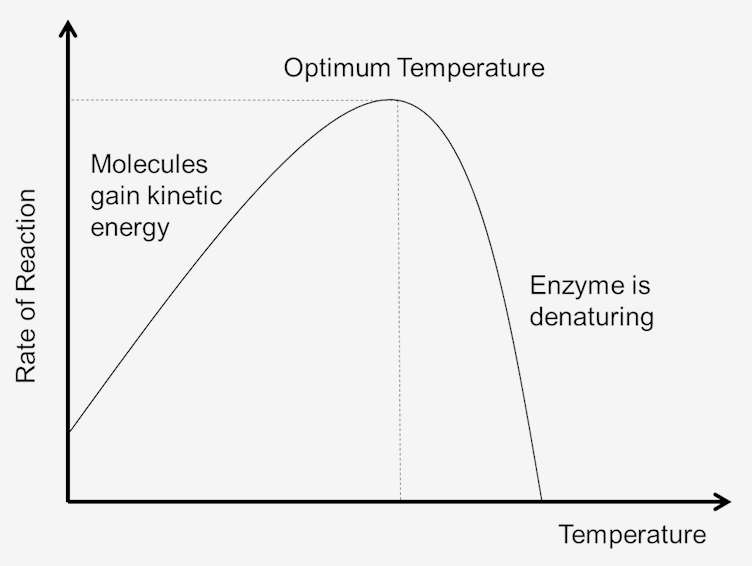
Note
Human body temperature of 37°C represents a balance between maximising reaction rates and avoiding denaturation. Higher body temperatures would increase metabolic rates slightly, but would require more energy to maintain and risk denaturing other proteins.
Effect of pH on enzyme action
The pH of a solution measures its hydrogen ion concentration, calculated using the formula: .
Each enzyme has an optimum pH at which it functions most effectively, shown as peaks on activity curves.
pH affects enzyme function in two main ways:
- Changes in pH alter the electrical charges on amino acid residues that make up the active site. When these charges change, the substrate can no longer bind properly to the active site, preventing enzyme-substrate complex formation.
- More extreme pH changes can disrupt the bonds maintaining the enzyme's tertiary structure. This causes the active site to change shape, reducing the enzyme's effectiveness or causing complete denaturation.
The hydrogen and ionic bonds between amino acid groups are particularly sensitive to pH changes. Small shifts in pH typically reduce enzyme activity rather than causing permanent damage, but significant changes can denature the enzyme irreversibly.
Note
pH fluctuations within living organisms are usually small, making enzyme activity reduction more common than complete denaturation in biological systems.
Effect of enzyme concentration on rate of reaction
When substrate is present in excess, increasing enzyme concentration leads to a proportional increase in reaction rate. This occurs because more enzyme molecules provide more active sites available for substrate binding.
At low enzyme concentrations, many substrate molecules cannot find an available active site simultaneously. The reaction rate is limited by the number of enzyme molecules present. As more enzymes are added, more substrates can be processed at once, increasing the overall rate.
However, once substrate becomes the limiting factor, further increases in enzyme concentration have no effect. At this point, all available substrate molecules are already being processed as quickly as possible by the existing enzymes. Additional enzymes simply remain unused because there is insufficient substrate to occupy all active sites.
Example
Worked Example: Understanding Enzyme Limitation
Consider a reaction with 10 enzyme molecules and 100 substrate molecules:
- Initially: All 10 enzymes are working at maximum capacity
- Adding 10 more enzymes: Still only 10 enzymes can work because substrate is limited
- Result: No change in reaction rate despite doubling enzyme concentration
This relationship produces graphs showing an initial proportional increase that eventually levels off to a constant rate, regardless of further enzyme additions.
Effects of substrate concentration on rate of enzyme action
When enzyme concentration remains fixed, increasing substrate concentration initially increases the reaction rate proportionally. At low substrate concentrations, enzyme molecules have limited substrate available to bind with, so many active sites remain empty.
As substrate concentration increases, more active sites become occupied simultaneously. The reaction rate continues to increase as more enzyme-substrate complexes form per unit time.
Eventually, all active sites become saturated - every enzyme molecule is working at maximum capacity. At this point, called Vmax (maximum velocity), adding more substrate produces no further increase in reaction rate. The system has reached its maximum possible rate of reaction.
Beyond this saturation point, excess substrate molecules must wait for active sites to become available as other reactions complete. This creates the characteristic curve showing initial proportional increase followed by levelling off at Vmax.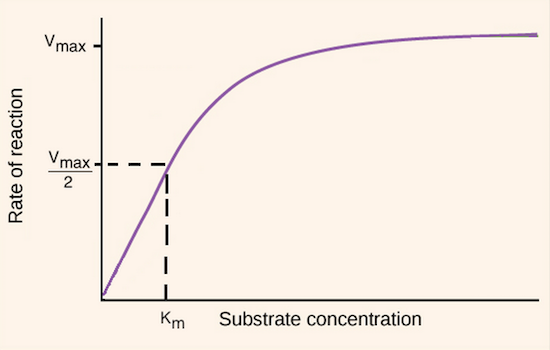
Note
The point at which saturation occurs depends on the number of enzyme molecules present - more enzymes mean higher substrate concentrations are needed to achieve Vmax.
Remember!
Summary
Key Points to Remember:
- Temperature increases reaction rate until denaturation occurs at the optimum temperature
- pH changes affect active site shape by altering amino acid charges, with each enzyme having an optimum pH
- Enzyme concentration increases reaction rate proportionally until substrate becomes limiting
- Substrate concentration increases reaction rate until all active sites are saturated (Vmax)
- Denaturation is permanent and irreversible, while other factors may cause temporary activity changes