Enzyme Inhibition (AQA A-Level Biology): Revision Notes
📚Revision Notes
Enzyme Inhibition
What are enzyme inhibitors?
Enzyme inhibitors are molecules that interfere with enzyme function by affecting the active site, either directly or indirectly. This interference reduces the enzyme's activity and slows down the rate of the catalysed reaction.
Understanding enzyme inhibition is crucial for comprehending how cells regulate their metabolic processes and maintain homeostasis. Inhibitors play vital roles in both natural cellular control mechanisms and pharmaceutical interventions.
Note
Enzyme inhibition is a reversible process in most cases, meaning the enzyme can regain its function when the inhibitor is removed. This reversibility makes inhibition an excellent control mechanism for cells.
There are two main types of enzyme inhibition that work through different mechanisms:
- Competitive inhibition - occurs at the active site
- Non-competitive inhibition - occurs at a site away from the active site
Competitive inhibition
Mechanism and molecular basis
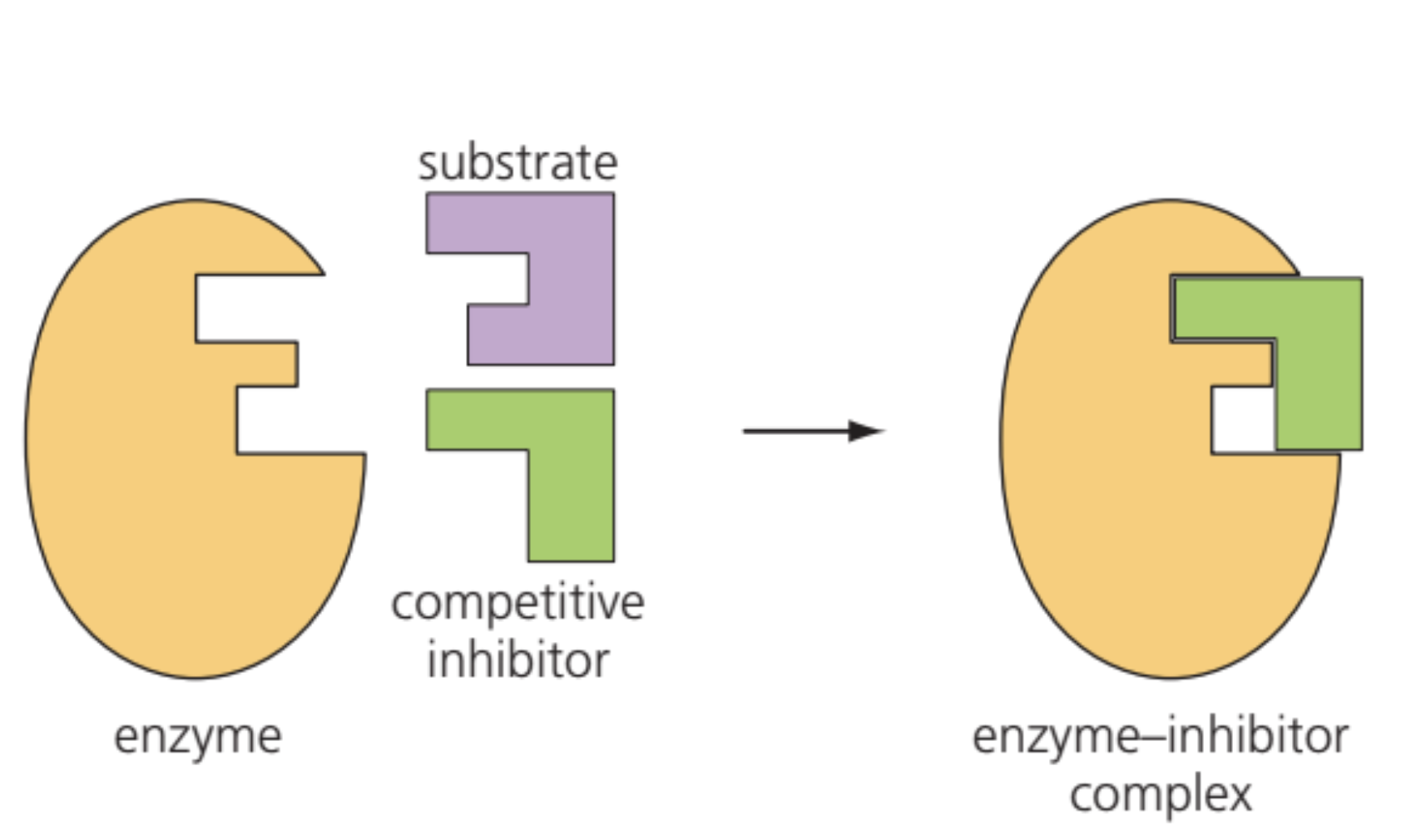
Competitive inhibitors have a similar molecular shape to the enzyme's natural substrate. This structural similarity allows them to bind to the active site of the enzyme, effectively blocking the substrate from accessing it.
The molecular basis of competitive inhibition relies on the principle that enzymes have highly specific active sites shaped to accommodate their particular substrates. When an inhibitor molecule closely resembles the substrate's shape, it can essentially "fool" the enzyme into binding with it instead.
Important
Key Principle: Only one molecule can occupy the active site at any given time. This is the primary reason why competitive inhibition works - it's literally a competition for the same binding space.
The key features of competitive inhibition include:
- The inhibitor and substrate compete for the same binding site (the active site)
- Only one molecule can occupy the active site at any given time
- The binding is typically reversible
- The inhibitor does not permanently damage the enzyme
Effect of substrate concentration
The effectiveness of competitive inhibition depends on the relative concentrations of the inhibitor and substrate. When substrate concentration increases, more substrate molecules are available to compete with the inhibitor molecules for the active site.
This concentration-dependent relationship means that competitive inhibition can be overcome, making it an ideal mechanism for cellular regulation. The enzyme's activity can be fine-tuned based on the availability of substrates and the presence of regulatory molecules.
This relationship works as follows:
- High substrate concentration → reduces the effect of the inhibitor
- Low substrate concentration → increases the effect of the inhibitor
Eventually, if enough substrate is present, the inhibitor's effect can be completely overcome as substrate molecules will occupy most active sites.
Example
Worked Example: Substrate Competition
Imagine an enzyme with 100 active sites:
- With 50 inhibitor molecules and 50 substrate molecules: approximately 50% inhibition
- With 50 inhibitor molecules and 200 substrate molecules: approximately 20% inhibition
- With 50 inhibitor molecules and 500 substrate molecules: approximately 9% inhibition
This demonstrates how increasing substrate concentration reduces the inhibitor's effectiveness.
Examples of competitive inhibition
A well-studied example involves the respiratory enzyme that acts on succinate. Malonate can inhibit this enzyme because its molecular shape closely resembles succinate, allowing it to bind to the enzyme's active site and prevent succinate from binding.
Another important example is penicillin, which inhibits the enzyme transpeptidase by competing with the enzyme's natural substrate. This mechanism is fundamental to penicillin's effectiveness as an antibiotic.
Note
The discovery of competitive inhibition in drug design has revolutionised medicine. Many modern pharmaceuticals work by competitively inhibiting specific enzymes involved in disease processes.
Non-competitive inhibition
Mechanism and molecular basis
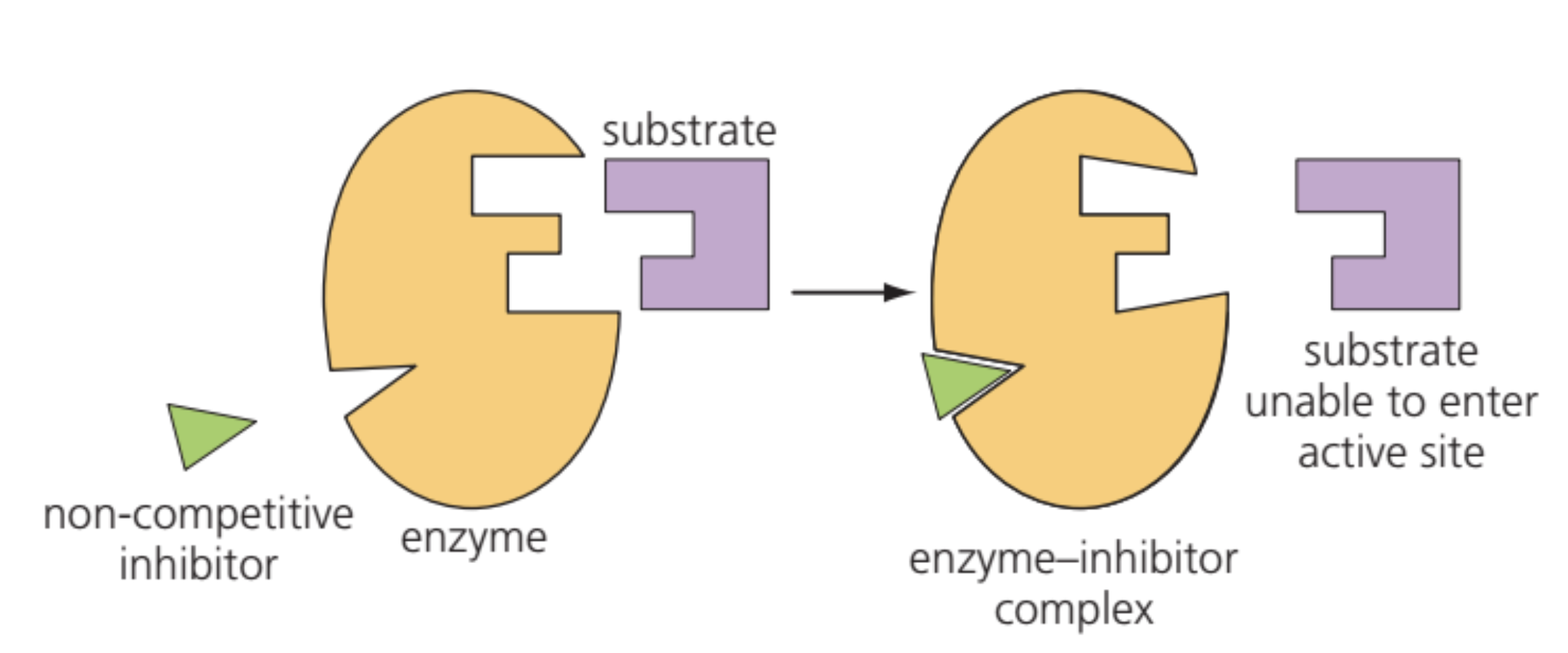
Non-competitive inhibitors bind to the enzyme at a location other than the active site, called an allosteric site. When the inhibitor attaches to this alternative binding site, it causes a change in the enzyme's three-dimensional shape.
The term "allosteric" comes from Greek words meaning "other shape," which perfectly describes this mechanism. The allosteric site is specifically evolved to bind regulatory molecules that can either increase or decrease enzyme activity.
This shape change affects the active site, making it unsuitable for substrate binding. The substrate can no longer fit properly into the altered active site, preventing the enzyme-substrate complex from forming.
Important
Critical Concept: Non-competitive inhibition demonstrates that enzymes are dynamic, flexible molecules. Small changes in one part of the enzyme can dramatically affect function in another part, highlighting the importance of protein structure in biological systems.
Effect of substrate concentration
Unlike competitive inhibition, non-competitive inhibition cannot be overcome by increasing substrate concentration. This fundamental difference makes non-competitive inhibition particularly effective for permanent regulation of enzyme activity.
This occurs because:
- The inhibitor and substrate bind to different sites on the enzyme
- They are not competing for the same location
- Increasing substrate concentration does not affect the inhibitor's ability to bind to its allosteric site
- The change in enzyme shape persists regardless of substrate availability
Note
This concentration-independent characteristic makes non-competitive inhibition ideal for situations where cells need reliable, consistent control over enzyme activity, regardless of substrate availability.
Control of metabolic pathways
End-product inhibition
Cells use enzyme inhibition as a sophisticated control mechanism for metabolic pathways. A metabolic pathway consists of a series of enzyme-catalysed reactions where each step produces an intermediate that becomes the substrate for the next reaction.
This control system represents one of the most elegant examples of cellular self-regulation, allowing cells to automatically adjust their metabolic output based on their current needs without requiring external signals.
End-product inhibition occurs when the final product of a metabolic pathway acts as an inhibitor for the first enzyme in the pathway. This creates a negative feedback loop that helps maintain steady concentrations of the end product.
Example
Worked Example: Amino Acid Synthesis Pathway
Consider a pathway that produces the amino acid threonine:
- Normal conditions: Threonine levels are low → first enzyme operates normally → threonine production continues
- Excess threonine: Threonine concentration rises → threonine binds to allosteric site on first enzyme → enzyme activity decreases → less threonine produced
- Depletion: Threonine gets used up → concentration drops → inhibition decreases → enzyme activity increases → threonine production resumes
This cycle maintains optimal threonine levels automatically.
The process works as follows:
- When end-product concentration is normal, the pathway operates at its usual rate
- If end-product concentration rises above normal, it binds to and inhibits the first enzyme
- This reduces the pathway's activity, decreasing production of the end product
- When end-product concentration returns to normal levels, inhibition decreases and the pathway resumes normal activity
End-product inhibition is typically non-competitive, meaning the end product binds to an allosteric site on the enzyme rather than competing with the substrate at the active site.
Advantages of metabolic control
This feedback mechanism provides several benefits that are essential for efficient cellular function:
- Prevents overproduction of metabolic end products
- Conserves cellular resources and energy
- Maintains homeostasis within cells
- Allows cells to respond to changing metabolic demands
Note
End-product inhibition is so efficient that it often operates within seconds of changes in product concentration, making it one of the fastest regulatory mechanisms in cells.
Comparing competitive and non-competitive inhibition
The following comparison highlights the key differences between these two regulatory mechanisms:
| Feature | Competitive inhibition | Non-competitive inhibition |
|---|---|---|
| Binding site | Active site | Allosteric site (away from active site) |
| Relationship with substrate | Competes directly with substrate | Does not compete with substrate |
| Effect of increasing substrate concentration | Can overcome inhibition | Cannot overcome inhibition |
| Enzyme shape change | No change in enzyme shape | Changes enzyme shape |
| Reversibility | Usually reversible | Can be reversible or irreversible |
| Maximum reaction rate | Can reach normal maximum rate | Maximum rate is reduced |
Important
Key Distinction: The most crucial difference is that competitive inhibition can be overcome by adding more substrate, while non-competitive inhibition cannot. This makes each type suitable for different regulatory purposes in the cell.
Summary
Key Points to Remember:
- Competitive inhibitors compete with substrates for the active site and can be overcome by increasing substrate concentration
- Non-competitive inhibitors bind to allosteric sites, change enzyme shape, and cannot be overcome by more substrate
- End-product inhibition uses negative feedback to control metabolic pathways, typically through non-competitive mechanisms
- The molecular shape similarity between competitive inhibitors and substrates is crucial for their function
- Enzyme inhibition is an essential cellular control mechanism that maintains homeostasis and prevents waste of resources
- Understanding inhibition mechanisms is fundamental to drug design and metabolic regulation