Amino Acids & Peptide Bonds (AQA A-Level Biology): Revision Notes
📚Revision Notes
Amino Acids & Peptide Bonds
Structure of amino acids
Amino acids serve as the fundamental monomer units that combine to create larger polymer molecules called polypeptides. Scientists have identified approximately 100 different amino acids, though only 20 occur naturally in proteins across all living organisms.
Note
The 20 naturally occurring amino acids are considered the "standard" amino acids because they are encoded directly by the genetic code and found in proteins across all forms of life, from bacteria to humans.
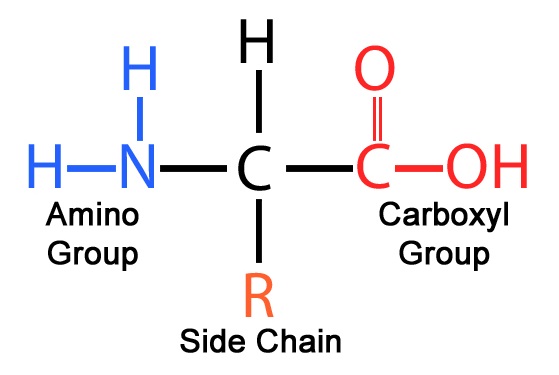
Each amino acid contains a central carbon atom with four distinct chemical groups attached:
- Amino group (—NH₂) - a basic chemical group that gives amino acids part of their name
- Carboxyl group (—COOH) - an acidic group responsible for the "acid" portion of the name
- Hydrogen atom(—H) - a single hydrogen attached to the central carbon
- R group (side chain) - a variable chemical group that differs between amino acids
Important
The R group determines the unique properties of each amino acid. While the first three components remain identical across all amino acids, the R group varies significantly, creating the diversity needed for different protein functions.
This variation in side chains allows the 20 naturally occurring amino acids to have distinct chemical properties, ranging from hydrophobic (water-repelling) to hydrophilic (water-attracting), and from acidic to basic.
Formation of peptide bonds
Amino acids link together through a process similar to how monosaccharides combine to form disaccharides. This connection occurs via a condensation reaction, which involves removing a water molecule.
Example
Worked Example: Peptide Bond Formation
Step 1: Identify the reactive groups
- The hydroxyl group (—OH) from the carboxyl group of the first amino acid
- The hydrogen atom (—H) from the amino group of the second amino acid
Step 2: Water elimination
- These components (—OH and —H) combine to form a water molecule (H₂O)
- The water molecule is eliminated from the reaction
Step 3: Bond formation
- A peptide bond forms between the carbon atom of the first amino acid and the nitrogen atom of the second amino acid
- This creates a covalent link between the two amino acids
This peptide bond creates a strong covalent link between the two amino acids. The reverse process, hydrolysis, can break peptide bonds by adding water molecules, separating the linked amino acids back into individual units.
Summary
Key Points to Remember:
- Amino acids are monomers with four chemical groups attached to a central carbon atom
- The R group (side chain) varies between different amino acids, creating their unique properties
- Peptide bonds form through condensation reactions that remove water molecules
- Peptide bonds link the carbon of one amino acid to the nitrogen of another