Regulation of Blood Glucose Concentration (AQA A-Level Biology): Revision Notes
📚Revision Notes
Regulation of Blood Glucose Concentration
Importance of blood glucose regulation
Blood glucose serves as the primary substrate for respiration, providing energy for cellular processes in mammals. Maintaining a relatively constant glucose concentration around is essential for survival.
If glucose levels fall too low, cells become deprived of energy - brain cells are particularly vulnerable since they can only respire glucose. Conversely, if glucose levels rise too high, the water potential of blood decreases, creating osmotic problems that cause dehydration and can be equally dangerous.
Important
Homeostatic control of blood glucose concentration represents a vital regulatory mechanism that responds to both internal metabolic demands and external environmental changes. Failure to maintain proper glucose levels can result in serious health consequences or death.
Hormones and their mode of action
Hormones are chemical messengers with several key characteristics:
- Produced in endocrine glands and secreted directly into blood
- Transported in blood plasma to target cells containing specific receptors
- Effective at very low concentrations with widespread, long-lasting effects
The regulation of blood glucose involves three main hormones: insulin, glucagon, and adrenaline, which operate through the second messenger model.
Second messenger model
This mechanism allows hormones to have effects inside target cells without entering them directly:
Example
Step-by-Step Process: Second Messenger Model
- Hormone binding: The hormone (first messenger) binds to a specific transmembrane protein receptor on the target cell surface
- Receptor activation: Binding causes the receptor protein to change shape, activating adenyl cyclase enzyme inside the membrane
- Second messenger production: Active adenyl cyclase converts ATP to cyclic AMP (cAMP), which acts as the second messenger
- Enzyme activation: cAMP activates protein kinase enzymes by changing their shape
- Cellular response: Active protein kinases catalyse specific reactions, producing the hormone's effects
Note
This amplification system means one hormone molecule can trigger the production of many cAMP molecules, each activating multiple protein kinases - creating a powerful cascade effect.
Role of the pancreas in blood glucose regulation
The pancreas is a large, pale-coloured gland located behind the stomach in the upper abdomen. While it produces digestive enzymes, its endocrine function involves hormone production for glucose regulation.
Scattered throughout the pancreas are clusters of hormone-producing cells called islets of Langerhans, which contain two main cell types:
- α cells: Larger cells that produce and secrete glucagon
- β cells: Smaller cells that produce and secrete insulin
Note
These specialised cells can detect changes in blood glucose concentration and respond by releasing appropriate hormones directly into the bloodstream, making them crucial sensors in glucose homeostasis.
Role of the liver in blood glucose regulation
The liver consists of cells called hepatocytes and serves multiple functions in glucose homeostasis. Three key processes occur in liver cells:
Glycogenesis
The conversion of glucose into glycogen when blood glucose levels are higher than normal. The liver removes excess glucose from blood and stores it as glycogen granules. This can maintain normal blood glucose for approximately 12 hours during fasting.
Glycogenolysis
The breakdown of stored glycogen back into glucose when blood glucose levels fall below normal. This glucose then diffuses from liver cells into blood through channel proteins, restoring normal concentrations.
Gluconeogenesis
The production of glucose from non-carbohydrate sources such as glycerol and amino acids. This process becomes important when glycogen stores are exhausted, allowing continued glucose supply.
Note
The liver acts as the body's primary glucose buffer, storing excess glucose when abundant and releasing it when needed. This makes hepatocytes essential for maintaining stable blood glucose levels between meals.
Factors influencing blood glucose concentration
Blood glucose levels fluctuate due to three main sources of glucose input:
- Dietary glucose: Direct absorption following digestion of carbohydrates like starch, maltose, lactose and sucrose
- Glycogenolysis: Release from glycogen stores in liver and muscle cells
- Gluconeogenesis: Production from non-carbohydrate sources
Since animals don't eat continuously and glucose usage varies with activity levels, the three regulatory hormones work together to maintain stable concentrations despite changing supply and demand.
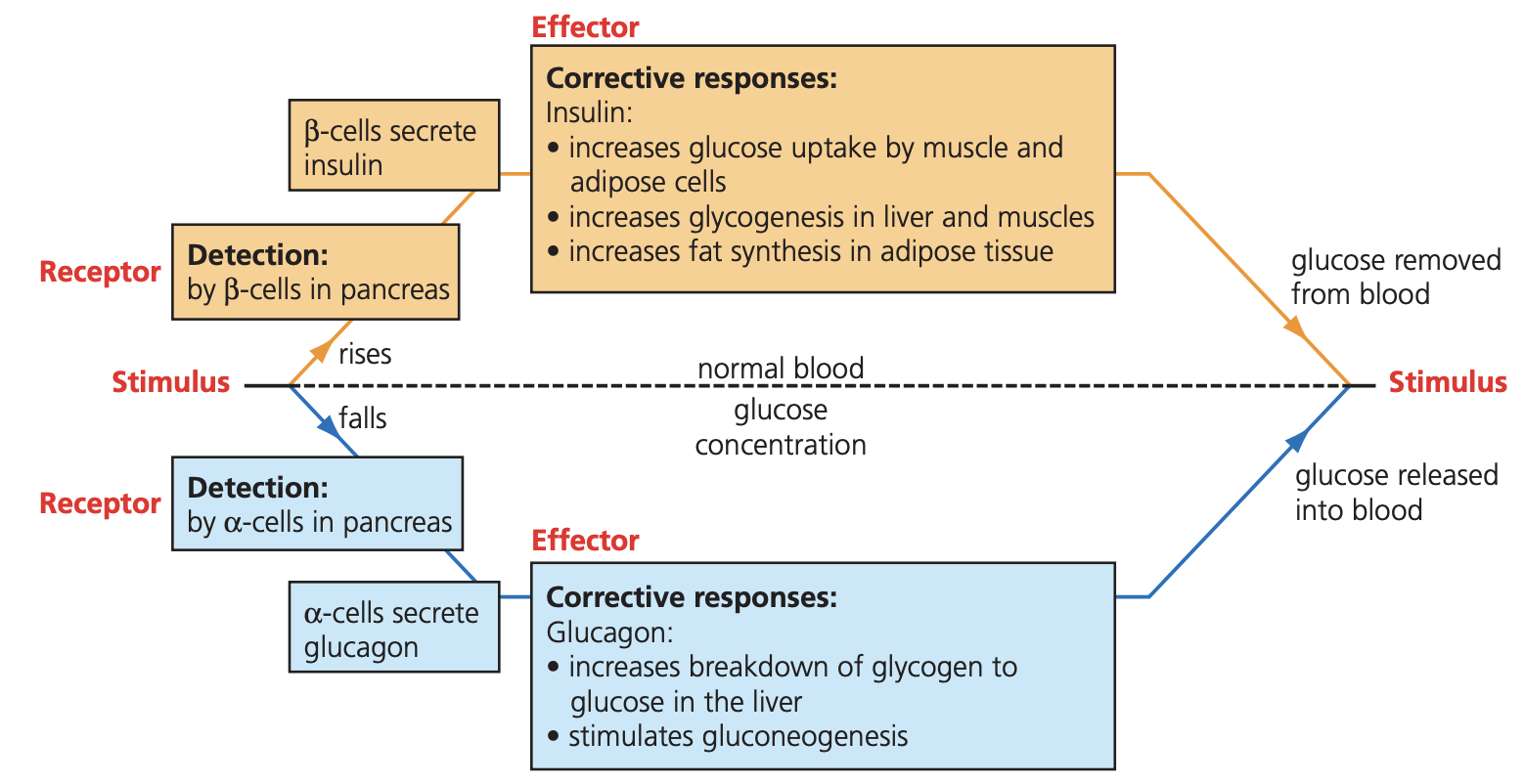
Insulin and β cells response
β cells in pancreatic islets detect rising blood glucose concentrations and respond by secreting insulin directly into blood plasma. Insulin is a globular protein comprising 51 amino acids.
Almost all body cells (except red blood cells) possess glycoprotein receptors on their surface membranes that bind specifically with insulin molecules. When insulin combines with these receptors, it triggers several responses:
Note
Insulin's Effects on Target Cells:
- Glucose transport enhancement: Changes in tertiary structure of glucose transport carrier proteins cause them to open, allowing increased glucose uptake by facilitated diffusion
- Increased transport proteins: More carrier proteins are incorporated into cell-surface membranes from internal vesicles, creating additional glucose transport channels
- Enzyme activation: Activation of enzymes that convert glucose to glycogen and fat for storage
These processes remove glucose from blood through increased cellular absorption, enhanced respiration, glycogen synthesis (glycogenesis), and fat conversion. As blood glucose falls, β cells reduce insulin secretion through negative feedback.
Glucagon and α cells response
α cells detect falling blood glucose concentrations and secrete glucagon directly into blood plasma. Glucagon's actions include:
Note
Glucagon's Effects on Target Cells:
- Liver cell activation: Binding to specific protein receptors on hepatocyte surface membranes
- Glycogen breakdown: Activating enzymes that convert glycogen to glucose (glycogenolysis)
- Gluconeogenesis promotion: Activating enzymes involved in converting amino acids and glycerol into glucose
These processes increase glucose concentration in blood. As levels rise back to normal, α cells reduce glucagon secretion through negative feedback.
Role of adrenaline in glucose regulation
Adrenaline provides additional glucose regulation, particularly during periods of excitement or stress. Produced by adrenal glands above the kidneys, adrenaline raises blood glucose by:
- Attaching to protein receptors on target cell membranes
- Activating enzymes that break down glycogen to glucose in the liver
Important
This ensures adequate glucose availability during high-energy demand situations, preparing the body for "fight or flight" responses when extra energy is needed.
Hormone interaction and feedback control
Insulin and glucagon operate antagonistically - they have opposite effects on blood glucose concentration. This creates a self-regulating system where the actual glucose concentration determines the quantities of each hormone produced.
The control system works through negative feedback: when glucose levels deviate from the optimum (around ), hormone secretion changes to counteract the deviation. However, glucose concentration is not completely constant but fluctuates around the optimum point due to the time lag between hormone production and cellular responses.
Important
This sensitive dual-hormone system allows precise control of blood glucose concentration. When levels fall below normal, glucagon secretion increases while insulin secretion decreases. When levels rise above normal, insulin secretion increases while glucagon secretion decreases, creating highly responsive homeostatic control.
Summary
Key Points to Remember:
- Normal blood glucose concentration is and must be tightly regulated for cellular respiration
- Hormones work via the second messenger model using cAMP to amplify their effects inside target cells
- Pancreatic α cells produce glucagon (raises glucose) while β cells produce insulin (lowers glucose)
- The liver performs three key processes: glycogenesis (glucose → glycogen), glycogenolysis (glycogen → glucose), and gluconeogenesis (non-carbs → glucose)
- Negative feedback ensures homeostasis - rising glucose reduces its own concentration, falling glucose triggers its own increase