Parabolas, Ellipses, and Hyperbolas (AQA A-Level Further Maths): Revision Notes
📚Revision Notes
Parabolas, Ellipses, and Hyperbolas

Introduction to conic sections
Conic sections are special types of curves formed by the intersection of a plane and a cone. When you slice through a cone at different angles, you create different curves.
Note
The angle at which the plane intersects the cone determines the type of curve formed. Each type of conic section has unique properties and equations that distinguish it from the others.
The angle at which the plane intersects the cone determines the type of curve formed:
- A plane parallel to the base creates a circle
- A plane parallel to the curved face creates a parabola
- A plane cutting through only the curved surface creates an ellipse
- A plane steeper than the curved face creates a hyperbola
Parabolas
Standard forms
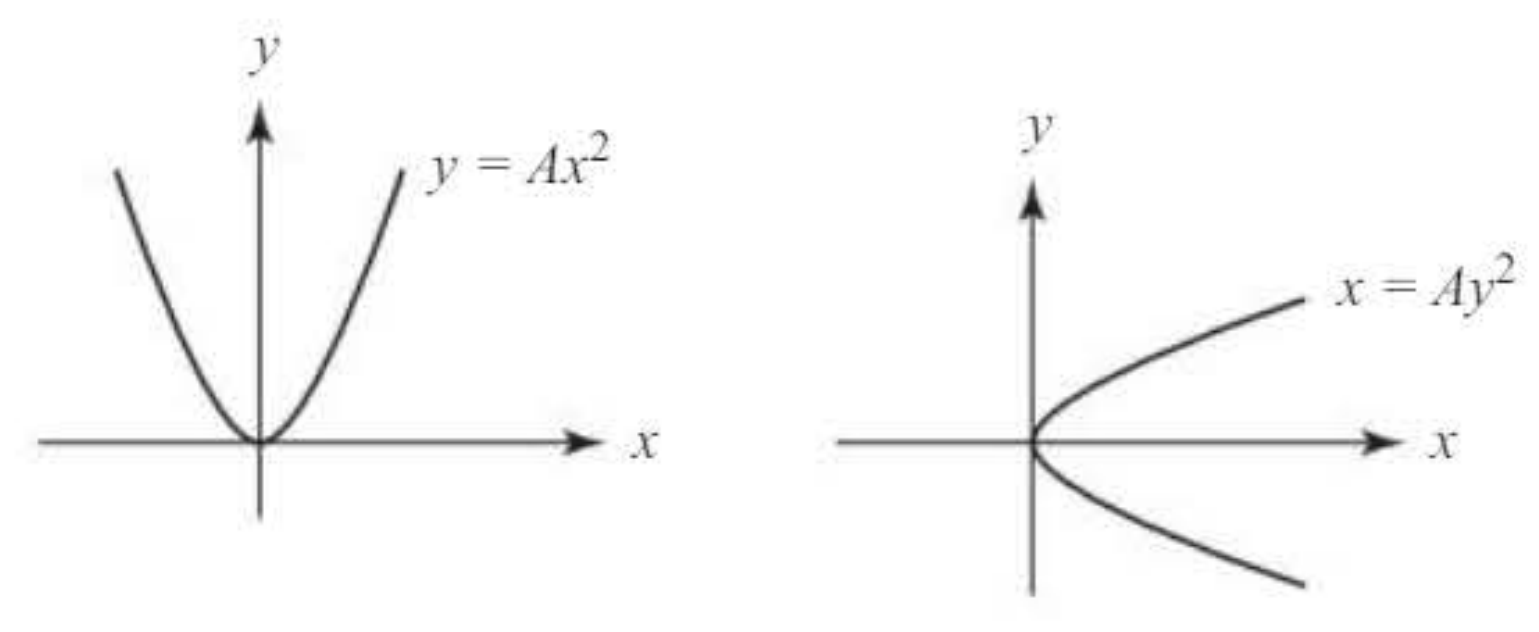
You are already familiar with the parabola . This equation describes a parabola with its vertex at the origin, opening upwards or downwards depending on the sign of .
Parabolas can also take the form , which can be rearranged to make the subject. This represents a parabola opening horizontally (to the left or right).
Important
Key point: An equation of the form describes a parabola with its vertex at the origin.
You may also see the standard equation written as .
Worked example: Sketching a parabola and finding intersections
Example
Worked Example: Sketching a Parabola and Finding Intersections
Question: A curve has equation
a) Sketch the curve, giving the coordinates of any intercepts with the coordinate axes.
b) Find the points of intersection between the curve and the line with equation
Solution:
Part a: The curve is a parabola opening to the right with vertex at the origin. At , we have , so . The only intercept is at the origin .
Part b: To find intersections, solve the equations simultaneously:
Solving gives: or
When :
When :
Therefore, the curve and line intersect at (, ) and (, ).
Note
Exam tip: Factorise or use your calculator to solve the quadratic efficiently.
Ellipses
Formation and definition
An ellipse is formed by the intersection of a cone with a plane that cuts through only the curved surface of the cone. If the plane is parallel to the base, a circle is formed, but in general an ellipse will be formed.
Standard equation
You know that the equation of a circle with centre at the origin is .
This can be written as .
An ellipse does not have a constant radius. Instead, its equation can be written:
where .
Important
Key point: An equation of the form describes an ellipse centred on the origin. The ellipse will pass through the points and .
Properties of ellipses
Understanding the properties of ellipses helps in sketching and analyzing these curves:
- The ellipse intersects the -axis at (found by setting )
- The ellipse intersects the -axis at (found by setting )
- The values and represent the semi-axes of the ellipse
- When , the ellipse becomes a circle
Worked example: Sketching an ellipse
Example
Worked Example: Sketching an Ellipse
Question: Sketch the ellipse
Solution:
From the equation: so , and so .
Check by letting : this gives , which means .
Check by letting : this gives , which means .
The ellipse passes through , , , and .
Note
Exam tip: Try to make your graph approximately to scale for better visualization and understanding.
Worked example: Ellipse from stretched circle
Example
Worked Example: Ellipse from Stretched Circle
Question: A circle with equation is stretched by scale factor 2 in the -direction to form an ellipse. Sketch the ellipse and state its equation.
Solution:
The original circle has radius 3, so it passes through and on the -axis.
A vertical stretch of scale factor 2 means the -intercept changes from 3 to .
The equation becomes: or
Worked example: Finding ellipse equation from different form
Example
Worked Example: Finding Ellipse Equation from Different Form
Question: Sketch each of these ellipses:
a)
b)
Solution:
Part a: so , and so .
Check by letting : this gives .
Check by letting : this gives .
Part b: Rearrange the equation to .
So and .
Note
Exam tip: Writing the equation in the usual form makes it easier to identify the values of and .
Hyperbolas
Standard form and properties
The final conic section is a hyperbola. This is formed by the intersection of a cone with a plane that is steeper than the curved face of the cone. A double-cone is shown as the plane will intersect both cones.
A hyperbola has equation:
Note
Notice that this is very similar to the equation of the ellipse, but with a minus sign instead of a plus sign. This small difference creates a completely different curve shape.
Key properties of hyperbolas
Understanding how hyperbolas intersect the coordinate axes is essential:
When , , so the curve crosses the -axis at .
However, if you substitute into the equation, you get , which is not possible since must be positive. Therefore, the hyperbola will not cross the -axis.
Asymptotes
The equation can be rearranged to give:
Since , is only defined when .
As and become large, becomes .
So the graph has asymptotes at , i.e. .
Important
Key point: An equation of the form describes a hyperbola centred on the origin with asymptotes .
Worked example: Sketching a hyperbola
Example
Worked Example: Sketching a Hyperbola
Question: Sketch the hyperbola and state the equations of the asymptotes.
Solution:
In this equation, and .
So the equations of the asymptotes are .
The -intercepts are at .
Rectangular hyperbola
A hyperbola whose asymptotes are the coordinate axes is called a rectangular hyperbola.
The equation of a rectangular hyperbola is .
Important
Key point: An equation of the form describes a rectangular hyperbola centred on the origin with asymptotes and (the coordinate axes).
Worked example: Rectangular hyperbola
Example
Worked Example: Rectangular Hyperbola
Question: A curve has equation
a) Sketch , giving the equations of the asymptotes.
b) The line with equation intersects at the points and . Calculate the length of the line segment .
Solution:
Part a: represents a rectangular hyperbola.
Asymptotes are and (the coordinate axes).
Part b: Solve simultaneously:
Solving: or
When : When :
So is and is .
Length of
Note
Exam tip: Use Pythagoras' theorem to find the length of .
Translations of conic sections
Translation rules
Replacing by in an equation translates the curve units in the -direction.
Similarly, replacing by translates the curve units in the -direction.
To sketch translations of conic sections, identify the type of curve involved and find the vertex (for a parabola) or centre (for a hyperbola or an ellipse) of the transformed curve.
Strategy for sketching translated conic sections
Note
Follow this systematic approach when sketching translated conic sections:
Step 1: Identify the curve by converting the equation to a standard form.
Step 2: Find the centre or vertex of the transformed curve.
Step 3: Sketch the transformed curve, stating the values of any intercepts and the equations of any asymptotes.
Worked example: Translated parabola
Example
Worked Example: Translated Parabola
Question: Sketch the curve of
Solution:
The equation can be written as .
This is the equation of a parabola.
The vertex of the curve has moved from the origin to . The curve has been translated 5 units left.
You can check the -intercept is correct by substituting to give .
To find the -intercepts, substitute to give .
Important
Key point: A parabola with equation will have its vertex on the point .
Worked example: Translated ellipse
Example
Worked Example: Translated Ellipse
Question: Sketch the curve of
Solution:
The equation can be written as .
This is the equation of an ellipse with a radius of 10 in the -direction and a radius of 5 in the -direction.
The centre of the curve has moved from the origin to . The curve has been translated 5 units up.
You can check the -intercepts are correct by substituting to give .
Important
Key point: An ellipse with equation will be centred on the point and have radius of in the -direction and in the -direction.
Worked example: Translated rectangular hyperbola
Example
Worked Example: Translated Rectangular Hyperbola
Question: Sketch the curve of
Solution:
The equation can be written as .
The centre of the curve has translated from the origin to , moving 1 unit down.
Verify the -intercept by substituting to get .
Important
Key point: A rectangular hyperbola with equation will be centred on the point and have asymptotes and .
Worked example: Translated hyperbola
Example
Worked Example: Translated Hyperbola
Question: Sketch the curve of
Solution:
Divide through by 48:
This is the equation of a hyperbola.
The centre of the curve has moved from the origin to , translating 3 units to the right.
You can check the -intercepts are correct by substituting to give .
From the standard form, and , so asymptotes are .
Important
Key point: A hyperbola with equation will be centred on the point and have asymptotes .
Stretches and reflections of conic sections
Stretch rules
Replacing by in an equation will stretch the curve by scale factor in the -direction.
Similarly, replacing by will stretch the curve by scale factor in the -direction.
Strategy for sketching stretches or reflections
Note
Follow this systematic approach when sketching stretches or reflections:
Step 1: Identify the curve by converting the equation to a standard form.
Step 2: Consider the direction to stretch in or the axis to reflect in.
Step 3: Sketch the transformed curve, stating the values of any intercepts and the equations of any asymptotes.
Worked example: Reflected parabola
Example
Worked Example: Reflected Parabola
Question: Sketch the curve of
Solution:
The equation can be written as .
This is the equation of a parabola.
The curve has been reflected in the line (the -axis).
Note that in this case a reflection in the line would have no effect since .
The -intercept remains at the origin.
Note
Exam tip: Notice that a stretch or a reflection in a coordinate axis will not affect the vertex.
Worked example: Stretched ellipse
Example
Worked Example: Stretched Ellipse
Question: The curve with equation is stretched by scale factor 3 in the -direction. Write the equation of the transformed curve and state its points of intersection with the coordinate axes.
Solution:
Equation of original curve is .
This is the equation of an ellipse.
A stretch of scale factor 3 in the -direction means equation becomes:
Which simplifies to .
This is an ellipse which intersects the coordinate axes at and .
Worked example: Stretched hyperbola
Example
Worked Example: Stretched Hyperbola
Question: The curve with equation is stretched by scale factor in the -direction. Sketch the transformed curve and state the equations of its asymptotes.
Solution:
Standard form:
This is the equation of a hyperbola.
To stretch by scale factor in the -direction, replace by :
Equation becomes
so asymptotes are
The -intercepts are at .
Reflection in the line
You can reflect in the line by reversing the roles of and in the equation:
- A parabola of the form will become
- An ellipse of the form will become
- A hyperbola of the form will become with asymptotes at
- A rectangular hyperbola of the form will become , so no change!
Reflection in the line
To reflect in the line , you need to replace with and with in the equation.
Worked example: Reflected ellipse
Example
Worked Example: Reflected Ellipse
Question: The curve with equation is reflected in the line . Sketch the transformed curve and state its equation.
Solution:
Standard form:
This is the equation of an ellipse.
Curve becomes
This can be rewritten as
which is an ellipse with centre .
Find the -intercepts by letting :
Remember!
Summary
Key Points to Remember:
-
Parabolas have the form (or ) with vertex at the origin. Translated parabolas have the form with vertex at .
-
Ellipses have the form and pass through and . They are like stretched circles.
-
Hyperbolas have the form with asymptotes . Rectangular hyperbolas have the form with asymptotes along the coordinate axes.
-
To sketch translated conic sections, first identify the curve type, then find the new centre or vertex, and finally sketch showing all intercepts and asymptotes.
-
Stretches and reflections can be applied to conic sections using substitution rules: replace with for a horizontal stretch of scale factor , or swap and to reflect in the line .