Improper Integrals (AQA A-Level Further Maths): Revision Notes
📚Revision Notes
Improper Integrals
What is an improper integral?
When working with definite integrals, you typically evaluate them by integrating and then substituting the limits. The result represents a finite area between a curve and an axis. However, some integrals cannot be evaluated using this standard approach because they involve infinite limits or points where the function is undefined. These special cases are called improper integrals.
Note
An improper integral is a definite integral that has at least one of the following characteristics:
- One or both of the integration boundaries are infinite (±∞)
- The function being integrated is undefined at one of the limits
- The function being integrated is undefined at some point between the limits
Understanding when an integral is improper is crucial because you need to use a different technique to evaluate it. You cannot simply substitute infinity into your antiderivative, as this is not a valid mathematical operation.
Evaluating improper integrals with infinite limits
When an integral has an infinite limit, you evaluate it by replacing the infinity symbol with a variable (usually ) and then considering what happens as that variable approaches infinity. This approach allows you to work with finite values throughout your calculation and only consider the infinite behaviour at the end.
The formal notation for this method is:
or
After you have set up the limit and integrated the function, you substitute the limits as normal. Then you examine the behaviour of the expression as the variable approaches infinity.
Convergent and divergent integrals
Once you have evaluated the limit, the improper integral falls into one of two categories:
Important
Convergent vs Divergent Integrals:
-
Convergent: If the limit exists and equals a finite number, the improper integral is convergent. This means the integral represents a finite area, even though one of the boundaries extends to infinity.
-
Divergent: If the limit does not exist or approaches infinity, the improper integral is divergent. This means the integral represents an infinite area.
The distinction between convergent and divergent integrals is fundamental. A convergent integral has a definite numerical value, whilst a divergent integral cannot be evaluated.
Example: convergent integral
Consider the integral . This is an improper integral because the upper limit is infinite.
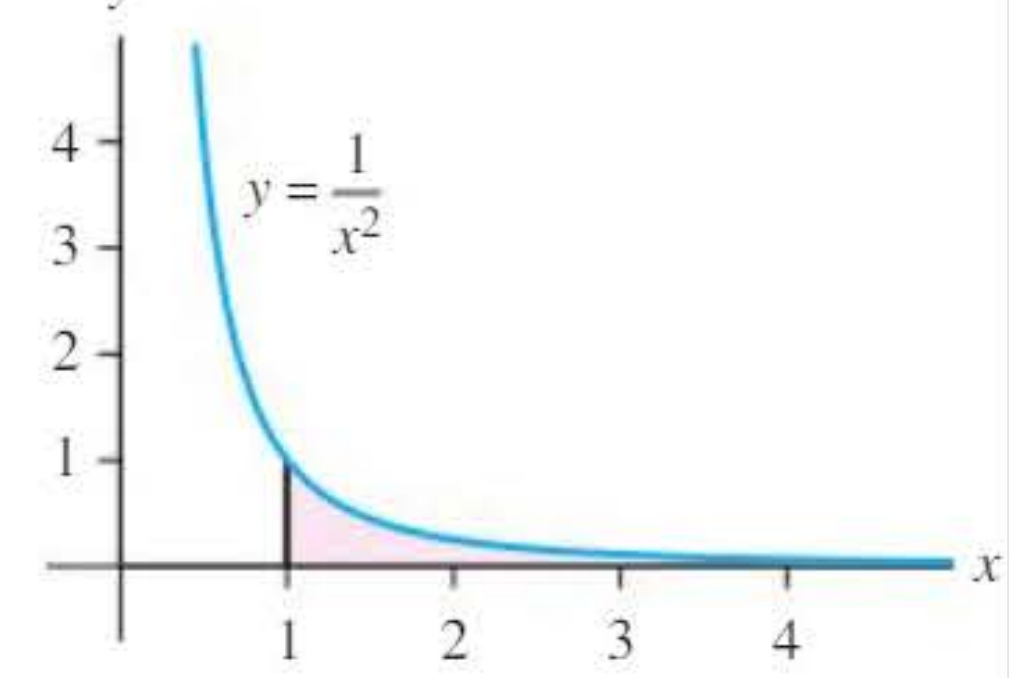
To evaluate it, replace ∞ with and take the limit:
As , the term , so:
Since the limit exists, the improper integral is convergent and represents a finite area of 1 square unit.
Example: divergent integral
Now consider . This is improper because the upper limit is infinite.
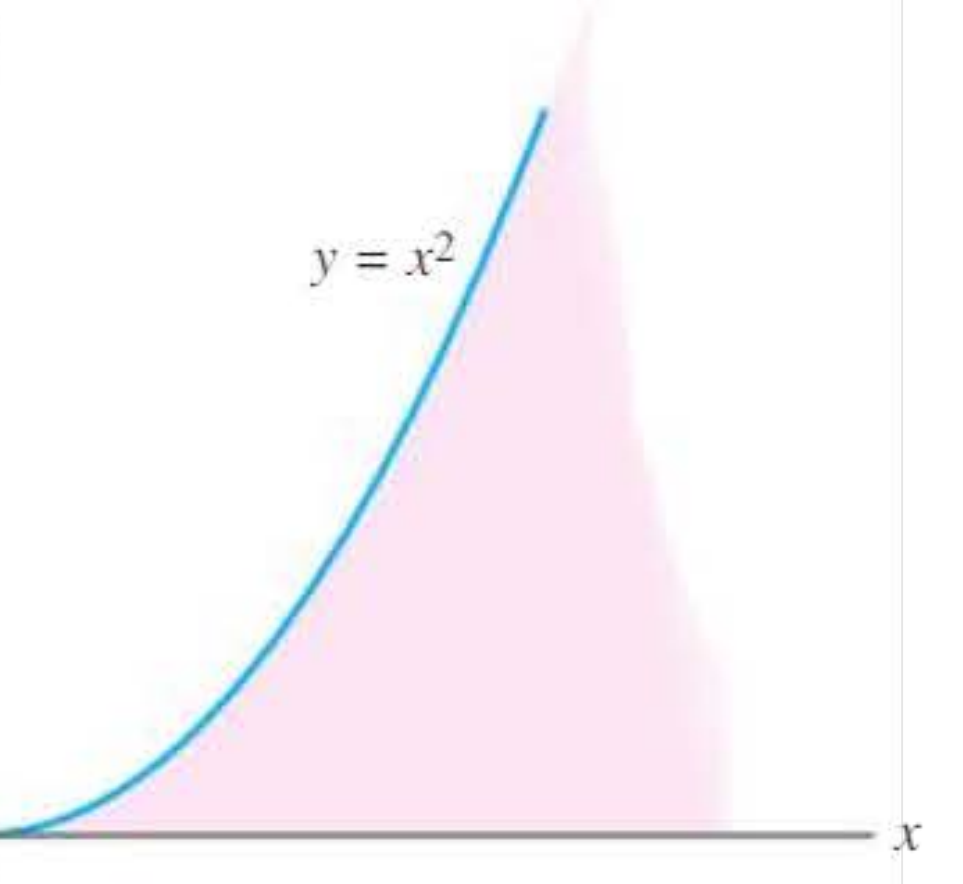
Following the same process:
As , the expression . The limit does not exist as a finite number, so the improper integral is divergent and represents an infinite area.
Worked example 1: improper integral with infinite upper limit
Example
Worked Example: Calculate
Solution:
This integral is improper because the upper limit is infinite. Replace ∞ with and evaluate the limit as :
Integrate using the power rule:
As , we have , therefore:
The integral converges to .
Splitting integrals with two infinite limits
When both integration limits are infinite, you cannot directly apply the limit method because you cannot have two different limits approaching different values simultaneously. Instead, you must split the integral into two separate integrals at any convenient point (often 0), giving each integral one finite limit.
Important
Critical Rule for Split Integrals:
When you split an integral with two infinite limits, both resulting integrals must be convergent for the original integral to be convergent. If either part is divergent, the whole integral is divergent.
Also, when splitting, you must use different variable names for the two limits (such as and ) because they approach their respective infinities independently.
Worked example 2: splitting an integral with two infinite limits
Example
Worked Example: Evaluating integrals with two infinite limits
a) Evaluate
b) Show that the improper integral is divergent.
Solution:
Part a:
Since both limits are infinite, split the integral at :
Use different variables for the two infinite limits:
To integrate, use the chain rule in reverse. Since , we have:
Since :
Both limits exist (as and , the exponentials and ), so the improper integral is convergent and equals 0.
Part b:
Split the integral at :
As , , so the first limit is .
However, as , , so the second limit does not exist.
Since the second limit does not exist, the improper integral is divergent. Both parts must converge for the original integral to be convergent.
Important limit results
When evaluating improper integrals, you will frequently need to determine the behaviour of expressions as variables approach infinity or zero. Two crucial limit results simplify this process significantly:
Important
Essential Limit Results:
For any real number :
This result tells you that exponential decay (the term) always dominates polynomial growth (the term) as approaches infinity, regardless of the power .
For any real number :
The notation means that approaches zero from above (positive values only), which is necessary because is only defined for positive . This result shows that the logarithm's behaviour near zero dominates the power function, causing the product to approach zero.
Note
You can quote these results directly in your work without proof, though they can be proved using series expansions or L'Hôpital's rule.
Evaluating improper integrals with discontinuities
Another type of improper integral occurs when the function being integrated is undefined at one or both limits, or at some point between the limits. This creates a discontinuity that must be handled carefully. You cannot simply substitute the problematic value into your antiderivative.
When the function is undefined at a boundary, replace that limit with a variable and take the limit as the variable approaches the problematic value. The approach direction is important: approach from the side where the function is defined.
Worked example 3: discontinuity at a boundary
Example
Worked Example: Evaluate
Solution:
The function is undefined at (the lower limit), making this an improper integral. Replace 0 with and take the limit as from above:
Integrate using the power rule:
As , we have , therefore:
The integral converges to 8.
Worked example 4: using integration by parts with a discontinuity
Example
Worked Example: Calculate
Solution:
This integral requires integration by parts because of the logarithm term. Since is undefined at , replace 0 with and evaluate the limit:
For the term, use integration by parts with and . This gives .
Since :
As , we have .
For the term, use the limit result as with .
Therefore .
The integral converges to 3.
Discontinuities between the limits
When the function is undefined at a point between the integration limits (not at a boundary), you must split the integral into two parts at the discontinuity. Each part is then evaluated separately as an improper integral, and both must converge for the original integral to be convergent.
Worked example 5: discontinuity between the limits
Example
Worked Example: Evaluate the improper integral
Solution:
The function is undefined at , which lies between the limits and . Split the integral at this point of discontinuity:
Evaluate the first integral by replacing 0 with and taking the limit as :
Use integration by parts with and :
Using the limit result as with :
Now evaluate the second integral by replacing 0 with and taking the limit as :
Since :
Since both limits exist, the improper integral converges. The final answer is:
Determining convergence or divergence
Sometimes you are asked to determine whether an improper integral converges or diverges without necessarily calculating its exact value. This requires you to set up the limit, integrate, substitute the limits, and then analyse the behaviour as the variable approaches infinity or the problematic value.
Strategy for determining convergence or divergence
Note
Three-Step Strategy:
Follow these three steps:
-
Replace the problematic limit with a variable (use , , or depending on whether you're approaching infinity, negative infinity, or a discontinuity).
-
Integrate and substitute the limits as you would for a normal definite integral.
-
Consider the behaviour of the result as the variable approaches its target value (infinity or the discontinuity point).
If the limit exists and equals a finite number, the integral converges. If the limit does not exist or approaches infinity, the integral diverges.
Handling rational expressions
When working with rational expressions (fractions with polynomials), determining the limit behaviour requires careful analysis. The most effective technique is to divide both the numerator and denominator by the highest power of in the denominator. This allows you to see clearly which terms approach zero and which terms dominate as .
For example, the expression can be rewritten by dividing numerator and denominator by :
As , the terms and , so the expression approaches .
Worked example 6: determining convergence of a rational expression integral
Example
Worked Example: Determine whether the improper integral is convergent or divergent.
Solution:
Replace ∞ with and evaluate as :
Both terms have the form , which integrates to . Recognise that:
- For : the derivative of is
- For : the derivative of is
Combine the logarithms using the law :
To find the limit of the rational expression, divide numerator and denominator by :
As , we have and , so:
Therefore:
The final result is:
Since the limit exists and equals a finite value, the integral converges to .
Exam tips
Note
Essential Exam Strategies:
- Always identify the type of improper integral first: infinite limits, discontinuity at a boundary, or discontinuity between limits.
- When replacing infinity with a variable, use different variables (, , ) if you have multiple infinite limits.
- Remember that when splitting an integral with infinite limits or a discontinuity between limits, both parts must converge for the original integral to converge.
- For rational expressions, divide numerator and denominator by the highest power of to determine limit behaviour.
- Quote the limit results and directly when needed - you don't need to prove them.
- Integration by parts is often required when logarithms appear in improper integrals.
- Check whether the function is defined at the limits before starting - this determines your method.
- Show all limit notation clearly in your working.
Remember!
Summary
Key Points to Remember:
-
An improper integral occurs when: one or both limits are infinite, the integrand is undefined at a limit, or the integrand is undefined between the limits.
-
Replace infinity with a variable: To evaluate improper integrals with infinite limits, use and evaluate the limit.
-
Convergent vs divergent: A convergent integral has a limit that exists (finite value). A divergent integral has a limit that doesn't exist or is infinite.
-
Split at discontinuities: When the integrand is undefined at a point between the limits, split the integral at that point. Both parts must converge for the original integral to converge.
-
Key limit results to remember: as for any real , and as for any real . Use these to simplify limit evaluation.