Polar Graphs and Areas (AQA A-Level Further Maths): Revision Notes
📚Revision Notes
Polar Graphs and Areas
Introduction to polar curves
Polar curves are curves that can be defined using polar coordinates rather than the usual Cartesian (x, y) coordinates. In polar form, a point's position is determined by:
- r: the distance from the origin (the pole)
- θ: the angle measured anticlockwise from the positive x-axis
A polar curve is expressed as , where the radius r varies as the angle θ changes. This is particularly useful for curves with circular or rotational symmetry.
Note
Polar coordinates provide a natural way to describe curves that exhibit symmetry around a central point. While Cartesian coordinates use (x, y) to locate a point, polar coordinates use (r, θ) - the distance and direction from the origin.
Sketching polar curves
To sketch a curve given in polar form, you need to calculate the value of r for several key values of θ. Typically, you would consider values such as .
Important curve types
Cardioid curves have the form or , where a is a positive constant. These curves create a distinctive heart-like shape.
Important
Key properties of cardioids:
- The minimum value of r is 0, occurring when the trigonometric function equals -1
- The maximum value of r is 2a, occurring when the trigonometric function equals 1
- The curve is continuous and loops back on itself
Rose curves have the form or , where n is a positive integer. These curves have n loops (or petals).
Important
Since r represents a radius (distance from the origin), it must be positive. Therefore, when sketching rose curves, you need to identify the values of θ for which r is positive to determine where the loops appear.
Worked example 1: Sketching a cardioid
Example
Worked Example: Sketching a Cardioid
Problem: Sketch the curve
Solution:
Calculate r at key angles:
- When :
- When :
- When :
- When :
- When :
Using the identity , we can also note:
This is a cardioid with:
- Minimum value of r is 0 at
- Maximum value of r is 6 at and
Worked example 2: Sketching a rose curve
Example
Worked Example: Sketching a Rose Curve
Problem: Sketch the curve
Solution:
First, find where :
Therefore:
Now determine where r is positive. Consider the graph of :
r is positive for:
The maximum value of r is 2, occurring when , which happens at .
This creates a rose curve with three loops (since n = 3). You don't need to draw all the construction half-lines in your final sketch, but you must be able to identify where they are positioned.
Area of a sector in polar coordinates
Deriving the area formula
The area of a sector of a circle with radius r and angle θ (in radians) is given by:
To find the area enclosed by a polar curve between two half-lines, we can use integration by splitting the region into many thin sectors.
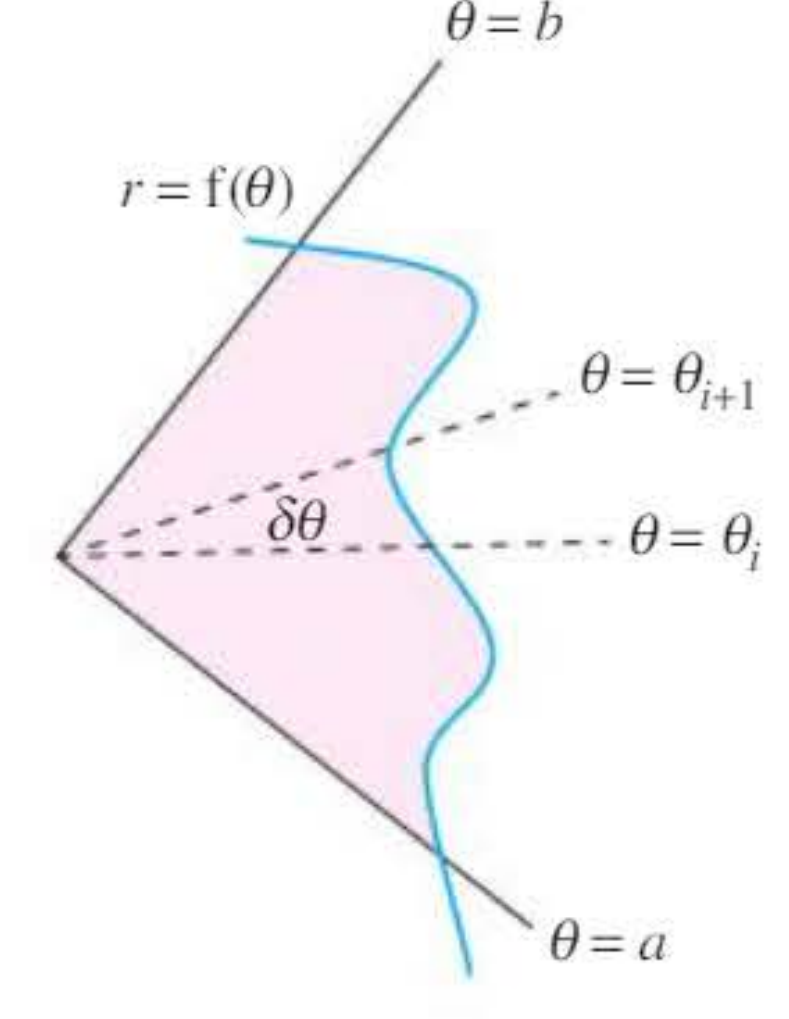
Consider a polar curve between the half-lines and .
Note
Derivation Process:
Step 1: Split the region into n thin slices, each with angle .
Step 2: The area of each slice can be approximated as the area of a sector of a circle with radius and angle :
Step 3: Taking the limit as (so ), the sum of these areas becomes an integral:
Key formula
Important
The area of a sector of a polar curve between the half-lines and is:
Critical: θ must be measured in radians for this formula to work correctly.
Worked example 3: Area of a rose curve loop
Example
Worked Example: Area of a Rose Curve Loop
Problem: Calculate the area enclosed by the curve , where
Solution:
First, find where :
Next, determine where r is positive:
Calculate the area of one loop (from to ):
Use the identity , so :
Since there are two identical loops, the total area is:
Area between two polar curves
To find the area between two polar curves, you need a systematic approach. This technique builds on the single-curve area formula but requires careful consideration of intersection points and curve positioning.
Important
Strategy for Finding Area Between Curves
Step 1: Sketch both curves and solve their equations simultaneously to find the points of intersection.
Step 2: Calculate the area of a sector for each curve using the formula , with appropriate limits.
Step 3: Add (or subtract) the areas together to find the required area, depending on the configuration.
Worked example 4: Area between two curves
Example
Worked Example: Area Between Two Curves
Problem: Find the area bounded by the curves and
Solution:
Step 1: Find the points of intersection by solving simultaneously:
The curves intersect at and (or equivalently ).
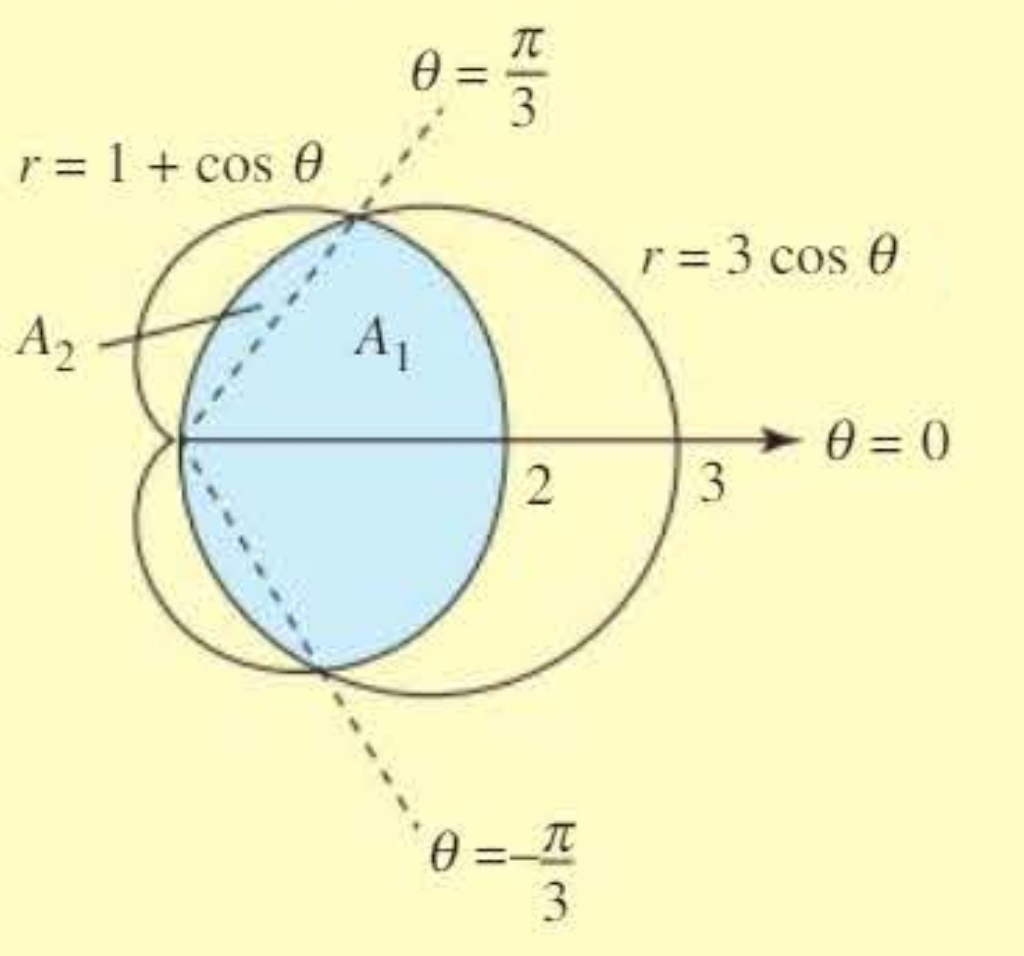
Step 2: Calculate the area enclosed by between and :
Use the identity :
Step 3: Calculate the area enclosed by between and :
Step 4: The total area of the top half is:
Since the configuration is symmetrical about , the total area is:
Common trigonometric identities
Note
Essential Trigonometric Identities for Polar Areas
These identities are frequently needed when calculating areas in polar coordinates:
You'll use these identities to simplify integrals involving squared trigonometric functions, which appear frequently in polar area calculations.
Exam tips
Important
Key Exam Tips for Success
-
Always use radians when working with the area formula. If angles are given in degrees, convert them first.
-
Sketch the curves before attempting to calculate areas. This helps you identify the correct limits and understand the geometry.
-
Check where r is positive for rose curves to correctly identify loop positions.
-
Find intersection points carefully by solving equations simultaneously when dealing with two curves.
-
Use symmetry to simplify calculations where possible, as seen in Example 4.
-
Remember the factor of ½ in the area formula - it's easy to forget under exam pressure.
Remember!
Summary
Key Points to Remember
- Polar curves are defined in the form , where r is the radius and θ is the angle in radians.
- Cardioids ( or ) have minimum value 0 and maximum value 2a.
- Rose curves ( or ) have n loops where r is positive.
- The area formula for a polar sector is , and θ must always be in radians.
- When finding area between two curves, first find intersection points, then calculate separate areas and combine them appropriately.