Euler’s Method (AQA A-Level Further Maths): Revision Notes
📚Revision Notes
Euler's Method
Introduction
Most first-order differential equations cannot be solved using standard calculus and algebra techniques. When this happens, you need to use numerical methods to find approximate solutions. Euler's method is one such numerical technique that allows you to estimate successive points on a solution curve.
Note
Euler's method is particularly useful when dealing with differential equations that have no closed-form analytical solution, making it an essential tool in applied mathematics and engineering.
What is Euler's method?
Euler's method is a numerical technique for approximating solutions to differential equations of the form:
where you know one starting point that lies on the solution curve.
The method is named after Swiss mathematician Leonhard Euler (1707-1783).
The basic principle
Euler's method works by using the gradient of the tangent line at a known point to estimate the next point along the solution curve. Since at the point , the value of represents the gradient of the tangent to the solution curve at that point.
On a straight line, the change in equals the change in times the gradient. If increases by a small amount (called the step length), then increases by approximately .
Note
When is small, the solution curve stays close to the tangent line, so the point should be close to the correct solution. This is the fundamental principle that makes Euler's method work.
The Euler formula
The iterative process of Euler's method can be expressed using a simple formula that generates successive approximations along the solution curve:
Important
Key Formula:
Where:
- is the step length
- is the gradient function evaluated at point
- is the starting point
This process can be repeated to generate successive approximations: , , , and so on, which lie approximately on the solution curve.
Accuracy considerations
Understanding the factors that affect accuracy is crucial for applying Euler's method effectively in practice.
Important
Important points about accuracy:
- Smaller step lengths produce more accurate results
- Accuracy improves when the start and end points are close together
- Position of approximations: Euler approximations are above the curve when it is concave and below when it is convex
Worked example 1: Basic Euler's method
Example
Worked Example: Basic Euler's Method Application
Problem: Given , with starting point and step length , calculate the approximate value of the curve when .
Solution:
| 0 | 1 | 1 |
| 1 | 1.5 | |
| 2 | 2 |
The approximate value when is 9.75.
Finding relative error:
The differential equation can be integrated: , so .
Using the initial condition : , giving .
Therefore, the accurate value when is .
With smaller step length ():
| 0 | 1 | 1 |
| 1 | 1.1 | |
| 2 | 1.2 | |
| ... | ... | ... |
| 10 | 2.0 |
The approximate value is 14.63, with relative error:
Notice that the smaller step length produces a more accurate result.
Worked example 2: Euler's method with complex function
Example
Worked Example: Euler's Method with Complex Function
Problem: Given with when , estimate the value of when using step length .
Solution:
Set up the calculation systematically:
| 0 | 1 | 2 |
| 1 | 1.1 | |
| 2 | 1.2 | |
| 3 | 1.3 | |
| 4 | 1.4 | |
| 5 | 1.5 |
Therefore, (to 4 d.p.).
In each calculation, you use the formula where .
The improved Euler method
The improved Euler method provides better accuracy by using the average of the gradients at the initial point and the end point of each step.
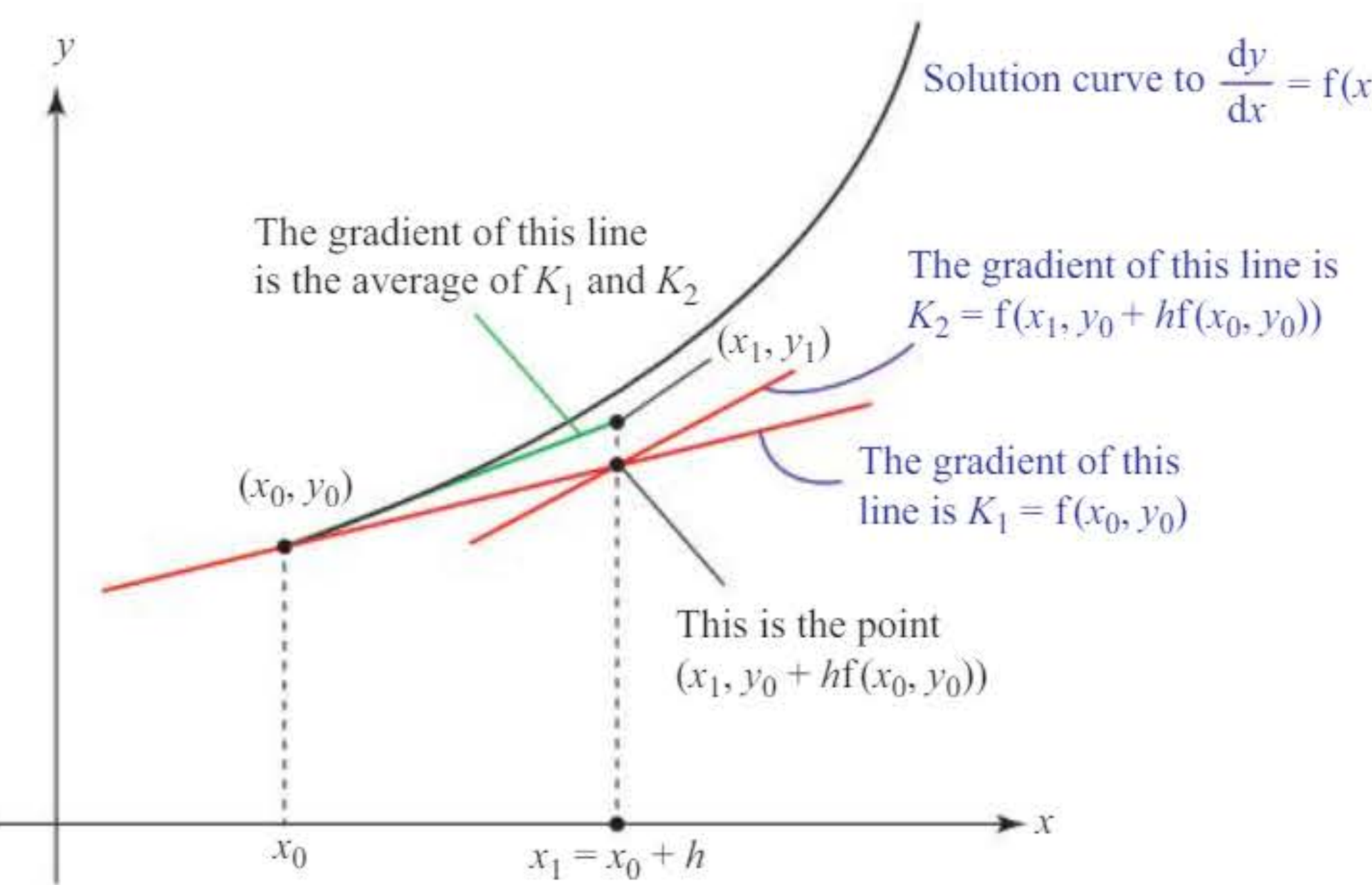
How it works
Let be the point and be the point .
Using basic Euler's method: and
The improved method calculates two gradients:
- - the gradient at point
- - the gradient at point
Then the improved estimate is:
Important
Key Formula - Improved Euler Method:
where:
Note
Working out is equivalent to using the ordinary Euler method on the right-hand boundary point. This means you're effectively using Euler's method to estimate the gradient at the end of the interval.
Worked example 3: Improved Euler method
Example
Worked Example: Improved Euler Method
Problem: Estimate the value of when for the differential equation , given that when .
Given: and
Step 1:
Hence:
Step 2:
Hence:
Therefore, (to 3 d.p.).
The midpoint method
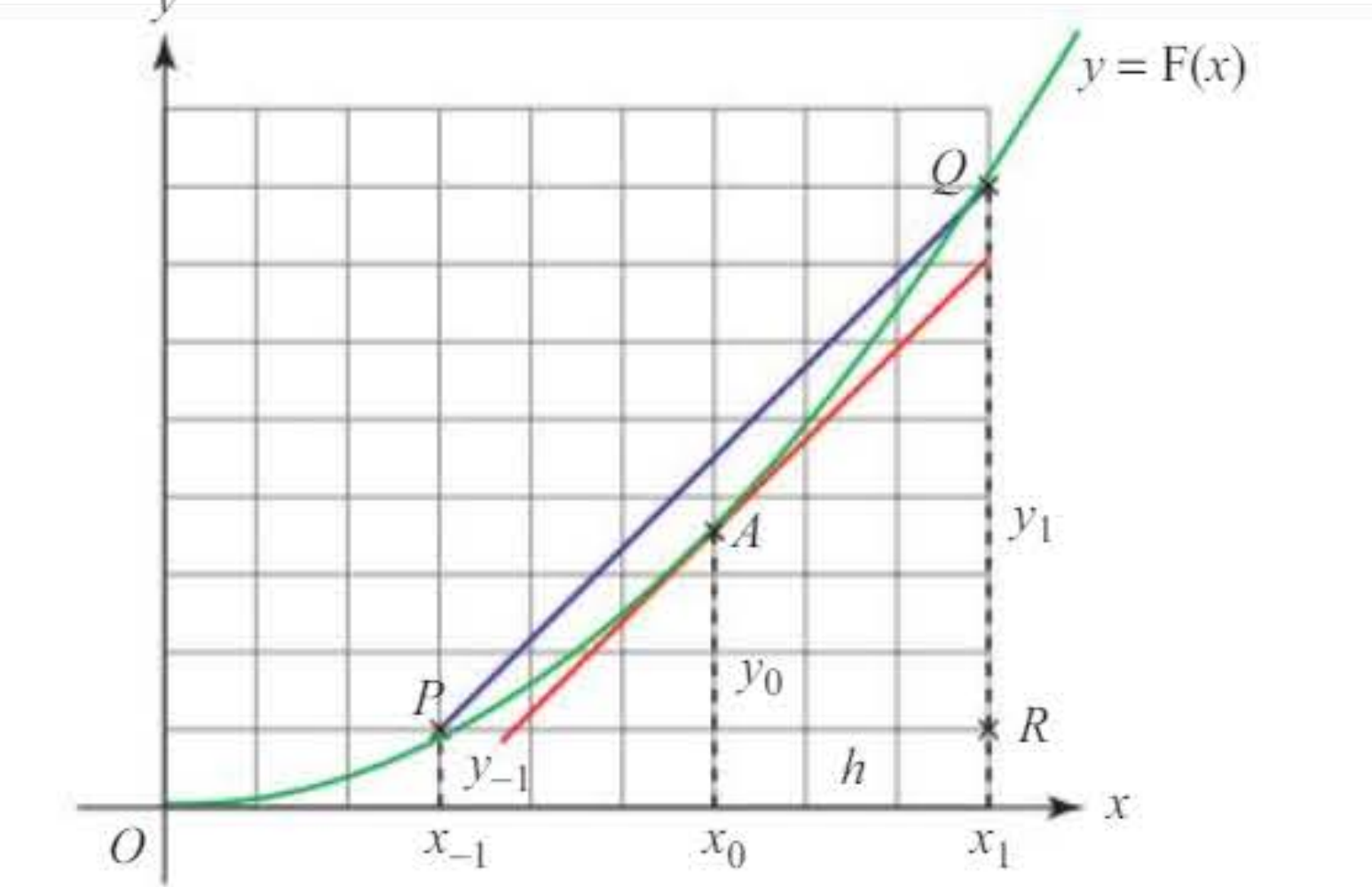
The midpoint method is an alternative improved Euler method. It compares the gradient of the chord on a curve with the gradient of the curve at the midpoint of the chord.
The formula
Let be and let be , with .
The gradient of the chord is:
This gradient approximates the gradient of the curve at the midpoint , so:
Rearranging gives:
Important
Key Formula - Midpoint Method:
Important
Exam tip: Most questions give you a starting point and a gradient function . This means you don't know . You will need to use the general Euler formula to create , then use the midpoint formula repeatedly to create further points.
Worked example 4: Midpoint method
Example
Worked Example: Midpoint Method
Problem: Use the midpoint method to estimate the value of when for the differential equation , given that when .
Use a step length of 0.1.
Solution:
Given: and
First, use basic Euler's method to find :
So
Now use the midpoint formula to find :
So
Finally:
Thus an estimate for when is 3.01 (to 3 s.f.).
Problem-solving strategy
When solving differential equations numerically using Euler's method, follow this systematic approach to ensure accuracy and completeness:
Step 1: Identify the differentiated function , a starting point , and a suitable step value .
Step 2: Calculate .
Step 3: Continue using until the desired endpoint is reached.
Step 4: Answer the question in context (including units where appropriate).
Using spreadsheets
For questions requiring many iterations, use a spreadsheet, graphical calculator, or computer software. This removes the tedious arithmetic and reduces calculation errors.
Note
Set up columns for:
- (step number)
- values
- values
- Formula calculations
This organization makes it easy to track your calculations and spot any errors.
Exam tips
Note
Exam Tips for Success:
- Always show your working - even if using a calculator, write down the formula and key values
- Check your step size - smaller steps give better accuracy but require more calculations
- Watch for rounding - don't round intermediate values too early; keep full accuracy until the final answer
- Relative error is calculated as:
- Starting points - make sure you correctly identify and from the question
- Gradient function - correctly substitute both and values into
Remember!
Summary
Key Points to Remember:
- Euler's method approximates solutions to differential equations using tangent line gradients at successive points.
- The basic formula is: where is the step length.
- Smaller step lengths produce more accurate approximations but require more calculations.
- The improved Euler method uses the average of two gradients: .
- The midpoint method uses the gradient at the midpoint: .