Vision defects and correction (AQA A-Level Physics): Revision Notes
📚Revision Notes
Vision defects and correction
The human eye can suffer from various defects that prevent it from focusing light correctly on the retina. These defects can be corrected using appropriate lenses to ensure clear vision at all distances.
Note
Understanding vision defects and their correction is essential for comprehending how optical systems work and how we can use lenses to compensate for imperfections in the eye's natural focusing ability.
Short sight (myopia)
Myopia, commonly known as short sight, is a vision defect where individuals can see nearby objects clearly but cannot focus on distant objects. The far point (the furthest distance at which objects can be seen clearly) is closer to the eye than infinity, which is abnormal.
Causes of myopia
Myopia occurs when either:
- The cornea and lens combination has too much refracting power, or
- The eyeball is too long from front to back
As a result, parallel rays of light from distant objects converge to a focal point before reaching the retina. This means the image forms in front of the retina rather than on it, causing distant objects to appear blurred.
Note
The key issue in myopia is that the eye's optical system is too powerful for its length, causing light to converge too soon. This is why distant objects appear blurred while nearby objects remain clear.
Correction of myopia
A diverging lens (concave lens) is used to correct myopia. This type of lens has negative power and causes light rays to spread out before entering the eye. The diverging lens reduces the overall converging power of the eye's optical system, allowing the image to be focused correctly on the retina.
Important
The corrective lens works by reducing the total converging power of the optical system. A diverging lens has negative power, which when added to the eye's positive power, gives a lower total power that matches what's needed for clear distance vision.
The corrective lens can be provided as:
- Spectacle lenses
- Contact lenses
Both work on the same principle of diverging incoming light to compensate for the excessive converging power of the eye.
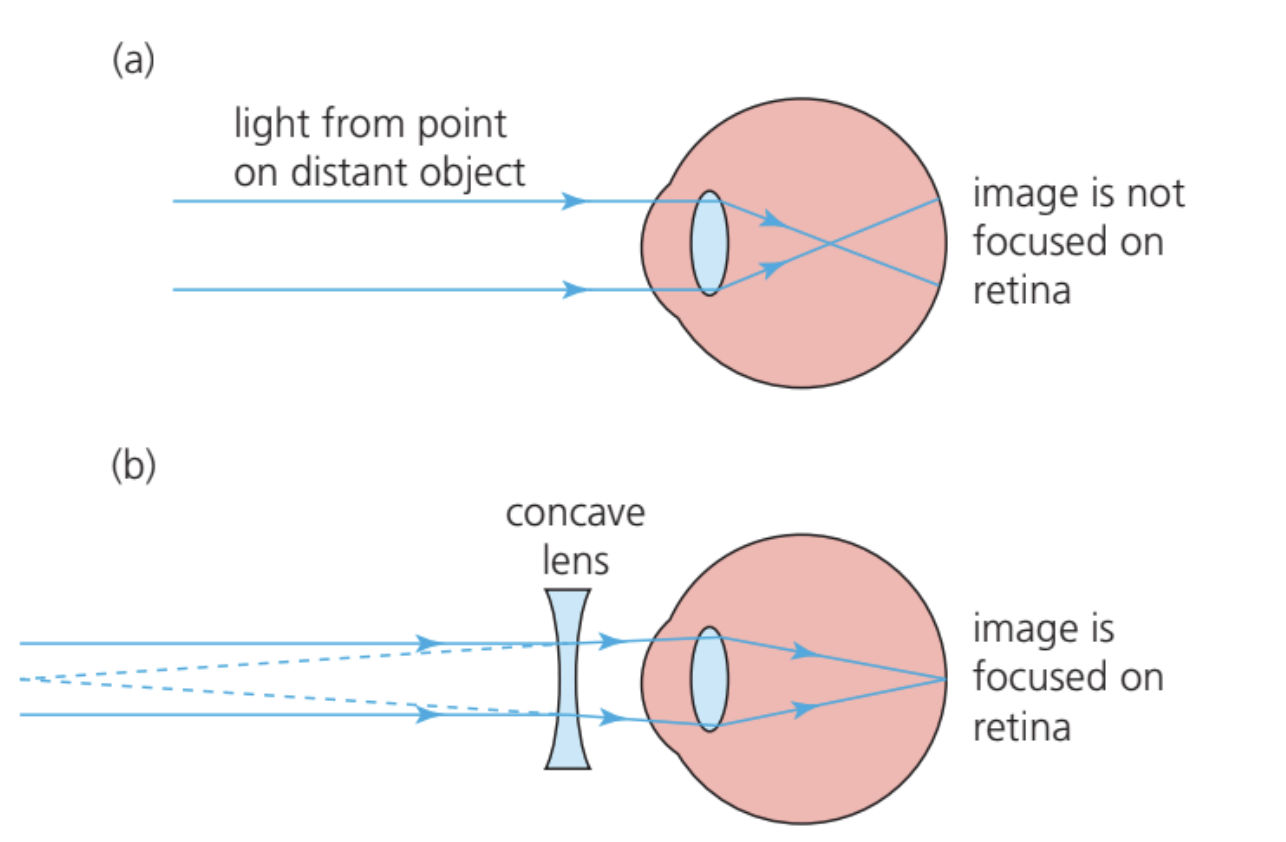
Calculating the required correction for myopia
To determine the power of the correcting lens needed, we use the lens formula:
where:
- is the focal length of the lens (in metres)
- is the object distance (in metres)
- is the image distance (in metres)
The power of a lens is given by:
Power is measured in dioptres (D), which is equivalent to . Diverging lenses have negative power values.
Example
Worked Example: Calculating Lens Power for Myopia
Consider a person with myopia whose far point is 50 cm. Without correction, they cannot see clearly beyond this distance. The distance from their eye lens to retina is 20 mm. We need to find the power of the correcting lens.
Step 1: Calculate the current power of the eye when focusing on the far point.
When viewing an object at the far point (50 cm), this is the furthest distance the eye can focus. The image must form on the retina.
Given:
- Object distance:
- Image distance: (lens to retina distance)
Using the lens formula:
Step 2: Calculate the required power to focus on objects at infinity.
For an object at infinity, , so:
(Note: )
Step 3: Determine the correcting lens power.
The eye currently has 52 D of power but needs only 50 D to focus at infinity. Therefore, we need to reduce the total power by 2 D.
Since the total refracting power of a combination of lenses equals the sum of their individual powers, the correcting lens must have:
Power = -2 D
The negative sign indicates a diverging (concave) lens.
Long sight (hypermetropia)
Hypermetropia, commonly called long sight, is a vision defect where individuals can focus on distant objects clearly but struggle to see nearby objects. The near point (the closest distance at which objects can be seen clearly) is further away than the normal 25 cm.
Causes of hypermetropia
Hypermetropia occurs when:
- The cornea and lens combination does not have sufficient refracting power, or
- The eyeball is too short from front to back
Light from nearby objects cannot be converged enough to focus on the retina. The focal point would be behind the retina, causing near objects to appear blurred.
Note
An additional cause, particularly common in older people, is reduced flexibility of the eye lens. This affects the process of accommodation, making it difficult to focus on nearby objects even if the eye's basic structure is normal.
Correction of hypermetropia
A converging lens (convex lens) is used to correct hypermetropia. This type of lens has positive power and causes light rays to converge more before entering the eye. The converging lens increases the overall converging power of the eye's optical system, allowing nearby objects to be focused on the retina.
Important
Unlike myopia, hypermetropia requires additional converging power to help the eye focus on nearby objects. A converging lens has positive power, which adds to the eye's existing power to reach the total power needed for clear near vision.
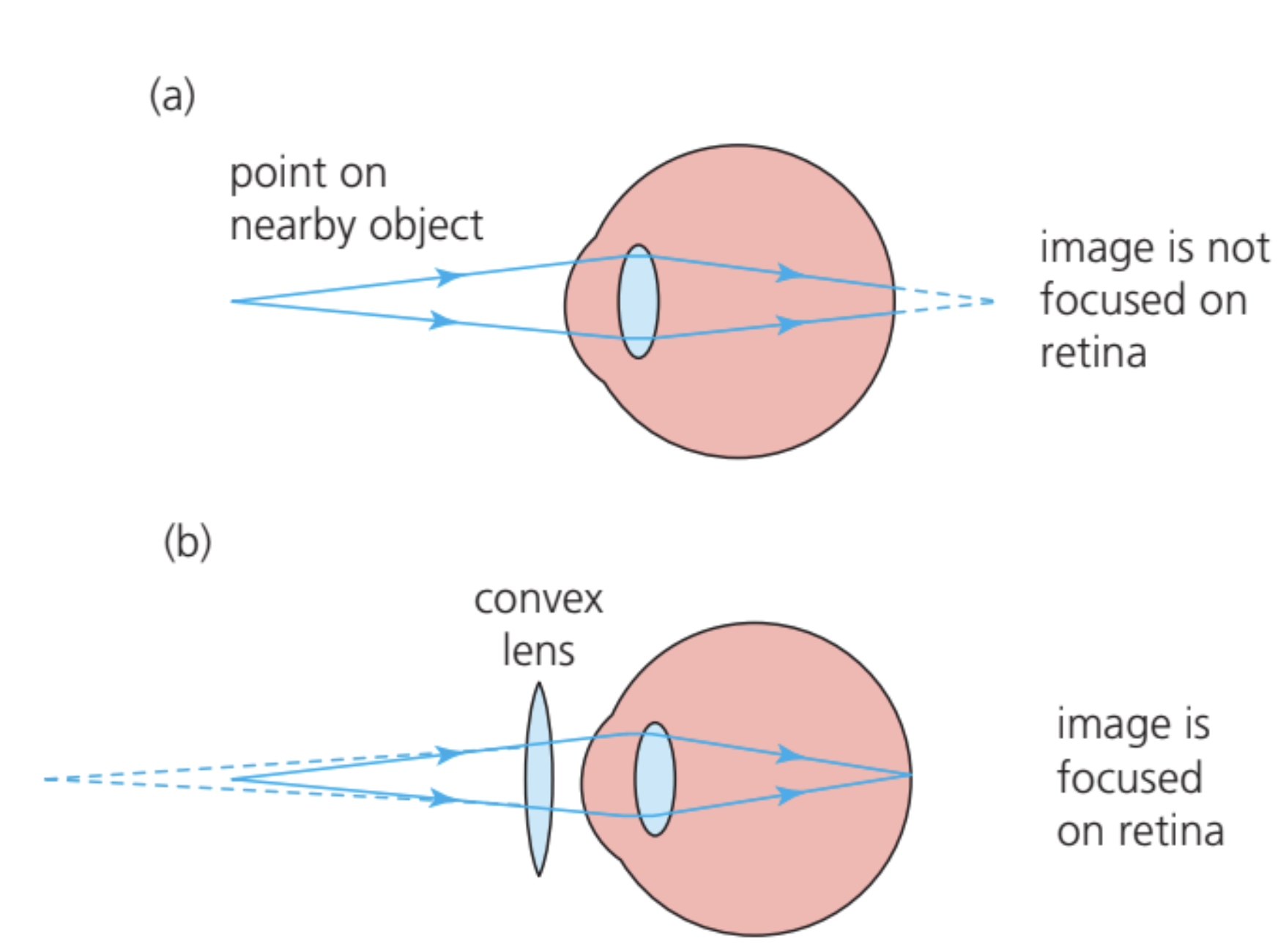
Calculating the required correction for hypermetropia
The same lens formula and power equation apply as for myopia:
However, converging lenses have positive power values.
Example
Worked Example: Calculating Lens Power for Hypermetropia
Consider a person with hypermetropia whose near point is 50 cm. Without correction, they cannot focus on objects closer than this. The distance from their eye lens to retina is 20 mm. We need to find the power of the correcting lens to bring their near point to the normal 25 cm.
Step 1: Calculate the current power of the eye when focusing on the near point.
When viewing an object at the current near point (50 cm):
Given:
- Object distance:
- Image distance: (lens to retina distance)
Using the lens formula:
Step 2: Calculate the required power to focus on objects at 25 cm.
For an object at the normal near point distance:
- Object distance:
- Image distance:
Step 3: Determine the correcting lens power.
The eye currently has 52 D of power but needs 54 D to focus at 25 cm. Therefore, we need to increase the total power by 2 D.
The correcting lens must have:
Power = +2 D
The positive sign indicates a converging (convex) lens.
Astigmatism
Astigmatism is a vision defect where the cornea is not spherical in shape. Instead, it has different curvatures and therefore different refracting powers in different directions. When this variation in curvature is large, or when there are irregularities in the corneal surface, the image formed on the retina becomes unevenly focused.
Spherical versus cylindrical lenses
The lenses used to correct myopia and hypermetropia are spherical lenses. These have spherical surface curvature and focus parallel light rays to a single point.
In contrast, a cylindrical lens has curved faces that are sections of a geometric cylinder. It has different radii of curvature along perpendicular axes and focuses parallel light rays to a line rather than a point.
Note
The fundamental difference between spherical and cylindrical lenses lies in their focusing behavior:
- Spherical lenses focus light to a point
- Cylindrical lenses focus light to a line
This makes cylindrical lenses ideal for correcting the directional variations in refracting power caused by astigmatism.
Correction of astigmatism
Astigmatism is corrected using a cylindrical lens (or by laser surgery). The cylindrical lens compensates for the uneven curvature of the cornea by having different refracting powers in different directions. This allows the image to be focused evenly across the retina.
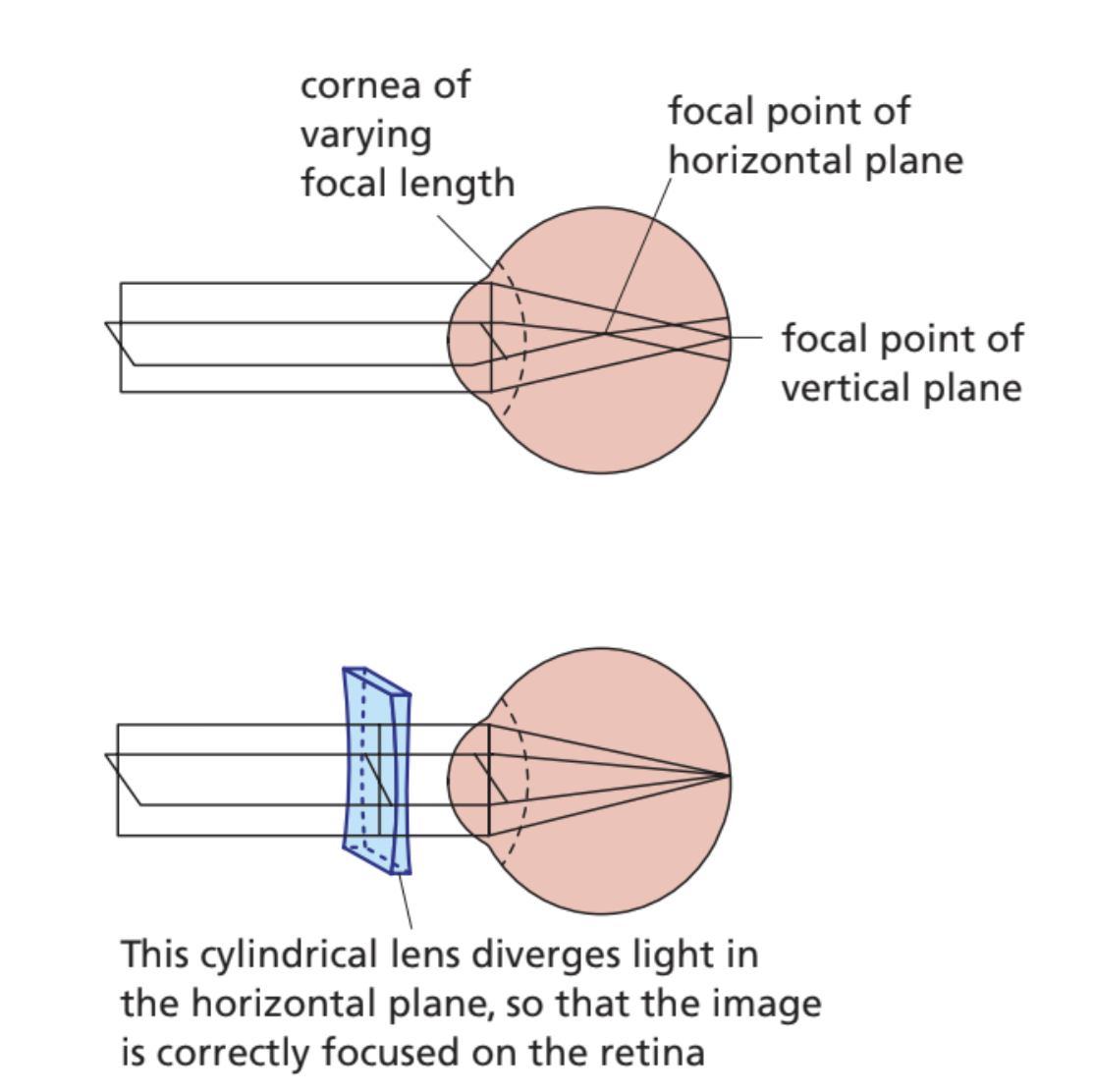
Understanding an astigmatism prescription
An optician's prescription for astigmatism must specify three components:
- Sphere (SPH): This is the spherical correction in dioptres needed for basic short-sightedness (negative value) or long-sightedness (positive value). This corrects the overall focusing power of the eye.
- Cylinder (CYL): This is the cylindrical correction in dioptres that addresses the astigmatism. It can be either positive or negative depending on the type of astigmatism. If this field is blank, no astigmatism correction is needed.
- Axis (AXI): This is an angle measured in degrees between 1° and 180°. It specifies the orientation at which the cylindrical correction should be positioned in the spectacle frame.
Important
Measuring the Axis for Cylindrical Correction
The axis is measured using an imaginary semicircle. The measurement starts at 0° in the horizontal direction (3 o'clock position as viewed by the optician facing the patient) and increases anticlockwise up to 180°. This angle indicates how the cylindrical lens should be oriented when fitted into the spectacle frame.
Example prescription interpretation
Consider a prescription showing:
- Right eye: SPH +0.25, CYL -1.25, Axis 75
- Left eye: SPH +0.25, CYL -1.25, Axis 100
For the right eye:
- The positive sphere value (+0.25 D) indicates slight long-sightedness
- The negative cylinder value (-1.25 D) indicates astigmatism requiring diverging cylindrical correction
- The axis at 75° shows the orientation of the cylindrical correction
For the left eye:
- Similar corrections but with the cylindrical axis oriented at 100°
Note
The different axis angles for each eye show that the astigmatism is oriented differently in each eye, which is common. Each eye may have a unique combination of sphere, cylinder, and axis values tailored to its specific optical characteristics.
Summary
Key Points to Remember:
-
Myopia (short sight) is corrected with diverging (concave) lenses with negative power, which reduce the overall converging power of the eye for distant objects.
-
Hypermetropia (long sight) is corrected with converging (convex) lenses with positive power, which increase the overall converging power of the eye for nearby objects.
-
The lens formula and the relationship power = 1/f are essential for calculating the required corrective lens power for both myopia and hypermetropia.
-
Astigmatism results from non-spherical corneal curvature and requires cylindrical lenses with specific axis orientations to correct uneven focusing in different directions.
-
When calculating corrections, remember that the total refracting power of combined lenses is the sum of their individual powers.