Physics of the Ear (AQA A-Level Physics): Revision Notes
📚Revision Notes
10.2.3 Defects of hearing
Hearing Loss
Hearing loss is a condition where the ear becomes less sensitive to sounds, meaning higher intensity sound waves are required to perceive sounds at the same loudness as before.
Hearing loss can occur due to:
- Age-related deterioration – Over time, as part of the natural ageing process, the ear's sensitivity declines.
- Injury – Prolonged exposure to very loud noises, such as from machinery in a factory, can damage hearing permanently.
Frequency-Specific Hearing Loss
The degree of hearing loss is not uniform across all frequencies:
- Age-related hearing loss often affects higher frequencies more than lower frequencies.
- Long-term exposure to specific frequencies causes damage mainly at that frequency.
- Exposure to excessive noise (especially around 4 kHz) is most damaging in that frequency range.
Using Equal Loudness Curves to Diagnose Hearing Loss
- Equal loudness curves are tools used to detect the type and extent of hearing loss:
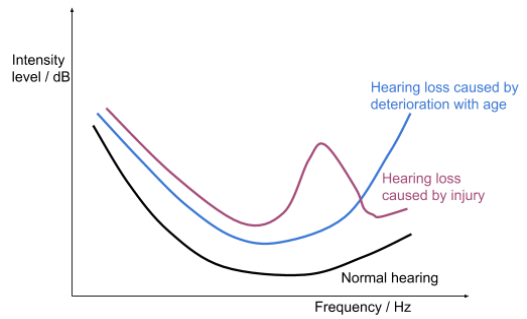
- Age-related hearing loss: Equal loudness curves for those affected will generally be elevated (indicating reduced sensitivity) across all frequencies, with the largest effects seen at higher frequencies. This curve will resemble the shape of a normal hearing curve but shifted higher on the dB axis.
- Injury-induced hearing loss: Here, the curve will have a distinctive peak at specific frequencies where the damage is most severe. This peak represents the frequencies most impacted by the injury.
The diagram illustrates these points by comparing:
- Normal hearing: Shown as the baseline, with a smooth, low curve across all frequencies.
- Age-related loss: A steady increase in threshold level across frequencies, especially noticeable at higher frequencies.
- Injury-related loss: A pronounced peak at the frequencies that were most damaged.