Absorption of X-rays (AQA A-Level Physics): Revision Notes
📚Revision Notes
10.5.3 Absorption of X-rays
Absorption and Attenuation of X-rays
As X-rays pass through a substance, they interact with the material, causing a reduction in the intensity of the beam. This process is called attenuation, which involves the X-rays being absorbed and scattered as they travel through the material.
Factors affecting attenuation:
- Thickness of the material.
- Density of the material.
- Proton number of the material's atoms.
- Energy of the X-ray photons. These factors determine how much of the X-ray beam is absorbed or scattered as it moves through the material.
Exponential Decay of X-ray Intensity
The intensity of a narrow, monoenergetic beam of X-rays decreases exponentially with thickness due to attenuation. The intensity after passing through a material can be calculated using the following formula:
Where:
- = initial intensity of the X-ray beam,
- = thickness of the material,
- = linear attenuation coefficient of the material. A graph of intensity versus thickness shows a rapid decrease in intensity as the thickness of the material increases, especially if the material has a high attenuation coefficient.
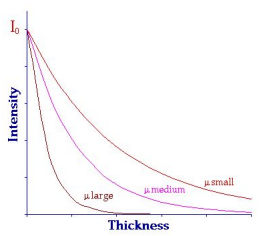
Attenuation Coefficients
- Linear Attenuation Coefficient : Measures how easily X-rays pass through a material of a given thickness. It reflects the rate of energy loss per unit thickness and depends on the density of the material.
- Mass Attenuation Coefficient : Describes the rate of energy loss per unit mass and is calculated as follows:
where is the material's density. This coefficient depends only on the material's composition, not on its density.
Note
For example, the mass attenuation coefficient of water remains the same whether it's in liquid, solid, or gas form, although the linear attenuation coefficient would change.
Half-Value Thickness
The half-value thickness is the thickness at which the X-ray intensity is reduced to half of its initial value. It can be calculated with the formula:
This concept helps in understanding how much material is required to significantly reduce X-ray intensity.
Density-Dependent Attenuation and Imaging Applications
The dependence of attenuation on material density is critical in X-ray imaging, especially for tissues or materials with similar proton numbers. The degree of attenuation allows materials to be differentiated based on their density, making it possible to distinguish between different types of tissue.
Note
For example, denser tissues (like bone) will attenuate X-rays more than less dense tissues (like muscle or fat), creating contrast in the X-ray image, which allows for diagnostic analysis.