Theories of Corporate Strategy (Edexcel A-Level Business): Revision Notes
📚Revision Notes
Theories of Corporate Strategy
Business strategy
Businesses set aims and objectives that guide their activities. Achieving these objectives requires careful planning. Corporate strategy is the long-term plan designed to achieve a business's overall aims. This strategy provides a framework for gaining competitive advantage and meeting stakeholder expectations.
Strategic planning involves senior management analysing the business's current position and determining future direction. The process typically begins with analytical tools such as SWOT analysis and Porter's Five Forces Analysis. From this analysis, businesses develop strategies using frameworks including Ansoff's Matrix, Porter's Strategic Matrix, and portfolio analysis tools.
Development of corporate strategy
Ansoff's Matrix
Ansoff's Matrix is a strategic planning tool developed by Igor Ansoff to help businesses plan for growth. The matrix considers two key dimensions: products (existing or new) and markets (existing or new). This creates four possible growth strategies, each carrying different levels of risk.
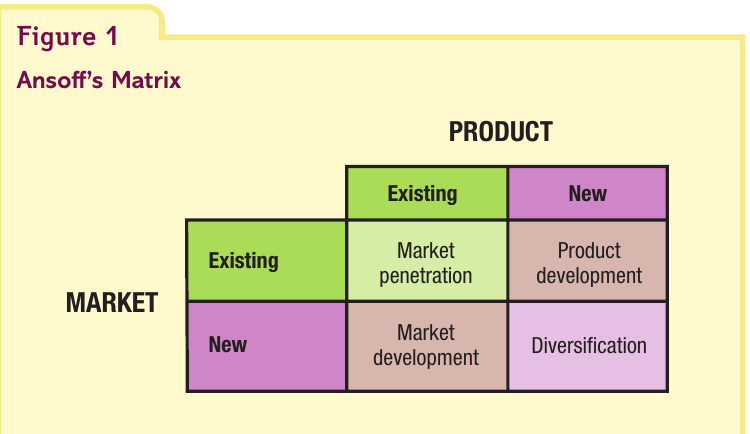
The matrix helps businesses consider:
- Investment levels required for existing and new products
- Opportunities in different markets
- Overall growth strategy
- Risk tolerance levels
Important
Risk increases the further a business moves from its core activities (existing products in existing markets). Diversification carries the highest risk, while market penetration carries the lowest.
Market penetration
Market penetration focuses on growing sales of existing products within existing markets. This is the lowest-risk strategy because the business already understands both the product and the market.
Businesses can achieve market penetration through:
- Building customer loyalty to reduce switching to competitors (e.g. Costa Coffee's reward card scheme)
- Encouraging more frequent product use (e.g. promoting breakfast cereal as an evening snack)
- Increasing consumption per use (e.g. offering larger packet sizes)
Note
This strategy requires relatively low investment and works well when a business has a successful product with room for increased market share. It's often the first strategy businesses should consider before moving to higher-risk options.
Product development
Product development involves introducing new or modified products to existing markets. This strategy suits markets where product life cycles are short or where trends and technology change rapidly.
Example
Real-World Examples of Product Development
The confectionery industry demonstrates this strategy well. Cadbury's Dairy Milk, established over 100 years ago, continuously launches new variants such as Marvellous Creations with Oreos.
Apple has built its reputation on continuous product development through the iPhone, iPad and Apple Watch, regularly introducing new models with enhanced features.
Product development requires:
- Significant investment in research and development
- Heavy promotional spending for new launches
- Acceptance of high risk (many new products fail)
Market development
Market development means selling existing products in new markets. The most common approach involves entering new geographical regions, though this presents challenges as customer preferences vary by location.
Success requires understanding local habits, tastes and needs. Even successful businesses can struggle with market development—Tesco's UK success did not translate to France in the 1990s. Enterprise Rent-A-Car successfully used market development by opening airport branches, accessing an entirely different customer segment and achieving significant growth.
Businesses often need to make minor product modifications for new markets, such as:
- Adapting product names for different languages
- Adjusting packaging to meet local regulations
- Modifying features to suit local preferences
Note
While this strategy maintains the familiarity of existing products, it requires careful market research to understand new customer segments. Cultural differences can significantly impact product acceptance.
Diversification
Diversification involves developing new products for new markets. This is the highest-risk strategy because the business operates outside its area of expertise.
Benefits of diversification include:
- Spreading risk across multiple markets
- Reducing reliance on single products or markets
- Potential for higher returns
However, businesses face challenges competing against established operators in unfamiliar markets. Mercedes Benz entering the small car market and Virgin diversifying into financial services and air travel demonstrate this strategy.
Important
Diversification typically suits large corporations with:
- Extensive business networks
- Significant capital resources
- Strong corporate brands
- Ability to overcome barriers to entry
Small businesses attempting diversification without these resources often struggle to compete effectively.
Porter's Strategic Matrix
Porter's Strategic Matrix identifies three generic strategies that businesses can adopt to achieve competitive advantage. Michael Porter, a Harvard Business School professor, argued that businesses failing to adopt one of these strategies become "stuck in the middle" and struggle to succeed.
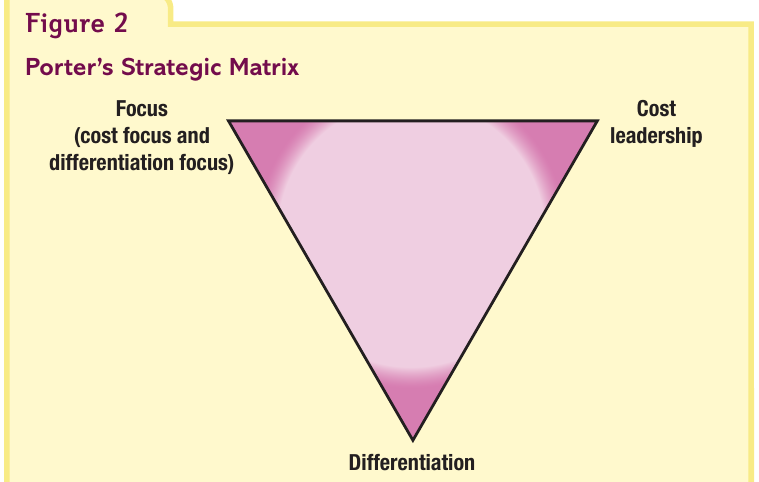
Important
Avoiding the "Stuck in the Middle" Position
Businesses that fail to clearly pursue cost leadership, differentiation, or focus often find themselves unable to compete effectively. They lack both the cost advantages of cost leaders and the unique features of differentiated businesses, resulting in poor performance.
Cost leadership
Cost leadership means operating as the lowest-cost provider in the market. This does not necessarily mean charging the lowest prices. Cost leaders can compete by:
- Increasing profits while charging market-level prices
- Increasing market share by charging lower prices (while still making profit due to lower costs)
Typically, only one business in each market achieves cost leadership. This requires:
- Significant market share to leverage economies of scale
- Focus on cost reduction through supplier negotiation
- Operational efficiency and streamlined processes
- "No-frills" products to minimize costs
- Limited service and product variation
- Mass production scale
Note
Cost leadership is difficult to achieve and maintain because it requires continuous focus on efficiency and cost control. However, once established, it provides a strong defensive position as competitors struggle to match the low-cost structure.
Differentiation
Differentiation involves creating a unique market position rather than competing on cost. Unlike cost leadership, any business can adopt differentiation if it can defend its unique features.
Businesses differentiate through:
- Superior quality
- Distinctive design
- Strong brand identity
- Excellent customer service
The advantages of differentiation include:
- Ability to charge premium prices
- Customer loyalty based on unique features
- Protection from price competition
However, differentiation requires:
- Strong research and development
- Effective marketing to communicate uniqueness
- Defensible features (e.g. patents, trademarks)
Important
Differentiation is easier for competitors to copy than cost leadership unless legally protected or inherently difficult to replicate. Businesses must continuously innovate to maintain their differentiated position.
Focus strategy
Focus strategies target a narrow market segment. This approach aligns with niche marketing and is typically used by small or specialist firms.
Benefits of focus strategies include:
- Deep understanding of specific customer needs
- High customer satisfaction and loyalty
- Less competition
- Higher profit margins
Limitations include:
- Small market size
- Low bargaining power with suppliers
- Vulnerability to market changes
Focus strategies take two forms:
Cost focus emphasizes cost minimization within a niche market. Aldi demonstrates this by offering a limited product range at very low prices without being the overall market cost leader.
Differentiation focus pursues unique strategies within a focused market. Ferrari exemplifies this by targeting high-performance cars at a small, wealthy segment of the population.
Example
Comparing Focus Strategies
Cost Focus: Aldi targets budget-conscious shoppers with a limited range of products at minimal prices. They achieve low costs through operational efficiency within their specific market segment.
Differentiation Focus: Ferrari creates unique, high-performance luxury vehicles for wealthy enthusiasts. They maintain exclusivity through limited production and premium pricing within their niche market.
Both strategies succeed by deeply understanding and serving their specific customer segments rather than competing broadly.
Achieving competitive advantage through distinctive capabilities
Competitive advantage consists of unique features of a company and its products that customers perceive as significant and superior to competitors. These features allow businesses to outperform rivals.
Businesses can develop competitive advantage through:
- Superior quality or design
- Creative advertising
- Excellent after-sales service
- Economies of scale enabling lower prices
- Flexible delivery times or product attributes
- Strong reputation or ethical stance
Distinctive capabilities represent a special form of competitive advantage that competitors find difficult to understand or imitate. Because they cannot be easily reproduced, distinctive capabilities provide sustainable competitive advantage.
John Kay's book The Foundations of Corporate Success (1995) identified three types of distinctive capability:
Architecture
Architecture refers to contracts and relationships within and around an organization. This includes:
- Relationships between the business and its employees
- Collaborative relationships with partners, suppliers and customers
Some firms excel at building and managing relationships. Effective architecture adds value through:
- Improved efficiency
- Easy knowledge and information transfer
- Better coordination and cooperation
Note
The value of architecture is often intangible and closely linked to organizational culture. Strong architecture takes time to develop and becomes difficult for competitors to replicate. This makes it a particularly valuable source of sustainable competitive advantage.
Reputation
Reputation connects closely to brand image and requires time to build. It encompasses positive associations with:
- Quality
- Reliability
- Service
- Prestige
- Honesty
Important
Reputation cannot be built quickly. Negative publicity or brand deterioration can cause lasting damage. A strong reputation becomes a valuable asset that competitors cannot easily copy or acquire. Businesses must carefully protect their reputation through consistent quality and ethical behavior.
Innovation
Innovation creates sustainable competitive advantage when businesses develop new products or processes. Successful innovation requires:
- Substantial investment in research and development
- Some element of luck
- Protection through patents or trade secrets
Innovation can provide distinctive capability and sometimes creates entirely new markets or industries. The challenge lies in maintaining innovation advantages as competitors attempt to copy successful ideas.
Note
While innovation offers significant competitive advantages, it requires continuous investment and carries inherent risks. Many innovative ideas fail to achieve commercial success, making innovation a high-risk, high-reward strategy.
Aim of portfolio analysis
Portfolio analysis categorizes all products and services a firm offers to determine their role in strategic plans. Products are evaluated according to competitive position and potential growth rates.
The process involves two steps:
Step 1: Create a comprehensive overview of all products and services in the current business portfolio.
Step 2: Analyze performance by examining:
- Current and projected sales
- Current and projected costs
- Competitor activity and future competition
- Performance risks
The Boston Matrix
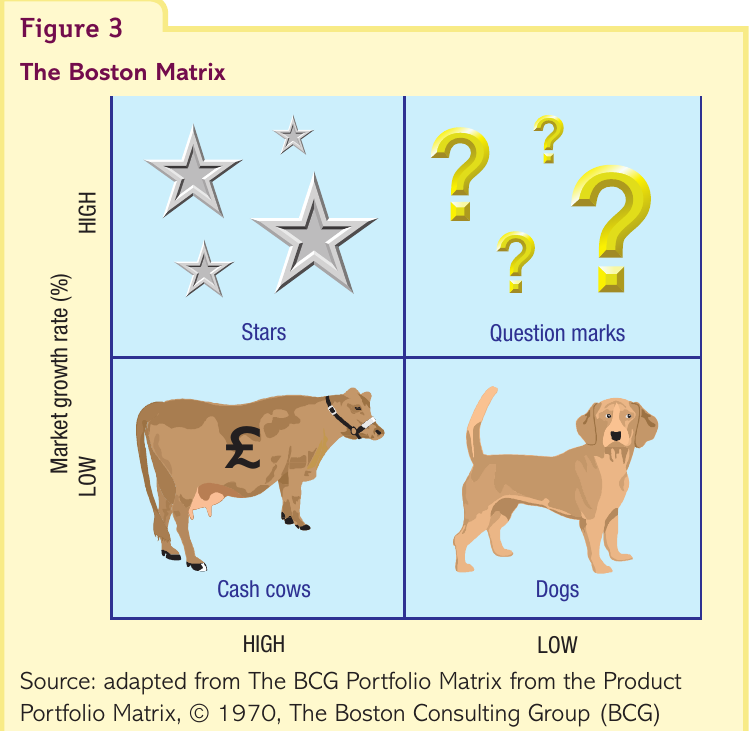
The Boston Consulting Group developed the Boston Matrix (also called the BCG Matrix or Growth-Share Matrix) as an advanced portfolio analysis tool. Businesses gather market-share and growth-rate data on products, then categorize them into four areas:
Stars
Stars are high-growth products with strong competitive positions. They require investment but have potential to become cash cows. Stars need resources to maintain market position while growth continues.
Note
Stars represent the future of the business. While they consume resources during the growth phase, they should eventually transition to cash cows as the market matures and growth slows.
Cash cows
Cash cows are low-growth products with high market shares. They generate more cash than they consume, providing:
- Returns for investors
- Funding for investment in other areas
Cash cows are often mature products in stable markets. Businesses should maintain these products to fund growth elsewhere.
Note
Cash cows are the financial backbone of the business. They provide the resources needed to invest in stars and question marks. Protecting and maintaining cash cows is crucial for overall portfolio health.
Question marks
Question marks (also called problem children) have low market shares in high-growth markets. They:
- Consume significant cash
- Generate little return
- Have potential to become stars
Important
Keeping question marks requires belief in their growth potential. Businesses must decide whether to invest in developing them or divest. This decision is critical as continued investment in failing question marks can drain resources needed elsewhere.
Dogs
Dogs have low market share in low-growth markets. They:
- May break even but generate little profit
- Consume time and effort
- Offer limited growth prospects
Dogs should typically be sold or discontinued unless they serve a strategic purpose (e.g. completing a product range).
Using the Boston Matrix for strategy
The Boston Matrix helps businesses determine appropriate strategies. For example:
- Stars may benefit from market penetration strategies to maximize market share
- Question marks might be moved from low-growth to high-growth markets (market development)
- Dogs should be identified for discontinuation to support cost leadership strategies
- Cash cows should be maintained to fund other strategic initiatives
Example
Strategic Application of the Boston Matrix
A technology company might use the Boston Matrix as follows:
Stars: Their latest smartphone model with strong sales in a growing market receives continued investment in marketing and production capacity.
Cash Cows: Their established laptop range, while not growing rapidly, generates steady profits that fund new product development.
Question Marks: A new tablet product with low market share but potential for growth requires a decision: invest heavily or discontinue.
Dogs: An outdated desktop computer line is discontinued to free up resources for more promising products.
This analysis helps the company allocate resources effectively and make informed strategic decisions.
The matrix provides a visual overview of the product portfolio, helping businesses allocate resources effectively and make informed strategic decisions.
Summary
Key Points to Remember:
-
Corporate strategy is the long-term plan to achieve business aims and requires analytical tools like SWOT and Five Forces Analysis.
-
Ansoff's Matrix identifies four growth strategies with increasing risk: market penetration (lowest risk), product development, market development, and diversification (highest risk).
-
Porter's Strategic Matrix presents three generic strategies: cost leadership (being the lowest-cost provider), differentiation (creating unique market position), and focus (targeting narrow market segments).
-
Distinctive capabilities (architecture, reputation, innovation) provide sustainable competitive advantage because competitors cannot easily imitate them.
-
The Boston Matrix categorizes products as stars, cash cows, question marks, or dogs to guide resource allocation and strategic decisions.