Aristotles' understanding of reality (Edexcel A-Level Religious Studies): Revision Notes
📚Revision Notes
Aristotle's understanding of reality.
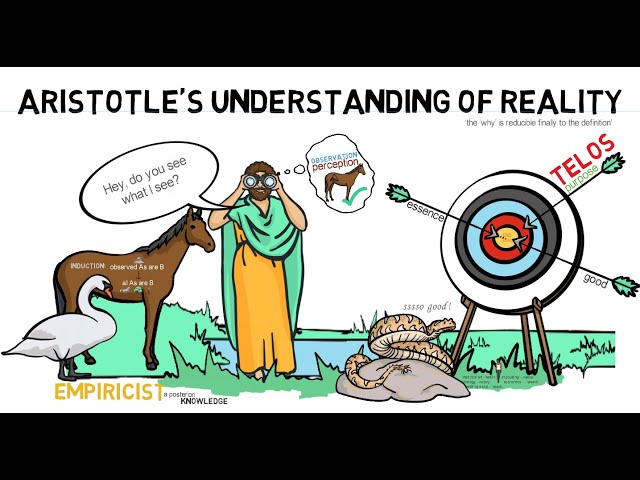
Contrary to Plato, Aristotle believes that even though the world we experience is in a state of flux, we can still gain knowledge about it if we analyse and understand the causal process that explains the change that occurs.
Note
If an empirical theory like Aristotle's theory of the four causes is successful, then Plato's theory is wrong because Plato thought we could not gain knowledge from experience.
Key terms
- Actuality: something in its current state
- Potentiality: the way things could become If certain conditions are met, things can evolve from their actuality to potentiality.
To go from cause to effect, something has to go through the 4 causes which allows it to achieve its telos (the final end.)
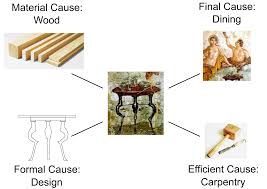
The four causes
The Material cause: what something is made of (eg a chair is made of wood)
The formal cause: The essence or defining character of something (EG the shape of a chair)
The efficient cause: what brings it into existence (whoever made the chair)
Final cause: The end goal of something, the telos. (a chair is to be sat on)
All change in the universe can be explained by these causes, allowing a posteriori knowledge to make sense of the flux.
For Aristotle, the final cause is God.
Advantages of Aristotle's four causes
- The Four Causes are derived from Aristotle's reflections on his studies of the natural world, some may agree that they are reliable, including many scientists.
- They can be applied to things which already exist, the material cause can be rested and confirmed e.g. a chair can be proved to be made from wood. The formal cause can also be tested as the structure of something is easy to be seen.
- The theory doesn't overrule any theories such as God or the Big Bang, so it doesn't have much opposition.
Disadvantages of Aristotle's four causes
- The four causes highly rely on experience. Plato argued that experience was unreliable as it changes from person to person - we cannot be sure that chairs, for example, look the same to everybody.
- Aristotle doesn't have concrete evidence that the material world is the source of knowledge - many turn to religion and faith as a source of truth.
- If things happen by chance or luck, they don't fit into any of the four categories.
- Emotions have no material or formal cause, their efficient and final causes can be questioned.
- Existentialists have no purpose or meaning other than what we prescribe.
- Things may have a particular purpose but people may use it for a different purpose e.g. a cricket bat's purpose is to hit a ball, but people may use it for other reasons i.e. to hit someone
Aristotle's understanding of the soul
- The "essence" of the human is the soul.
- The soul is therefore the formal cause of the body.
- Neuroscience is wound claim rationality reduces to material brain structure and its physiological process.
- This can be explained by science
- However, can science explain consciousness?
The Prime Mover
Aristotle assumes that since humans have a purpose, the universe must also have a purpose.
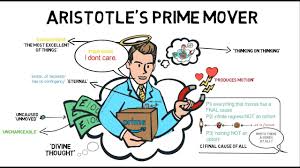
The motion requires explanation→ there cannot be an infinite chain of motion→ there must be an uncaused causer, causing this change in the universe.
The Prime Mover is responsible for the everlasting motion and change of the universe.
The Prime Mover is not a traditional God but a completely transcendent God who creates movement and change.
The Prime Mover must be unmoved and cannot change, it is pure actuality and the final cause of the universe.
The Prime Mover cannot be material since material things are subject to change.
Everything in the universe is attracted to the Prime Mover, it sustains the pattern of change from actuality to potentiality (Think of a kitten being attracted to a bowl of milk.)
The Prime Mover should not be seen as a creator but as something that creates movement by "pulling" on things.
Criticisms of Aristotle's understanding of reality.
Purpose is unscientific
Aristotle argues that the final cause is the purpose of something yet the purpose is unscientific.
Francis Bacon (father of empiricism) argues that the final cause has no place in empirical science as purpose is a divine matter. A deterministic universe operates by the laws of physics and therefore does not need purpose.
Science can explain change within the world
Modern science can explain the change and apparent purpose in the world without telos
McGrath would argue against this as science is limited, it can tell us the what but not the why. It cannot answer questions about purpose.
Dawkins would respond to McGrath by arguing that just because we can ask about the purpose and "why" does not make it valid.
Questions about purpose assume life has purpose over a scientific explanation.
Satre: There is no objective telos or purpose as "existence precedes essence." Humans exist and then decide their purpose.
People have created the concept of purpose as people are scared of the freedom to decide their own purpose and destiny.
Arguably just because people have a psychological need for purpose, doesn't mean it doesn't exist (Genetic fallacy.)
Yet the criticism of satre is unsuccessful as nothing suggests we have telos- we have complete freedom.
Fallacy of Composition
Just because something is true of a part, it does not mean it is true of the whole.
Just because an organ for example has a purpose, it is a leap in logic to assume that the universe as a whole has a purpose.