Coordination of the Nervous and Endocrine Systems (OCR A-Level Biology A): Revision Notes
📚Revision Notes
Coordination of the Nervous and Endocrine Systems
Introduction
The nervous and endocrine systems do not function independently but work together to coordinate body responses. This integration is particularly evident in stress responses and in the regulation of vital physiological parameters such as heart rate. The nervous system provides rapid, short-term responses through electrical impulses, while the endocrine system delivers slower but longer-lasting effects through hormones circulating in the blood.
Note
Understanding the Difference:
The key distinction between these two coordination systems lies in their speed and duration:
- Nervous system: Uses electrical impulses travelling along neurones for almost instantaneous responses that are typically brief
- Endocrine system: Uses chemical messengers (hormones) transported in the bloodstream for slower responses that persist for longer periods
The fight-or-flight response
Overview and mechanism
The fight-or-flight response demonstrates how the nervous and endocrine systems collaborate to produce a coordinated stress reaction. This response activates when an organism encounters threatening stimuli or experiences fear and aggression. The response prepares the body to either confront the danger or escape from it.
The process begins when sense organs detect threatening environmental stimuli and transmit electrical impulses via sensory neurones to the brain. The amygdala, a region in the cerebrum involved in emotional processing, receives and evaluates these danger signals. The amygdala then communicates with various brain regions, including the hypothalamus, which serves as the central coordination centre.
Important
Two Parallel Pathways for Stress Response:
The hypothalamus activates two simultaneous but distinct pathways to maximize survival chances:
- Fast pathway (Sympathetic Nervous System): Provides immediate response within seconds
- Slow pathway (HPA Axis): Sustains the response over minutes to hours
This dual activation ensures both rapid reaction to immediate danger and sustained physiological support for prolonged threats.
The hypothalamus activates two parallel pathways:
Sympathetic nervous system pathway (rapid response):
- The hypothalamus sends impulses through sympathetic neurones directly to the adrenal medulla (the inner region of the adrenal glands)
- The adrenal medulla releases adrenaline into the bloodstream
- This pathway produces immediate physiological changes
HPA axis pathway (slower hormonal response):
- The hypothalamus releases a peptide hormone that stimulates the anterior pituitary gland
- The pituitary gland secretes ACTH (adrenocorticotropic hormone)
- ACTH travels through the blood to the adrenal cortex (outer region of the adrenal glands)
- The adrenal cortex releases cortisol
Both adrenaline and cortisol circulate through the bloodstream, reaching target organs and tissues throughout the body to coordinate the stress response.
Survival value
The fight-or-flight response has evolved because it confers significant survival advantages. When prey animals detect predators, this response enables them to become temporarily stronger, faster and more reactive, substantially improving their chances of escape. In males of many species, the response enhances aggression during territorial disputes or competition for mates, increasing both immediate survival prospects and reproductive success.
The action of adrenaline
Cell signalling mechanism
Cell signalling describes the release of a substance by one cell that transmits information to another cell, either locally or across distances. Adrenaline exemplifies this process as it circulates throughout the body in the blood but only affects cells possessing specific adrenaline receptors in their membranes. This selectivity ensures targeted responses despite widespread hormone distribution.
Physiological effects
Adrenaline acts rapidly, producing multiple coordinated effects across different body systems:
Note
Effects Organized by Body System:
Understanding adrenaline's effects is easier when grouped by the physiological systems they affect. Each system's response contributes to preparing the body for either fighting or fleeing from danger.
Cardiovascular effects:
- Increases heart rate and stroke volume (the volume of blood pumped per heartbeat), delivering more oxygen and nutrients to active tissues
- Raises blood pressure through vasoconstriction, which increases resistance to blood flow
- Stimulates vasodilation in blood vessels supplying muscles and the brain, enhancing oxygen and glucose delivery to these critical organs
- Causes vasoconstriction in blood vessels serving the gut and skin, redirecting blood away from non-essential systems
Respiratory effects:
- Increases bronchiole diameter by relaxing smooth muscle in airway walls
- This bronchodilation allows greater airflow to the alveoli, improving oxygen uptake
Metabolic effects:
- Elevates blood glucose concentration by stimulating enzymes in liver cells to convert glycogen stores into glucose (glycogenolysis)
- Provides readily available energy for muscles and brain
Sensory effects:
- Stimulates muscle contraction in the iris of each eye, causing pupil dilation
- Dilated pupils improve visual awareness in threatening situations
Breakdown rate
Important
Temporary Response:
Adrenaline degrades very rapidly in the body. The concentration decreases by half within to seconds. This short half-life ensures that the stress response is temporary and does not continue unnecessarily once the threat has passed.
This rapid breakdown is crucial because prolonged elevation of adrenaline would be metabolically expensive and could cause tissue damage.
Nerves and hormones in the control of heart rate
Myogenic nature of the heart
The heart muscle is myogenic, meaning it generates its own contractions without requiring external nervous stimulation. The sinoatrial node (pacemaker) initiates each heartbeat through spontaneous depolarisation. However, while the heart beats independently, the rate of contraction is regulated externally by both nervous and hormonal signals.
Factors affecting heart rate
Multiple nervous and hormonal factors modify the basic heart rate.
Nervous control:
- Sympathetic nerves increase heart rate by releasing noradrenaline at the sinoatrial node, which accelerates the rate of depolarisation
- The parasympathetic nerve (vagus nerve) decreases heart rate by releasing acetylcholine, which slows the rate of depolarisation
- These two divisions of the autonomic nervous system provide antagonistic control, allowing rapid adjustments in either direction
Hormonal control:
- Adrenaline increases heart rate when released from the adrenal medulla during stress responses
- Noradrenaline, also produced by the adrenal glands, similarly increases heart rate
- Thyroxine, secreted by the thyroid gland, increases heart rate and plays a role in setting the baseline metabolic rate
Important
Antagonistic Control Mechanism:
The nervous control of heart rate demonstrates a key principle in physiology: antagonistic control. The sympathetic and parasympathetic systems have opposing effects:
- Sympathetic activation → increases heart rate
- Parasympathetic activation → decreases heart rate
This dual control allows for precise, bidirectional regulation, enabling the heart to respond rapidly to changing physiological demands in either direction.
The integration of nervous and hormonal control allows both immediate adjustments (through nerve impulses) and sustained modifications (through circulating hormones) to match heart rate with the body's current demands.
Practical application: investigating heart rate and exercise
Research into cardiovascular responses to exercise demonstrates the practical importance of understanding heart rate regulation. Studies comparing healthy weight and overweight children reveal significant differences in both resting heart rate and recovery following exercise.
Example
Study Design: Investigating Cardiovascular Fitness in Children
Objective: Compare heart rate responses in healthy weight versus overweight children
Participants:
- healthy weight children (age years)
- overweight children (age years)
- Classification based on BMI adjusted for age and gender
Methodology:
- Measure resting heart rate for minutes
- Exercise on bicycle ergometer at fixed tension for minutes
- Record heart rate continuously using wireless data loggers
- Measure recovery time (duration to return to resting heart rate)
Equipment: Heart rate data loggers with wireless transmission to computers for accurate, continuous measurement
Data interpretation
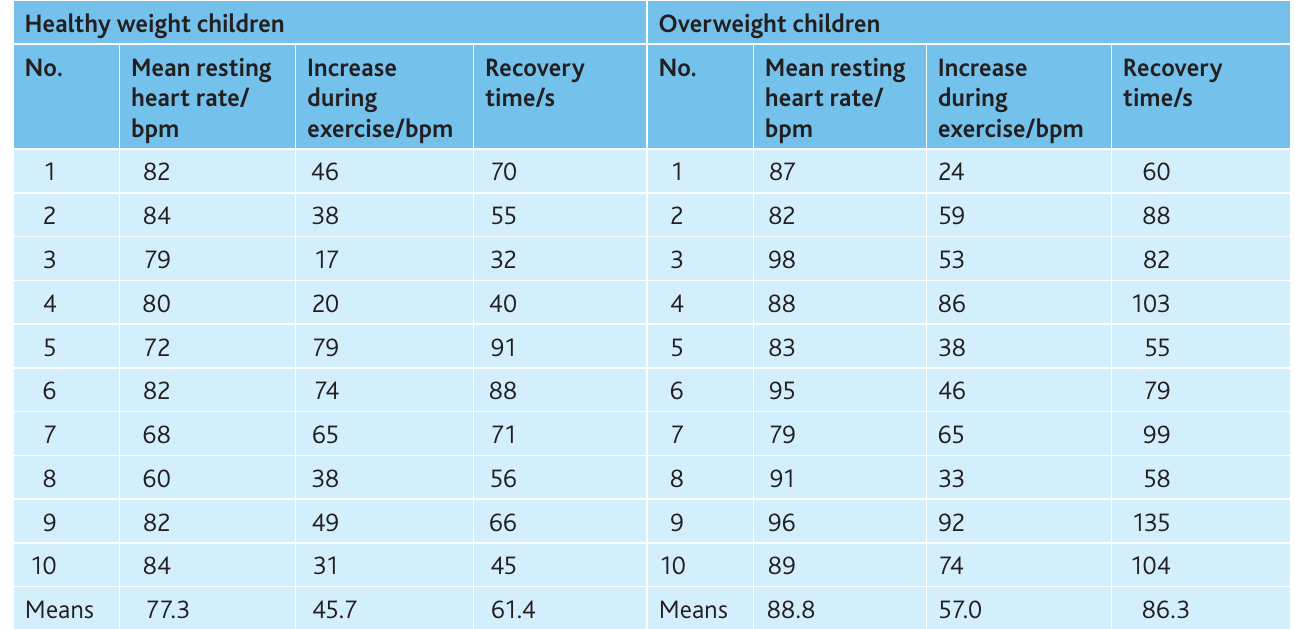
The data typically show that overweight children have:
- Higher mean resting heart rate ( bpm vs bpm)
- Greater heart rate increase during exercise ( bpm vs bpm)
- Longer recovery time ( seconds vs seconds)
These differences suggest reduced cardiovascular efficiency in overweight children, as their hearts work harder both at rest and during exercise, and require more time to return to baseline.
Statistical analysis
Statistical tests such as the Student's t-test allow researchers to determine whether observed differences between groups are statistically significant or could have occurred by chance. The test compares the means of two groups while accounting for variation within each group.
For the recovery time data, the null hypothesis states that no real difference exists between healthy weight and overweight groups. Calculating the t-value involves determining the variance within each group and comparing it to the difference between group means. If the calculated t-value exceeds the critical value for the chosen significance level (typically ), the null hypothesis is rejected, indicating a significant difference.
Note
Interpreting Statistical Significance:
In this investigation, the calculated t-value () exceeded the critical value at degrees of freedom. This means:
- The probability that the observed difference occurred by chance is less than ()
- We can reject the null hypothesis with confidence
- There is a statistically significant difference in recovery times between the two groups
This provides scientific evidence that overweight children have genuinely longer recovery times, not just a result of random variation.
In this investigation, the calculated t-value () exceeded the critical value at degrees of freedom, confirming that overweight children do have significantly longer recovery times than healthy weight children at the confidence level.
Summary
Key Points to Remember:
-
The nervous and endocrine systems work together in coordinating body responses, combining rapid neural signals with sustained hormonal effects
-
The fight-or-flight response involves both sympathetic nervous system activation (releasing adrenaline from adrenal medulla) and the HPA axis (releasing cortisol from adrenal cortex) to prepare the body for danger
-
Adrenaline produces widespread effects including:
- Increased heart rate and stroke volume
- Bronchodilation for improved breathing
- Elevated blood glucose through glycogenolysis
- Redistribution of blood flow to muscles and brain
- Pupil dilation for enhanced vision
- These effects occur through cell signalling to specific receptors
-
Heart rate is controlled by antagonistic mechanisms:
- Increase: Sympathetic nerves and hormones (adrenaline, noradrenaline, thyroxine)
- Decrease: Parasympathetic vagus nerve
-
Although the heart is myogenic and initiates its own contractions, external nervous and hormonal signals regulate the rate to match physiological demands
-
Adrenaline's effects are temporary due to its rapid breakdown (half-life of - seconds)