The Human Nervous System (OCR A-Level Biology A): Revision Notes
📚Revision Notes
The Human Nervous System
Organization of the nervous system
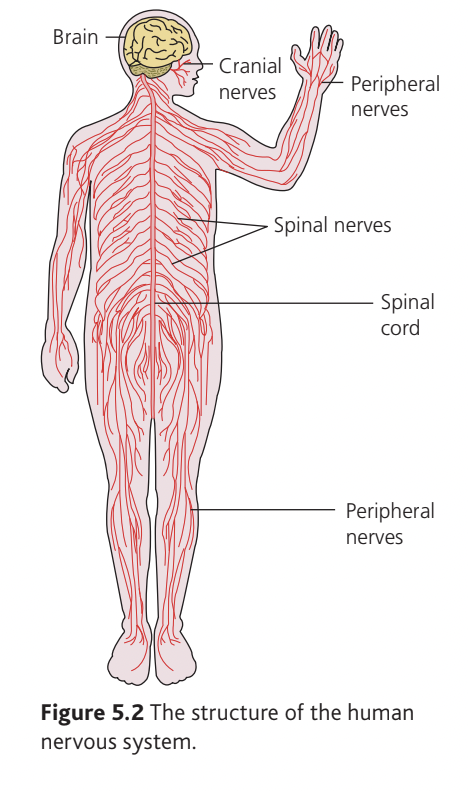
The human nervous system, like that of all mammals, follows a consistent organizational pattern. It divides into two main anatomical components:
The central nervous system (CNS) comprises the brain and spinal cord. These structures serve as the body's primary processing and integration centres.
The peripheral nervous system (PNS) consists of all nerves that extend from the CNS to the rest of the body. These nerves form the communication pathways between the CNS and peripheral tissues.
The nervous system can also be classified functionally into two divisions:
The somatic nervous system manages voluntary body movements and responses that are under conscious control.
The autonomic nervous system regulates involuntary functions that occur without conscious awareness.
Note
The distinction between somatic and autonomic systems is functional rather than structural. The neurones in both systems have identical structures and often run alongside one another throughout the body, rather than occupying separate anatomical regions.
The somatic nervous system
The somatic nervous system coordinates voluntary movements and comprises three distinct types of nerve:
Sensory nerves contain only sensory neurones. These nerves transmit impulses from sense organs toward the CNS, carrying information about both external and internal environments.
Motor nerves contain exclusively motor neurones. They convey signals from the CNS to effectors, including skeletal muscles and glands.
Mixed nerves, such as the spinal nerves emerging from the spinal cord, contain both sensory and motor neurones. This arrangement allows bidirectional communication between the CNS and the body.
Important
Mixed nerves are particularly important because they enable simultaneous two-way communication—sensory information can travel to the CNS whilst motor commands return to effectors through the same nerve bundle.
The autonomic nervous system
The autonomic nervous system divides into two complementary branches that regulate involuntary physiological processes:
The sympathetic nervous system prepares the body for action during stressful situations. It mediates the 'fight-or-flight' response, increasing heart rate, dilating airways, and redirecting blood flow to skeletal muscles.
The parasympathetic nervous system promotes the 'rest-and-digest' state. It conserves energy by slowing heart rate, stimulating digestive processes, and supporting recovery and repair functions.
Note
Together, these systems maintain homeostasis by adjusting involuntary functions including heart rate, blood vessel diameter, and peristalsis in the digestive tract. They work antagonistically—when one system is dominant, the other is inhibited.
The brain
The human brain represents an extraordinarily complex organ in both structure and function. Different regions specialize in specific tasks, allowing coordinated control of body systems and sophisticated behavioral responses.
The cerebrum
The cerebrum forms the largest component of the human brain, accounting for approximately of its total mass. This region handles conscious activities including vision, hearing, speech, thinking, and memory formation.
The cerebrum divides into two cerebral hemispheres, connected by a band of nerve fibres called the corpus callosum. Each hemisphere controls the opposite side of the body—the left hemisphere manages the right side, whilst the right hemisphere controls the left side.
Note
Why is the cerebral cortex folded?
The outer layer of the cerebrum is the cerebral cortex, commonly known as grey matter. This layer consists of neurone cell bodies and displays extensive folding. The folds significantly increase surface area, allowing more neurone cell bodies to pack into the limited skull volume. Greater numbers of neurones enable more complex neural connections, which in turn support more sophisticated behaviors and cognitive functions.
Beneath the cerebral cortex lies the white matter, composed of myelinated axons. The myelin sheaths give this tissue its characteristic pale appearance and facilitate rapid signal transmission between brain regions.
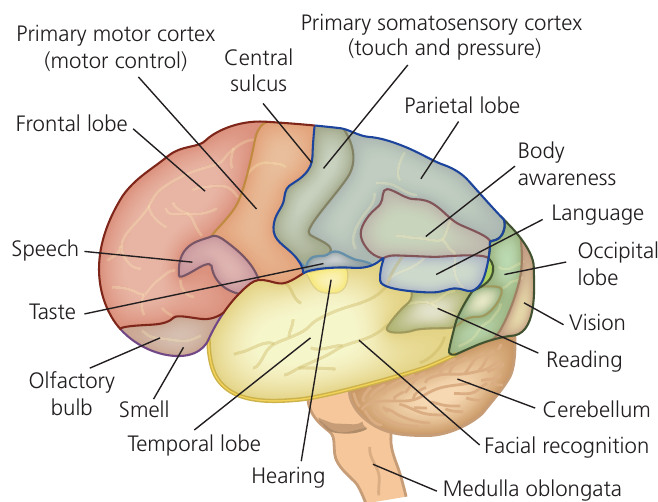
The cerebrum organizes into five lobes, each associated with specific functions. Different areas specialize in motor functions (such as movement control and speech production), sensory processing (including smell, taste, vision, and hearing), and association tasks (such as facial recognition, reading, and language comprehension).
The hypothalamus
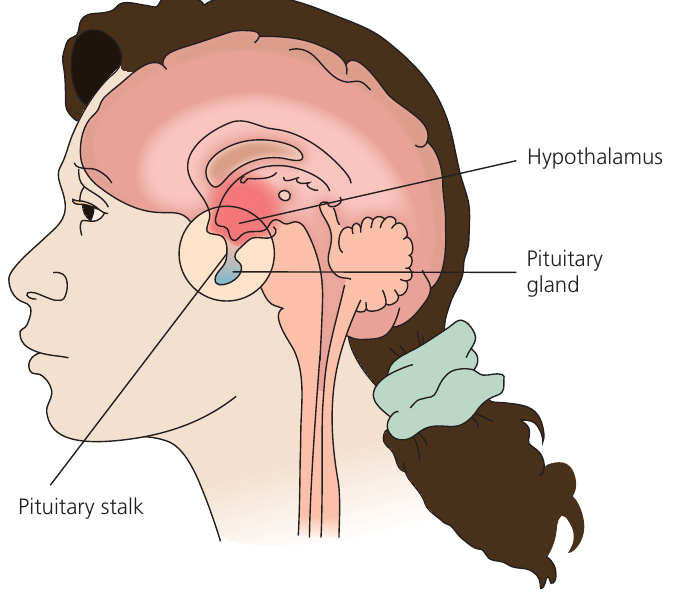
The hypothalamus occupies a central position on the lower surface of the brain, directly above and connected to the pituitary gland. This small but vital structure monitors blood composition as it flows through the region and coordinates numerous homeostatic responses.
Important
The Hypothalamus: Master Regulator of Homeostasis
Despite its small size, the hypothalamus is one of the most important regions in the brain. It continuously monitors blood composition and initiates responses to maintain optimal internal conditions. Think of it as the body's thermostat, water level sensor, and metabolic controller all in one.
The hypothalamus performs several essential regulatory functions:
Temperature regulation: The hypothalamus continuously monitors blood temperature. When temperature deviates from the optimal range, it initiates appropriate homeostatic responses to restore normal conditions.
Osmoregulation: By monitoring blood concentration, the hypothalamus detects changes in water balance. When blood becomes too concentrated and viscous, the hypothalamus triggers release of anti-diuretic hormone (ADH) from the posterior pituitary gland. ADH acts on the kidneys to increase water reabsorption. The hypothalamus also generates the sensation of thirst, promoting behavioral responses to restore water balance.
Digestive regulation: The hypothalamus controls gut secretions and peristaltic movements. It also generates hunger sensations when blood nutrient concentrations decrease.
Endocrine control: The hypothalamus produces releasing factors that stimulate hormone secretion from the pituitary gland, linking the nervous and endocrine systems.
The pituitary gland
The pituitary gland sits at the base of the brain, below the hypothalamus, attached by the pituitary stalk. Despite its small size, this gland produces numerous hormones that regulate body functions either directly or by stimulating other endocrine glands.
The pituitary gland comprises two functionally distinct regions:
The anterior pituitary synthesizes and secretes its own hormones in response to releasing factors from the hypothalamus.
The posterior pituitary does not produce hormones itself. Instead, it stores and releases ADH and oxytocin, which are manufactured in the hypothalamus and transported down the pituitary stalk.
Note
The pituitary gland is often called the "master gland" because it controls so many other endocrine glands. However, it is itself controlled by the hypothalamus, demonstrating the integration between nervous and endocrine systems.
The cerebellum
The cerebellum lies beneath the cerebrum, positioned at the back of the brain. This structure coordinates motor functions, with particular responsibility for balance and posture.
Maintaining balance requires sophisticated integration of sensory information from multiple sources. The cerebellum continuously processes signals from the eyes, the semicircular canals in the inner ears (which detect head position and movement), and proprioceptors in muscles and joints. It then coordinates appropriate muscular responses to maintain equilibrium.
Note
Due to the complexity and speed required for these adjustments, evolution has allocated an entire brain region to balance coordination. The cerebellum operates entirely at the subconscious level—all actions it controls are involuntary and occur without conscious awareness.
The medulla oblongata
The medulla oblongata (often shortened to medulla) occupies the base of the brain where it merges with the spinal cord. This region contains three specialized control centres that regulate vital involuntary functions:
The cardiac centre adjusts heart rate in response to the body's changing demands.
The vasomotor centre regulates blood pressure by controlling the contraction of smooth muscle in arteriole walls, thereby adjusting vessel diameter and blood flow distribution.
The respiratory centre governs breathing rate through separate inspiratory and expiratory centres within this region.
Important
Critical Control Centres
The medulla oblongata controls functions that are essential for survival. Damage to this region can be fatal because it would disrupt the regulation of heart rate, blood pressure, and breathing—all of which must be continuously maintained for life.
Summary
Key Points to Remember:
-
The nervous system divides anatomically into the CNS (brain and spinal cord) and PNS (all peripheral nerves), and functionally into somatic (voluntary) and autonomic (involuntary) systems.
-
The cerebrum, forming of brain mass, contains a folded cortex that increases surface area for more neurone cell bodies, enabling complex neural connections and sophisticated behaviors.
-
The hypothalamus monitors blood composition and coordinates homeostatic responses including temperature regulation, osmoregulation, digestive control, and endocrine function.
-
The medulla oblongata contains three control centres that regulate vital involuntary functions: cardiac (heart rate), vasomotor (blood pressure), and respiratory (breathing rate).